
Pulp Fiction, 1954 · page 12 of 162
Authentic Science Fiction Monthly No. 44 — page 12: what you’re looking at
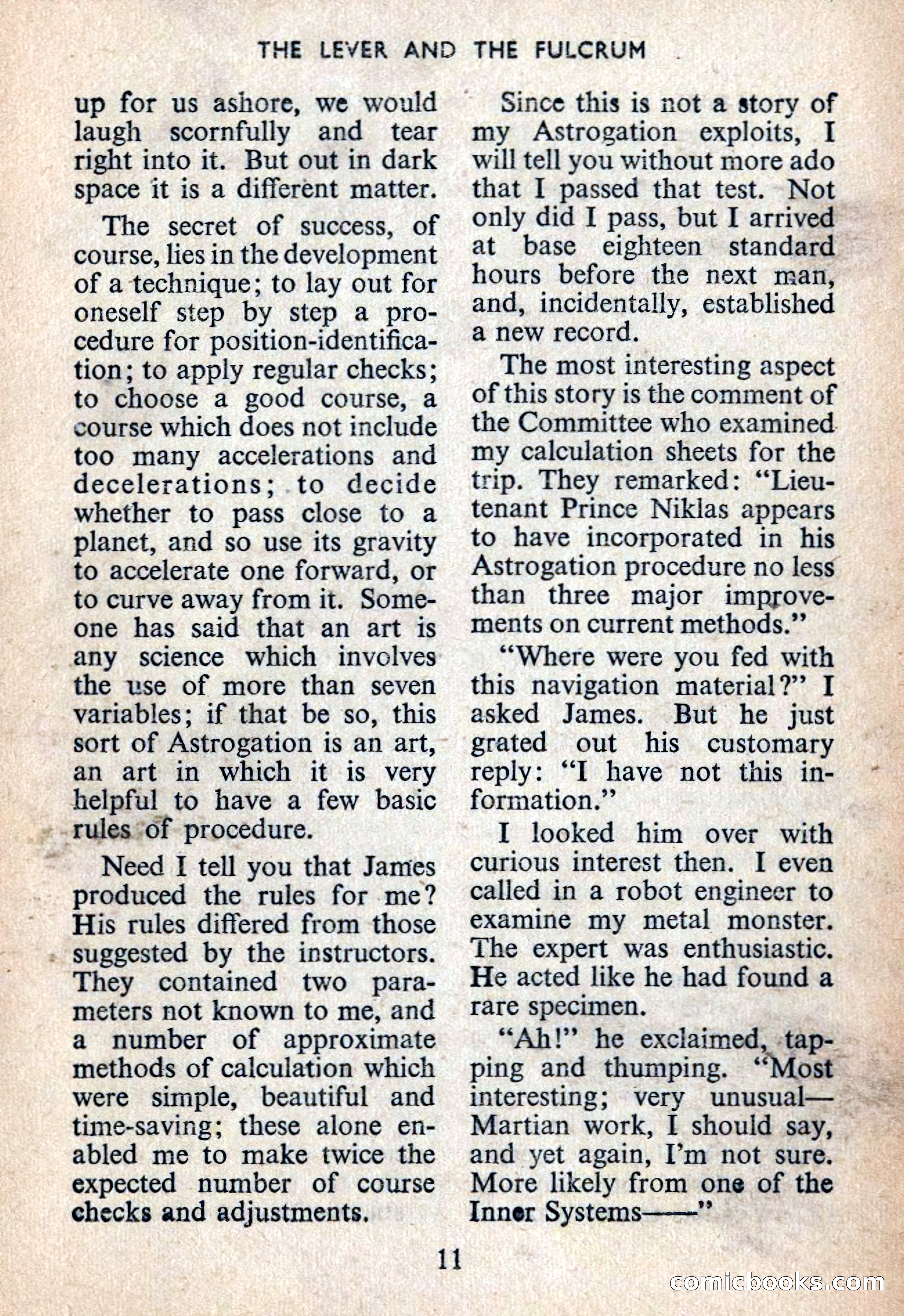
A restored page from Pulp Fiction, 1954. Page through the whole issue in the reader above.
📄 Transcribed text from this page (OCR, searchable)
Machine-transcribed from the original scan — historical spelling and the odd misread are preserved.
THE up for us ashore, we would laugh scornfully and _ tear right into it. But out in dark space it is a different matter. The secret of success, of course, lies in the development of a technique; to lay out for oneself step by step a pro- cedure for position-identifica- tion; to apply regular checks; to choose a good course, a course which does not include too many accelerations and decelerations; to decide whether to pass close to a planet, and so use its gravity to accelerate one forward, or to curve away from it. Some- one has said that an art is any science which involves the use of more than seven variables; if that be so, this sort of Astrogation is an art, an art in which it is very helpful to have a few basic » rules “of procedure. Need I tell you that James produced the rules for me? His rules differed from those - Suggested by the instructors. They contained two para- meters not known to me, and a number of approximate methods of calculation which were simple, beautiful and time-saving; these alone en- abled me to make twice the expected number of course checks and adjustments. LEVER AND THE FULCRUM Since this is not a story of my Astrogation exploits, I will tell you without more ado that I passed that test. Not only did I pass, but I arrived at base eighteen standard — hours before the next man, and, incidentally, established a new record. The most interesting aspect of this story is the comment of the Committee who examined. my calculation sheets for the trip. They remarked: “‘Lieu- tenant Prince Niklas appears to have incorporated in his Astrogation procedure no less than three major improve- ments on current methods.” ““Where were you fed with this navigation material?” I asked James. But he just grated out his customary reply: “I have not this in- formation.” I looked him over with curious interest then. I even called in a robot engineer to examine my metal monster. The expert was enthusiastic. He acted like he had found a rare specimen. “Ah!” he exclaimed, -tap- ost very unusual—_ Martian work, I should say, — ee ping and thumping. interesting; and yet again, I’m not sure. More likely from one of the Inner Systems—— < eins ESS > s- Conniclooolks.C@mn).