
Pulp Fiction, 1954 · page 11 of 162
Authentic Science Fiction Monthly No. 44 — page 11: what you’re looking at
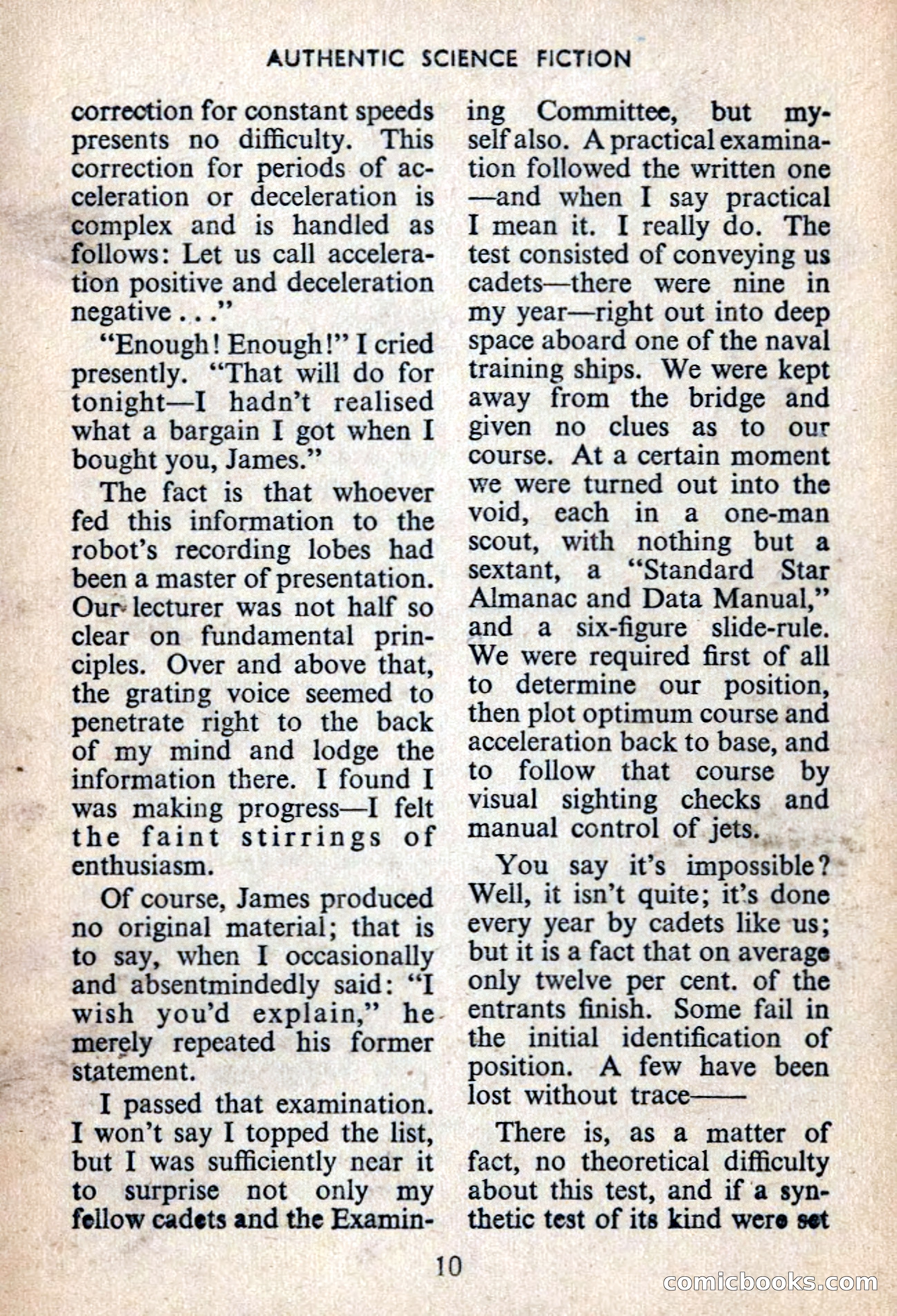
A restored page from Pulp Fiction, 1954. Page through the whole issue in the reader above.
📄 Transcribed text from this page (OCR, searchable)
Machine-transcribed from the original scan — historical spelling and the odd misread are preserved.
> -_* AUTHENTIC SCIENCE FICTION correction for constant speeds presents no difficulty. This correction for periods of ac- celeration or deceleration is complex and is handled as -follows: Let us call accelera- tion positive and deceleration negative...” “Enough! Enough!”’ I cried presently. “That will do for tonight—I hadn’t realised what a bargain I got when I bought you, James.” The fact is that whoever fed this information to the robot’s recording lobes had been a master of presentation. Our lecturer was not half so clear on fundamental prin- ciples. Over and above that, the grating voice seemed to penetrate right to the back of my mind and lodge the information there. I found I was making progress—lI felt the faint stirrings of enthusiasm. Of course, James produced no original material; that is to say, when I occasionally and absentmindedly said: “I wish you'd explain, merely repeated his ert Statement. I passed that examination. I won’t say I topped the list, but I was sufficiently near it to surprise not only my fellow cadets and the Examin- ” he- 10 ing Committee, but my- self also. A practical examina- tion followed the written one —and when I say practical I mean it. I really do. The test consisted of conveying us cadets—there were nine in my year—right out into deep space aboard one of the naval training ships. We were kept away from the bridge and given no clues as to our course. At a certain moment we were turned out into the void, each in a one-man scout, with nothing but a sextant, a “Standard Star Almanac and Data Manual,” and a six-figure slide-rule. We were required first of all to determine our position, then plot optimum course and acceleration back to base, and to follow that course by visual sighting checks and manual control of jets. . You say it’s impossible? ~ Well, it isn’t quite; it’s done every year by cadets like us; but it is a fact that on average. only twelve per cent. of the entrants finish. Some fail in the initial identification of position. A few have been lost without trace—— There is, as a matter of fact, no theoretical difficulty about this test, and if ‘a syn- thetic test of its kind were set conniclooolkks.comn)