
Pulp Fiction, 1954 · page 133 of 162
Authentic Science Fiction Monthly No. 43 — page 133: what you’re looking at
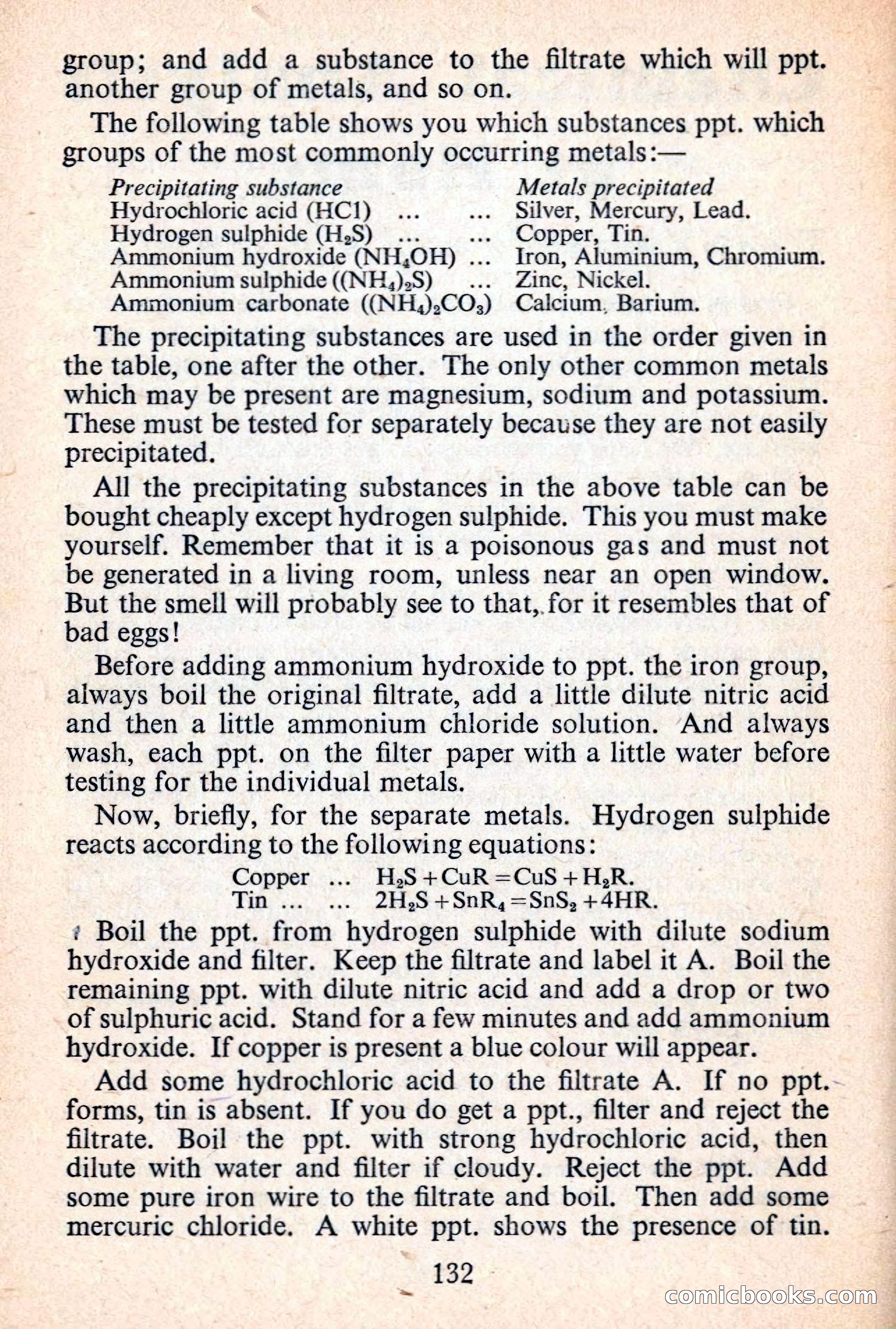
A restored page from Pulp Fiction, 1954. Page through the whole issue in the reader above.
📄 Transcribed text from this page (OCR, searchable)
Machine-transcribed from the original scan — historical spelling and the odd misread are preserved.
group; and add a substance to the filtrate which will ppt. another group of metals, and so on. The following table shows you which substances ppt. which groups of the most commonly occurring metals:— Precipitating substance Metals precipitated Hydrochloric acid (HCl) ... ... Silver, Mercury, Lead. Hydrogen sulphide (H,S) ... Copper, Tin. Ammonium hydroxide (NH,OH) . Iron, Aluminium, Chromium. Ammonium sulphide ((NH,).S) Zinc, Nickel. Ammonium carbonate ((NH,).CO;) Calcium. Barium. The precipitating substances are used in the order given in the table, one after the other. The only other common metals which may be present are magnesium, sodium and potassium. These must be tested for separately because they are not easily precipitated. All the precipitating substances in the above table can be bought cheaply except hydrogen sulphide. This you must make yourself. Remember that it is a poisonous gas and must not be generated in a living room, unless near an open window. But the smell will probably see to that, for it resembles that of bad eggs! Before adding ammonium hydroxide to ppt. the iron group, always boil the original filtrate, add a little dilute nitric acid and then a little ammonium chloride solution. And always wash, each ppt. on the filter paper with a little water before testing for the individual metals. Now, briefly, for the separate metals. Hydrogen sulphide reacts according to the following equations: Copper ... H,S+CuR=CuS+H,R. Tin ... ... 2H.S+SnR,=SnS, +4HR. * Boil the ppt. from hydrogen sulphide with dilute sodium hydroxide and filter. Keep the filtrate and label it A. Boil the remaining ppt. with dilute nitric acid and add a drop or two of sulphuric acid. Stand for a few minutes and add ammonium hydroxide. If copper is present a blue colour will appear. Add some hydrochloric acid to the filtrate A. If no ppt.- forms, tin is absent. If you do get a ppt., filter and reject the filtrate. Boil the ppt. with strong hydrochloric acid, then dilute with water and filter if cloudy. Reject the ppt. Add some pure iron wire to the filtrate and boil. Then add some mercuric chloride. A white ppt. shows the presence of tin. 132 ~ connicbooks.conn » a