
Pulp Fiction, 1954 · page 132 of 162
Authentic Science Fiction Monthly No. 43 — page 132: what you’re looking at
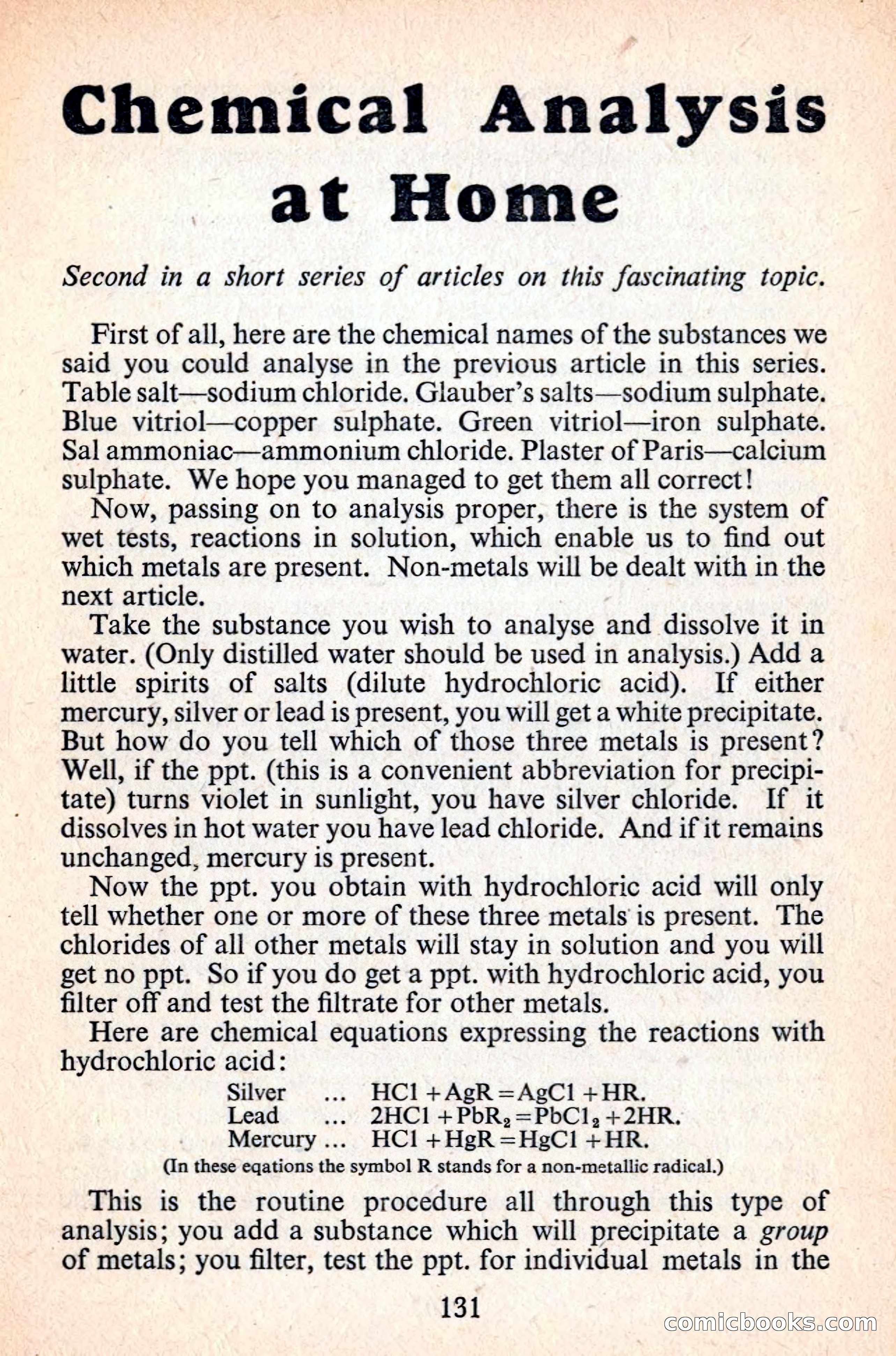
A restored page from Pulp Fiction, 1954. Page through the whole issue in the reader above.
📄 Transcribed text from this page (OCR, searchable)
Machine-transcribed from the original scan — historical spelling and the odd misread are preserved.
Chemical Analysis at Home Second in a short series of articles on this fascinating topic. First of all, here are the chemical names of the substances we said you could analyse in the previous article in this series. Table salt—sodium chloride. Glauber’s salts—sodium sulphate. Blue vitriol—copper sulphate. Green vitriol—iron sulphate. Sal ammoniac—ammonium chloride. Plaster of Paris—calcium sulphate. We hope you managed to get them all correct! Now, passing on to analysis proper, there is the system of wet tests, reactions in solution, which enable us to find out which metals are present. Non-metals will be dealt with in the next article. Take the substance you wish to analyse and dissolve it in water. (Only distilled water should be used in analysis.) Add a little spirits of salts (dilute hydrochloric acid). If either mercury, silver or lead is present, you will get a white precipitate. But how do you tell which of those three metals is present? Well, if the ppt. (this is a convenient abbreviation for precipi- tate) turns violet in sunlight, you have silver chloride. If it dissolves in hot water you have lead chloride. And if it remains unchanged, mercury is present. Now the ppt. you obtain with hydrochloric acid will only tell whether one or more of these three metals is present. The chlorides of all other metals will stay in solution and you will get no ppt. So if you do get a ppt. with hydrochloric acid, you filter off and test the filtrate for other metals. Here are chemical equations expressing the reactions with hydrochloric acid: Silver .... HCl+AgR=AgCl +HR. Lead .. 2HCI +PbR,=PbC1, +2HR. Mercury... HCl +HgR=HgCl1+HR. (In these eqations the symbol R stands for a non-metallic radical.) This is the routine procedure all through this type of analysis; you add a substance which will precipitate a group of metals; you filter, test the ppt. for individual metals in the 131 comiclooolkks.conn