
Pulp Fiction, 1954 · page 110 of 162
Authentic Science Fiction Monthly No. 43 — page 110: what you’re looking at
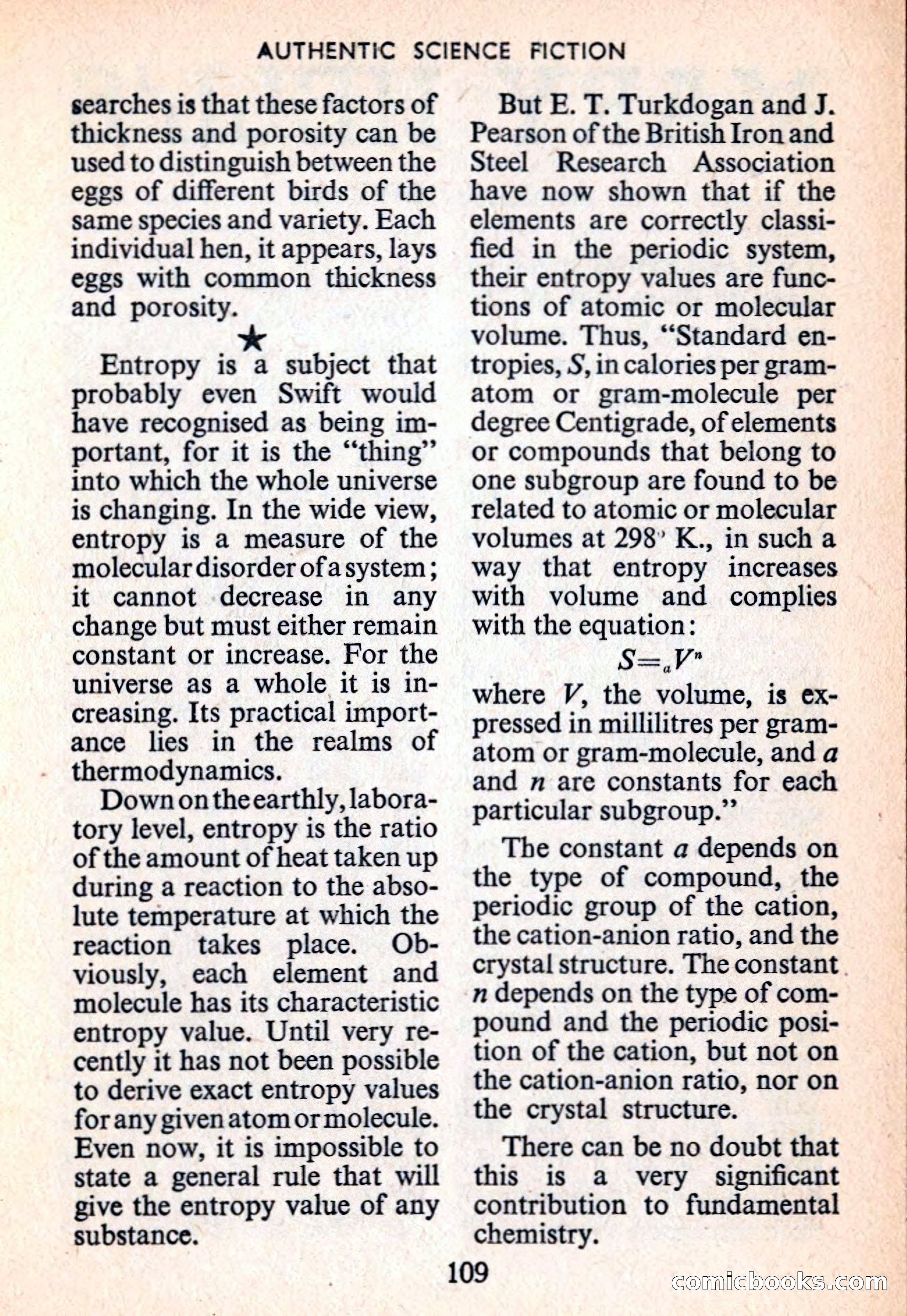
A restored page from Pulp Fiction, 1954. Page through the whole issue in the reader above.
📄 Transcribed text from this page (OCR, searchable)
Machine-transcribed from the original scan — historical spelling and the odd misread are preserved.
AUTHENTIC SCIENCE FICTION searches is that these factors of thickness and porosity can be used to distinguish between the eggs of different birds of the same species and variety. Each individual hen, it appears, lays eggs with common thickness and porosity. Entropy is a subject that probably even Swift would have recognised as being im- portant, for it is the “thing” into which the whole universe is changing. In the wide view, entropy is a measure of the molecular disorder ofasystem ; it cannot decrease in any change but must either remain constant or increase. For the universe as a whole it is in- creasing. Its practical import- ance lies in the realms of thermodynamics. Down ontheearthly, labora- tory level, entropy is the ratio of the amount of heat taken up during a reaction to the abso- lute temperature at which the reaction takes place. Ob- viously, each element and molecule has its characteristic entropy value. Until very re- cently it has not been possible to derive exact entropy values for any given atom ormolecule. Even now, it is impossible to state a general rule that will give the entropy value of any substance. 109 But E. T. Turkdogan and J. Pearson of the British Iron and Steel Research Association have now shown that if the elements are correctly classi- fied in the periodic system, their entropy values are func- tions of atomic or molecular volume. Thus, “‘Standard en- tropies, S, in calories per gram- atom or gram-molecule per degree Centigrade, of elements or compounds that belong to one subgroup are found to be related to atomic or molecular volumes at 298” K., in such a way that entropy increases with volume and complies with the equation: S==,V" where V, the volume, is ex- pressed in millilitres per gram- atom or gram-molecule, and a and n are constants for each particular subgroup.” The constant a depends on the type of compound, the periodic group of the cation, the cation-anion ratio, and the crystal structure. The constant. n depends on the type of com- pound and the periodic posi- tion of the cation, but not on the cation-anion ratio, nor on the crystal structure. There can be no doubt that this is a very significant contribution to fundamental chemistry. comicloooks. conn -