
Pulp Fiction, 1954 · page 109 of 162
Authentic Science Fiction Monthly No. 43 — page 109: what you’re looking at
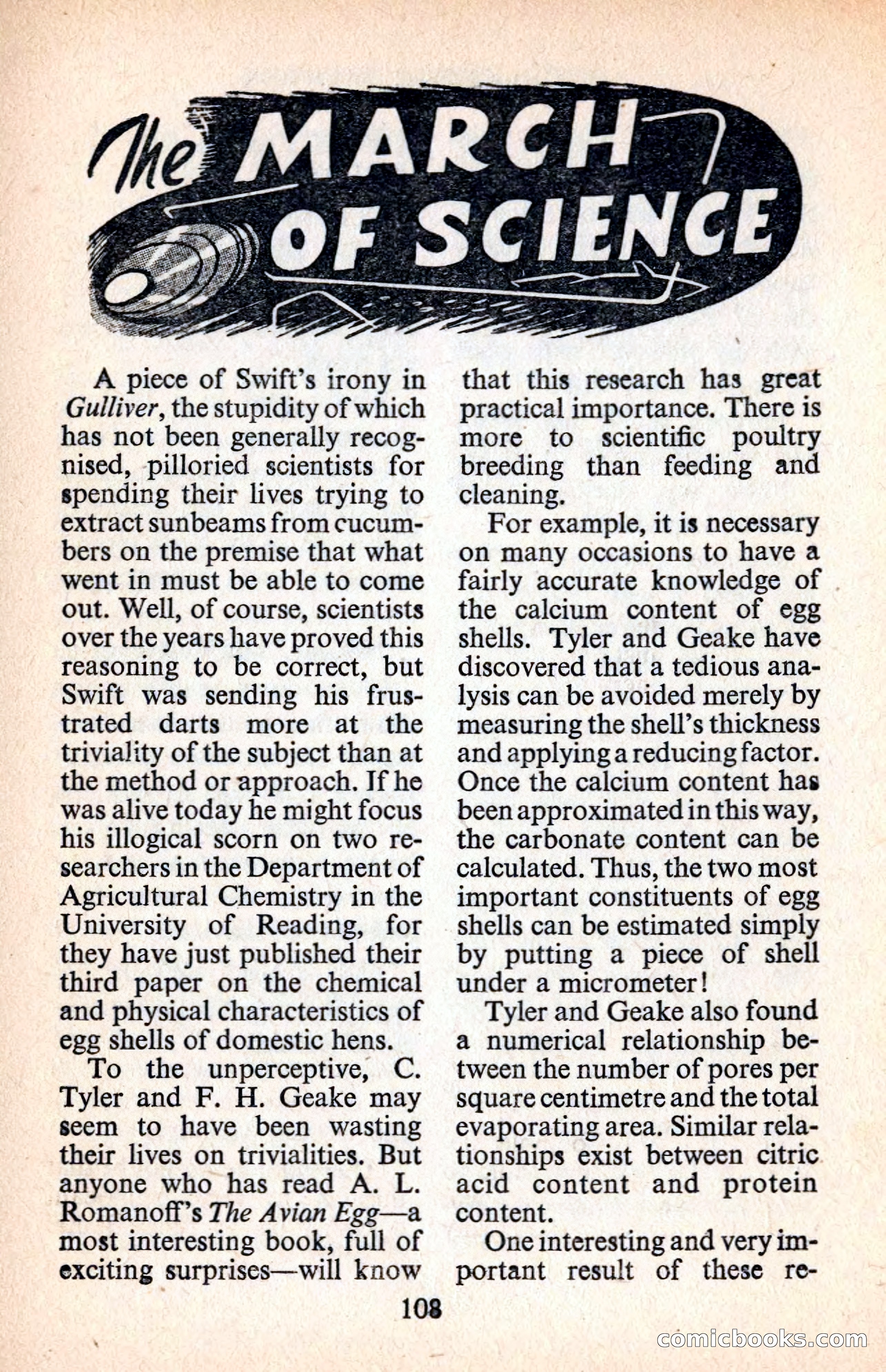
A restored page from Pulp Fiction, 1954. Page through the whole issue in the reader above.
📄 Transcribed text from this page (OCR, searchable)
Machine-transcribed from the original scan — historical spelling and the odd misread are preserved.
pe! ci A piece of Swift’s irony in Gulliver, the stupidity of which has not been generally recog- nised, pilloried scientists for spending their lives trying to extract sunbeams from cucum- bers on the premise that what went in must be able to come out. Well, of course, scientists over the years have proved this reasoning to be correct, but Swift was sending his frus- trated darts more at the triviality of the subject than at the method or approach. If he was alive today he might focus his illogical scorn on two re- searchers in the Department of Agricultural Chemistry in the University of Reading, for they have just published their third paper on the chemical and physical characteristics of egg shells of domestic hens. To the unperceptive, C. Tyler and F. H. Geake may seem to have been wasting their lives on trivialities. But anyone who has read A. L. Romanoff’s The Avian Egg—a most interesting book, full of exciting surprises—will know 108 ARCH) =) OF SCIENCE that this research has great practical importance. There is more to scientific poultry breeding than feeding and cleaning. For example, it is necessary on many occasions to have a fairly accurate knowledge of the calcium content of egg shells. Tyler and Geake have discovered that a tedious ana- lysis can be avoided merely by measuring the shell’s thickness and applying a reducing factor. Once the calcium content has been approximated in this way, the carbonate content can be calculated. Thus, the two most important constituents of egg shells can be estimated simply by putting a piece of shell under a micrometer! Tyler and Geake also found a numerical relationship be- tween the number of pores per square centimetre and the total evaporating area. Similar rela- tionships exist between citric acid content and protein content. One interesting and very im- portant result of these re- comiclooks.cormn