
Pulp Fiction, 1954 · page 152 of 162
Authentic Science Fiction Monthly No. 42 — page 152: what you’re looking at
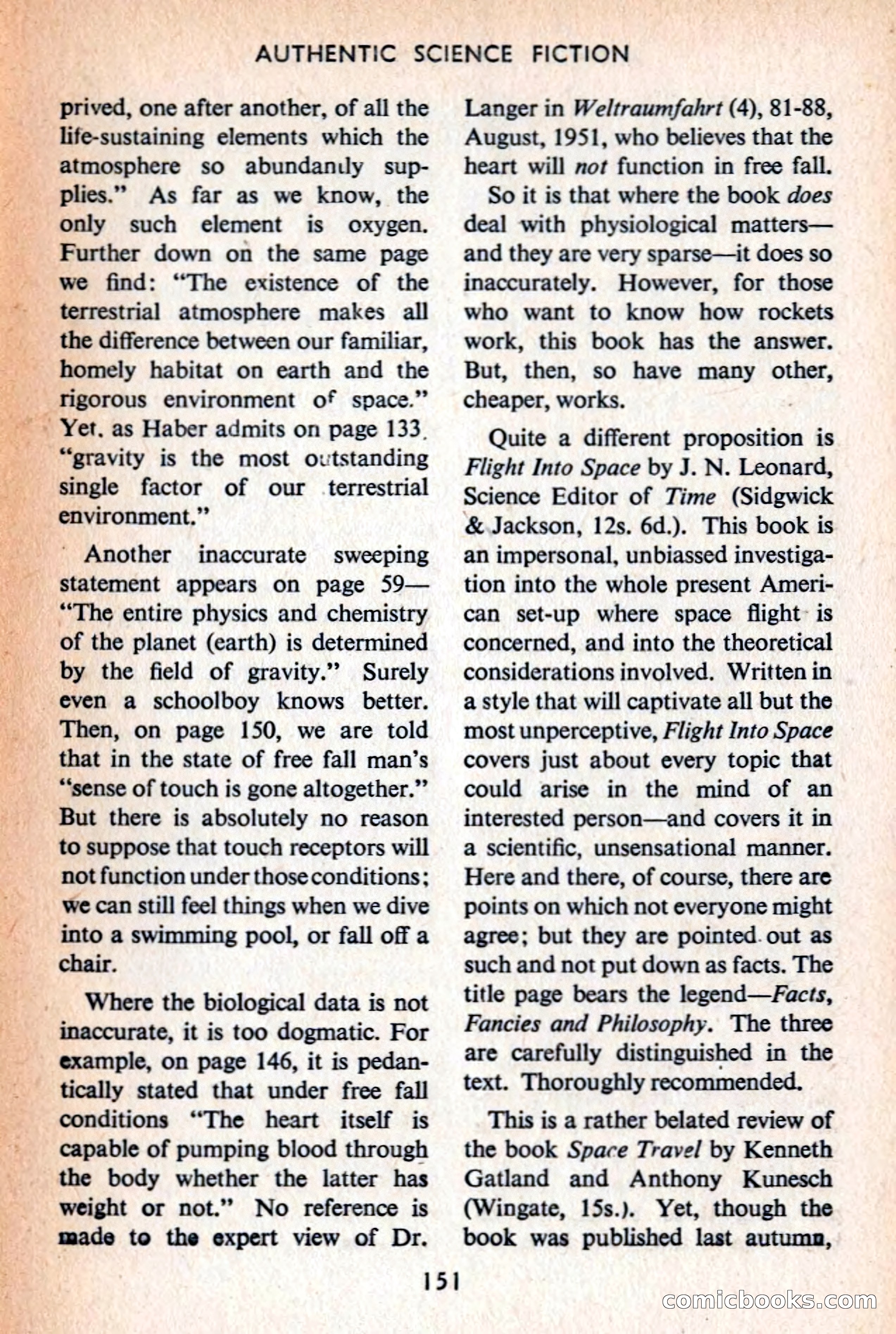
A restored page from Pulp Fiction, 1954. Page through the whole issue in the reader above.
📄 Transcribed text from this page (OCR, searchable)
Machine-transcribed from the original scan — historical spelling and the odd misread are preserved.
es AUTHENTIC SCIENCE FICTION prived, one after another, of all the life-sustaining elements which the atmosphere so abundanuy sup- plies.” As far as we know, the only such element is oxygen. Further down on the same page we find: “The existence of the terrestrial atmosphere makes all the difference between our familiar, homely habitat on earth and the rigorous environment of space.” Yet. as Haber admits on page 133. “gravity is the most outstanding single factor of our terrestrial environment.” ' Another inaccurate sweeping statement appears on page 59— “The entire physics and chemistry of the planet (earth) is determined by the field of gravity.’’ Surely even a schoolboy knows better. Then, on page 150, we are told that in the state of free fall man’s “‘sense of touch is gone altogether.” But there is absolutely no reason to suppose that touch receptors will not function under those conditions; we can still feel things when we dive into a swimming pool, or fall off a chair. Where the biological data is not inaccurate, it is too dogmatic. For example, on page 146, it is pedan- tically stated that under free fall conditions “The heart itself is capable of pumping blood through the body whether the latter has weight or not.”’ No reference is made to the expert view of Dr. 15] Langer in Weltraumfahrt (4), 81-88, August, 1951, who believes that the heart will not function in free fall. So it is that where the book does deal with physiological matters— and they are very sparse—it does so inaccurately. However, for those who want to know how rockets work, this book has the answer. But, then, so have many other, cheaper, works. , Quite a different proposition is Flight Into Space by J. N. Leonard, Science Editor of Time (Sidgwick & Jackson, 12s. 6d.). This book is an impersonal, unbiassed investiga- tion into the whole present Ameri- can set-up where space flight- is concerned, and into the theoretical considerations involved. Written in a style that will captivate all but the most unperceptive, Flight Into Space covers just about every topic that could arise in the mind of an interested person—and covers it in a scientific, unsensational manner. Here and there, of course, there are points on which not everyone might agree; but they are pointed. out as such and not put down as facts. The title page bears the legend—Facts, Fancies and Philosophy. The three are carefully distinguished in the text. Thoroughly recommended. This is a rather belated review of the book Space Travel by Kenneth Gatland and Anthony Kunesch (Wingate, 15s.). Yet, though the book was published last autumn, comiclooks.corn