
Pulp Fiction, 1954 · page 151 of 162
Authentic Science Fiction Monthly No. 42 — page 151: what you’re looking at
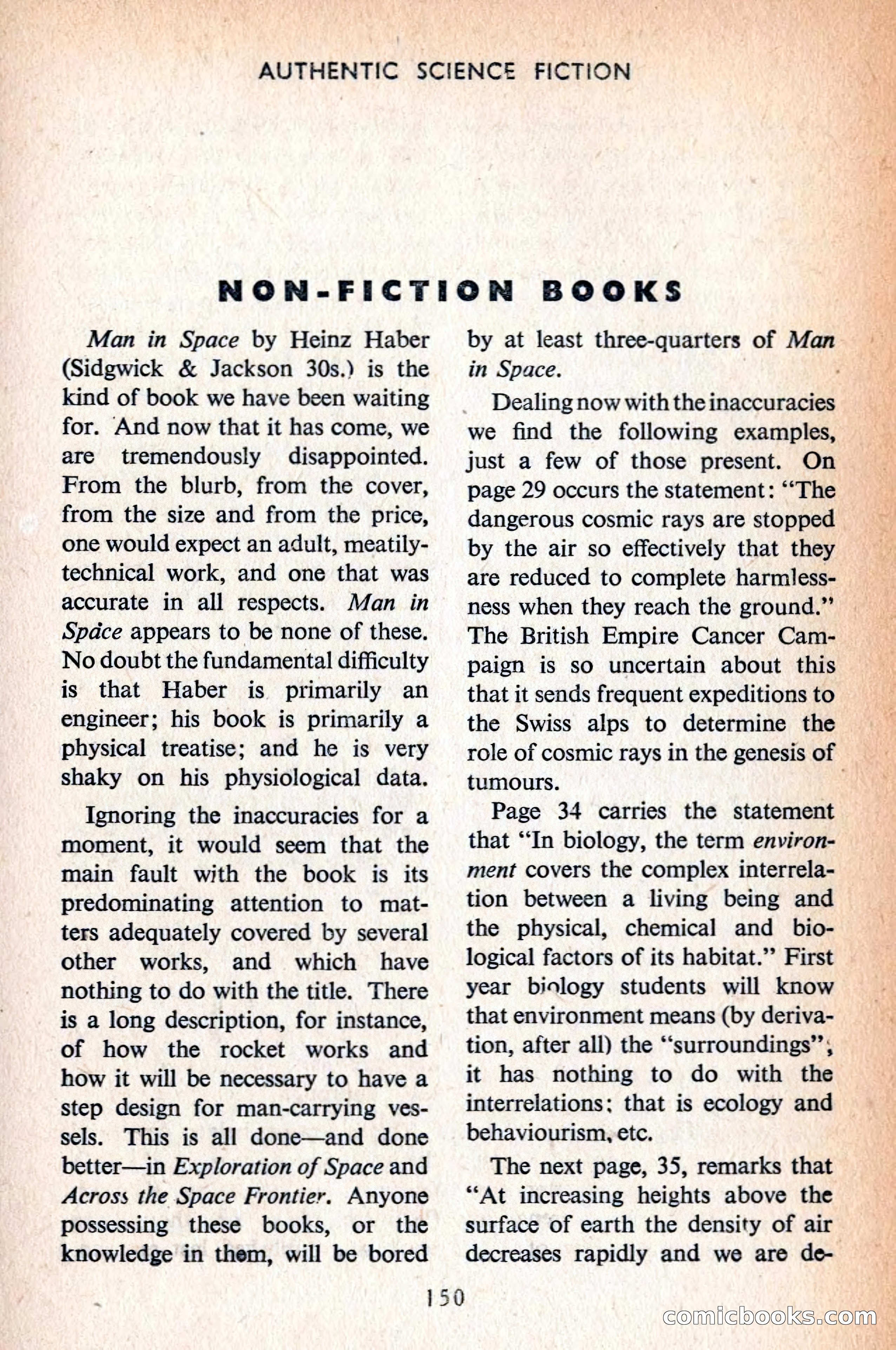
A restored page from Pulp Fiction, 1954. Page through the whole issue in the reader above.
📄 Transcribed text from this page (OCR, searchable)
Machine-transcribed from the original scan — historical spelling and the odd misread are preserved.
AUTHENTIC SCIENCE FICTION NON-FICTION BOOKS Man in Space by Heinz Haber (Sidgwick & Jackson 30s.) is the kind of book we have been waiting for. And now that it has come, we are tremendously disappointed. From the blurb, from the cover, from the size and from the price, one would expect an adult, meatily- technical work, and one that was accurate in all respects. Man in Spdce appears to be none of these. No doubt the fundamental difficulty is that Haber is primarily an engineer; his book is primarily a physical treatise; and he is very shaky on his physiological data. Ignoring the inaccuracies for a moment, it would seem that the main fault with the book is its predominating attention to mat- ters adequately covered by several other works, and which have nothing to do with the title. There is a long description, for instance, of how the rocket works and how it will be necessary to have a step design for man-carrying ves- sels. This is all done—and done better—in Exploration of Space and Across the Space Frontier. Anyone possessing these books, or the knowledge in them, will be bored by at least three-quarters of Man in Space. Dealing now with the inaccuracies we find the following examples, just a few of those present. On page 29 occurs the statement: ““The dangerous cosmic rays are stopped by the air so effectively that they are reduced to complete harmless- ness when they reach the ground.” The British Empire Cancer Cam- paign is so uncertain about this that it sends frequent expeditions to the Swiss alps to determine the role of cosmic rays in the genesis of tumours. Page 34 carries the statement that “‘In biology, the term environ- ment covers the complex interrela- tion between a living being and the physical, chemical and bio- logical factors of its habitat.’’ First year binlogy students will know that environment means (by deriva- tion, after all) the “‘surroundings’’; it has nothing to do with the interrelations; that is ecology and behaviourism, etc. The next page, 35, remarks that **At increasing heights above the surface of earth the density of air decreases rapidly and we are de- 150 comiclbooks.conn ;*