
Pulp Fiction, 1954 · page 146 of 162
Authentic Science Fiction Monthly No. 42 — page 146: what you’re looking at
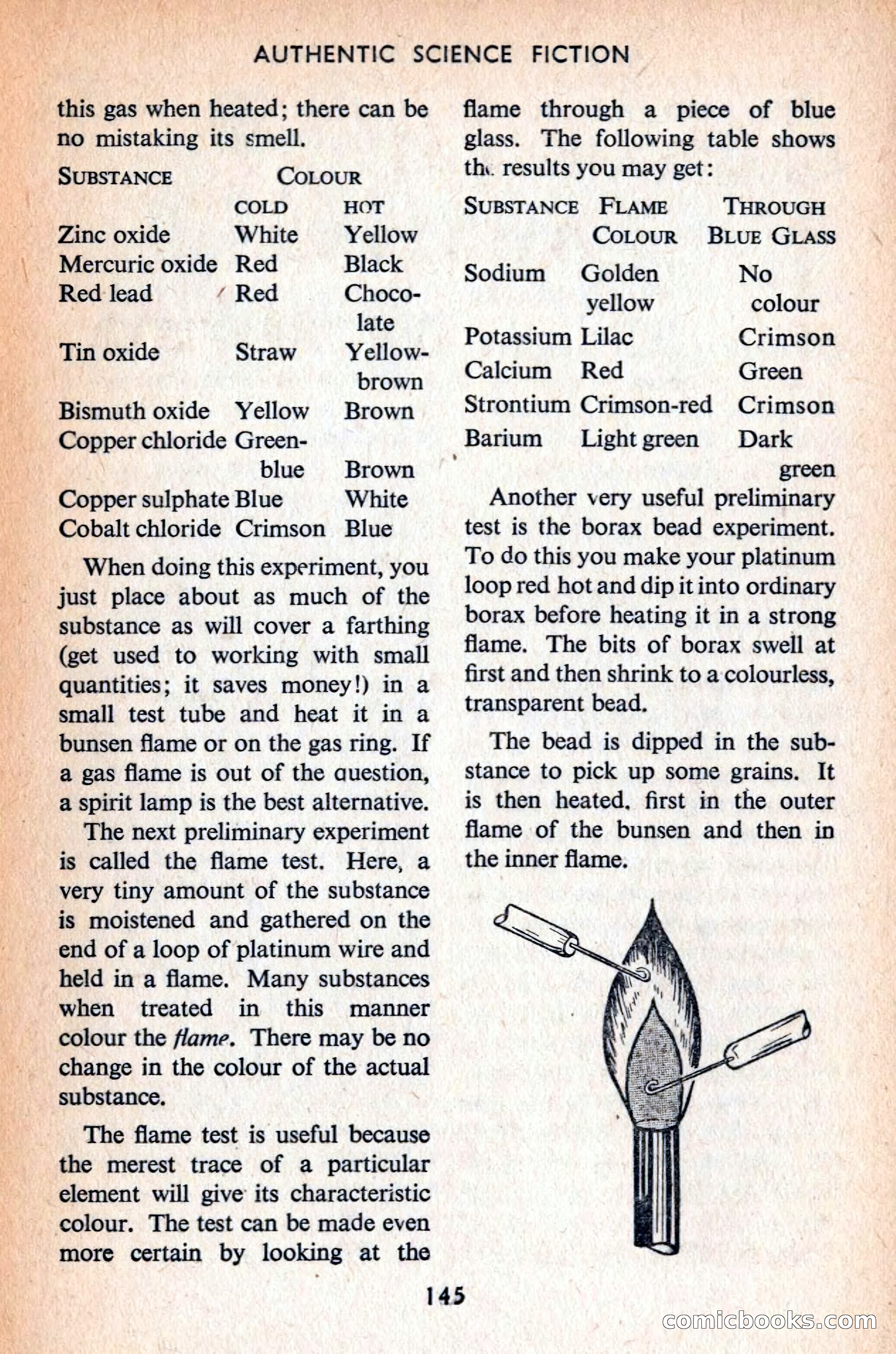
A restored page from Pulp Fiction, 1954. Page through the whole issue in the reader above.
📄 Transcribed text from this page (OCR, searchable)
Machine-transcribed from the original scan — historical spelling and the odd misread are preserved.
AUTHENTIC SCIENCE FICTION this gas when heated; there can be no mistaking its smell. SUBSTANCE COLOUR COLD HOT Zinc oxide White Yellow Mercuric oxide Red Black Red lead ‘ Red Choco- late Tin oxide Straw Yellow- brown Bismuth oxide Yellow Brown Copper chloride Green- blue Brown Copper sulphate Blue White Cobalt chloride Crimson Blue When doing this experiment, you just place about as much of the substance as will cover a farthing (get used to working with small quantities; it saves money!) in a small test tube and heat it in a bunsen flame or on the gas ring. If a gas flame is out of the question, a spirit lamp is the best alternative. The next preliminary experiment is called the flame test. Here, a very tiny amount of the substance is moistened and gathered on the end of a loop of platinum wire and held in a flame. Many substances when treated in this manner colour the flame, There may be no change in the colour of the actual substance. The flame test is useful because the merest trace of a particular element will give its characteristic colour. The test can be made even more certain by looking at the 145 flame through a piece of blue glass. The following table shows th. results you may get: SUBSTANCE FLAME THROUGH COLOUR BLUE GLASS Sodium Golden No yellow colour Potassium Lilac Crimson Calcium Red Green Strontium Crimson-red Crimson Barium Light green Dark green Another very useful preliminary test is the borax bead experiment. To do this you make your platinum loop red hot and dip it into ordinary borax before heating it in a strong flame. The bits of borax swell at first and then shrink to a colourless, transparent bead. The bead is dipped in the sub- stance to pick up some grains. It is then heated, first in the outer flame of the bunsen and then in the inner flame. comiclooolkks.com