
Pulp Fiction, 1954 · page 123 of 162
Authentic Science Fiction Monthly No. 42 — page 123: what you’re looking at
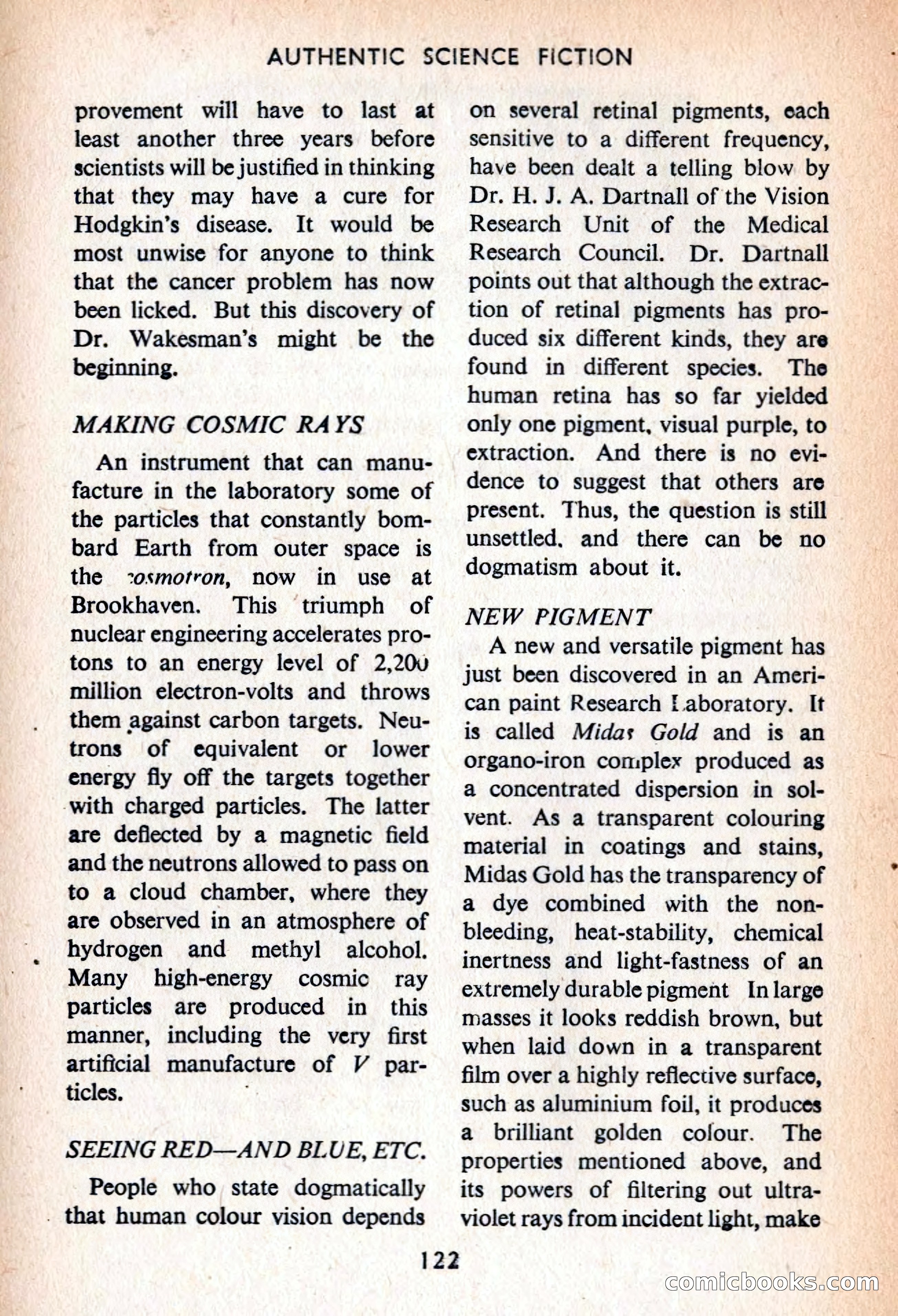
A restored page from Pulp Fiction, 1954. Page through the whole issue in the reader above.
📄 Transcribed text from this page (OCR, searchable)
Machine-transcribed from the original scan — historical spelling and the odd misread are preserved.
AUTHENTIC SCIENCE FICTION provement will have to last at least another three years before scientists will be justified in thinking that they may have a cure for Hodgkin’s disease. It would be most unwise for anyone to think that the cancer problem has now been licked. But this discovery of Dr. Wakesman’s might be the beginning. MAKING COSMIC RAYS An instrument that can manu- facture in the laboratory some of the particles that constantly bom- bard Earth from outer space is the -:osmotron, now in use at Brookhaven. This triumph of nuclear engineering accelerates pro- tons to an energy level of 2,20u million electron-volts and throws them against carbon targets. Neu- trons of equivalent or lower energy fly off the targets together ‘with charged particles. The latter are deflected by a magnetic field and the neutrons allowed to pass on to a cloud chamber, where they are observed in an atmosphere of hydrogen and methyl alcohol. Many high-energy cosmic ray particles are produced in this manner, including the very first artificial manufacture of V par- ticles. SEEING RED—AND BLUE, ETC. People who state dogmatically . that human colour vision depends on several retinal pigments, each sensitive to a different frequency, have been dealt a telling blow by Dr. H. J. A. Dartnall of the Vision Research Unit of the Medical Research Council. Dr. Dartnall points out that although the extrac- tion of retinal pigments has pro- duced six different kinds, they are found in different species. The human retina has so far yielded only one pigment, visual purple, to extraction. And there is no evi- dence to suggest that others are present. Thus, the question is still unsettled. and there can be no dogmatism about it. NEW PIGMENT A new and versatile pigment has just been discovered in an Ameri- can paint Research Laboratory. It is called Midas Gold and is an organo-iron complex produced as a concentrated dispersion in sol- vent. As a transparent colouring material in coatings and stains, Midas Gold has the transparency of a dye combined with the non- bleeding, heat-stability, chemical inertness and light-fastness of an extremely durable pigment In large masses it looks reddish brown, but when laid down in a transparent film over a highly reflective surface, such as aluminium foil, it produces a brilliant golden colour. The properties mentioned above, and its powers of filtering out ultra- violet rays from incident light, make 122 conmicloooks.comn)