
Pulp Fiction, 1945 · page 14 of 68
Astounding Science Fiction (UK Edition) — page 14: what you’re looking at
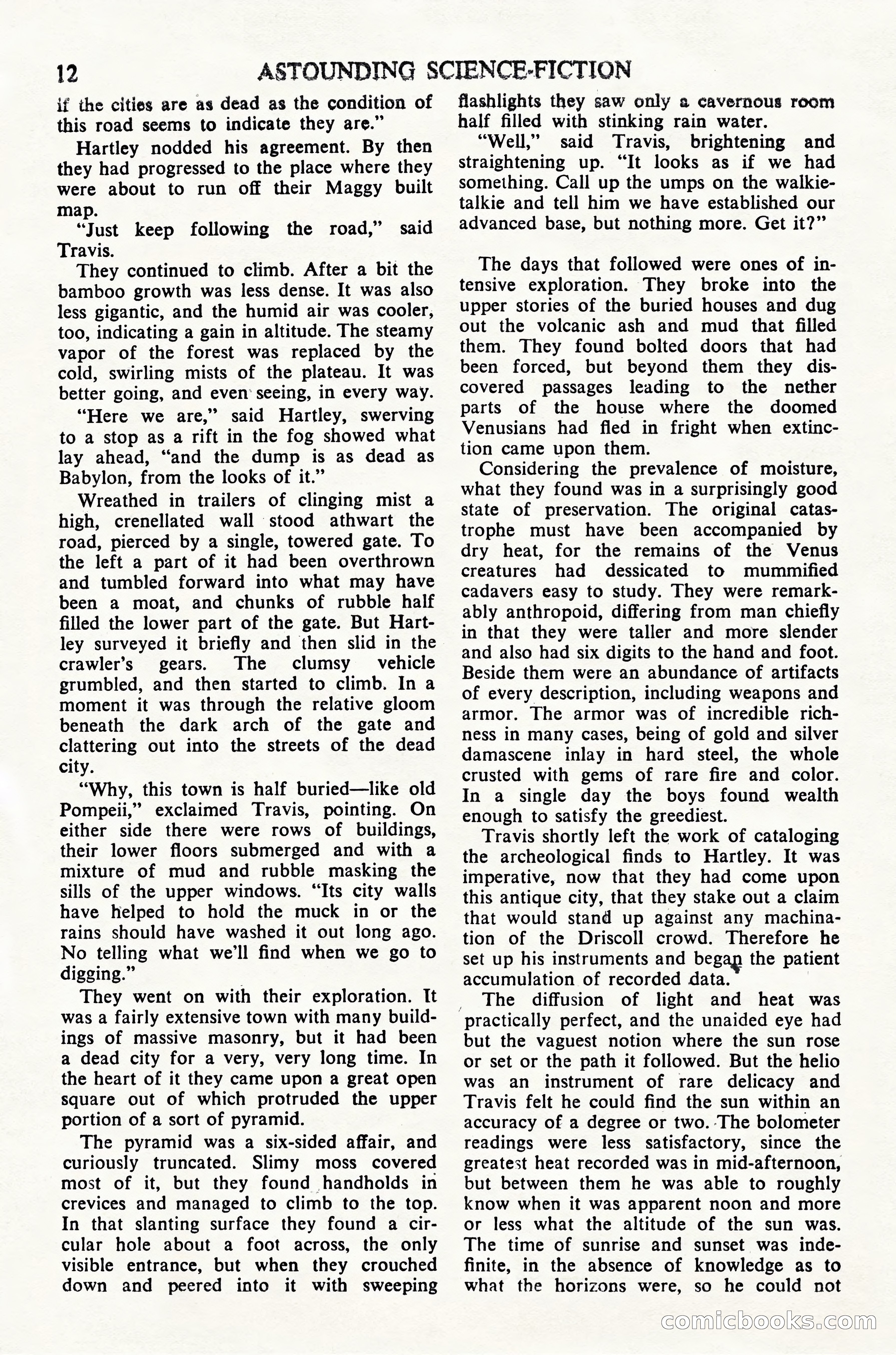
A restored page from Pulp Fiction, 1945. Page through the whole issue in the reader above.
📄 Transcribed text from this page (OCR, searchable)
Machine-transcribed from the original scan — historical spelling and the odd misread are preserved.
12 if the cities are as dead as the condition of this road seems to indicate they are.” Hartley nodded his agreement. By then they had progressed to the place where they were about to run off their Maggy built map. “Just keep following the road,” said Travis. They continued to climb. After a bit the bamboo growth was less dense. It was also less gigantic, and the humid air was cooler, too, indicating a gain in altitude. The steamy vapor of the forest was replaced by the cold, swirling mists of the plateau. It was better going, and even seeing, in every way. “Here we are,” said Hartley, swerving to a stop as a rift in the fog showed what lay ahead, “and the dump is as dead as Babylon, from the looks of it.” Wreathed in trailers of clinging mist a high, crenellated wall stood athwart the road, pierced by a single, towered gate. To the left a part of it had been overthrown and tumbled forward into what may have been a moat, and chunks of rubble half filled the lower part of the gate. But Hart- ley surveyed it briefly and then slid in the crawler’s gears. The clumsy vehicle grumbled, and then started to climb. In a moment it was through the relative gloom beneath the dark arch of the gate and clattering out into the streets of the dead city. “Why, this town is half buried—like old Pompeii,” exclaimed Travis, pointing. On either side there were rows of buildings, their lower floors submerged and with a mixture of mud and rubble masking the sills of the upper windows. “Its city walls have helped to hold the muck in or the rains should have washed it out long ago. No telling what we'll find when we go to digging.” They went on with their exploration. It was a fairly extensive town with many build- ings of massive masonry, but it had been a dead city for a very, very long time. In the heart of it they came upon a great open square out of which protruded the upper portion of a sort of pyramid. The pyramid was a six-sided affair, and curiously truncated. Slimy moss covered most of it, but they found handholds in crevices and managed to climb to the top. In that slanting surface they found a cir- cular hole about a foot across, the only visible entrance, but when they crouched down and peered into it with sweeping ASTOUNDING SCIENCE-FICTION flashlights they saw only a cavernous room half filled with stinking rain water. “Well,” said Travis, brightening and straightening up. “It looks as if we had something. Call up the umps on the walkie- talkie and tell him we have established our advanced base, but nothing more. Get it?” The days that followed were ones of in- tensive exploration. They broke into the upper stories of the buried houses and dug out the volcanic ash and mud that filled them. They found bolted doors that had been forced, but beyond them they dis- covered passages leading to the nether parts of the house where the doomed Venusians had fled in fright when extinc- tion came upon them. Considering the prevalence of moisture, what they found was in a surprisingly good state of preservation. The original catas- trophe must have been accompanied by dry heat, for the remains of the Venus creatures had dessicated to mummified cadavers easy to study. They were remark- ably anthropoid, differing from man chiefly in that they were taller and more slender and also had six digits to the hand and foot. Beside them were an abundance of artifacts of every description, including weapons and armor. The armor was of incredible rich- ness in many cases, being of gold and silver damascene inlay in hard steel, the whole crusted with gems of rare fire and color. In a single day the boys found wealth enough to satisfy the greediest. Travis shortly left the work of cataloging the archeological finds to Hartley. It was imperative, now that they had come upon this antique city, that they stake out a claim that would stand up against any machina- tion of the Driscoll crowd. Therefore he set up his instruments and begap the patient accumulation of recorded data. The diffusion of light and heat was ‘practically perfect, and the unaided eye had but the vaguest notion where the sun rose or set or the path it followed. But the helio was an instrument of rare delicacy and Travis felt he could find the sun within an accuracy of a degree or two. The bolometer readings were less satisfactory, since the greatest heat recorded was in mid-afternoon, but between them he was able to roughly know when it was apparent noon and more or less what the altitude of the sun was. The time of sunrise and sunset was inde- finite, in the absence of knowledge as to what the horizons were, so he could not comicbooao S (©)