
Pulp Fiction, 1945 · page 13 of 68
Astounding Science Fiction (UK Edition) — page 13: what you’re looking at
A restored page from Pulp Fiction, 1945. Page through the whole issue in the reader above.
📄 Transcribed text from this page (OCR, searchable)
Machine-transcribed from the original scan — historical spelling and the odd misread are preserved.
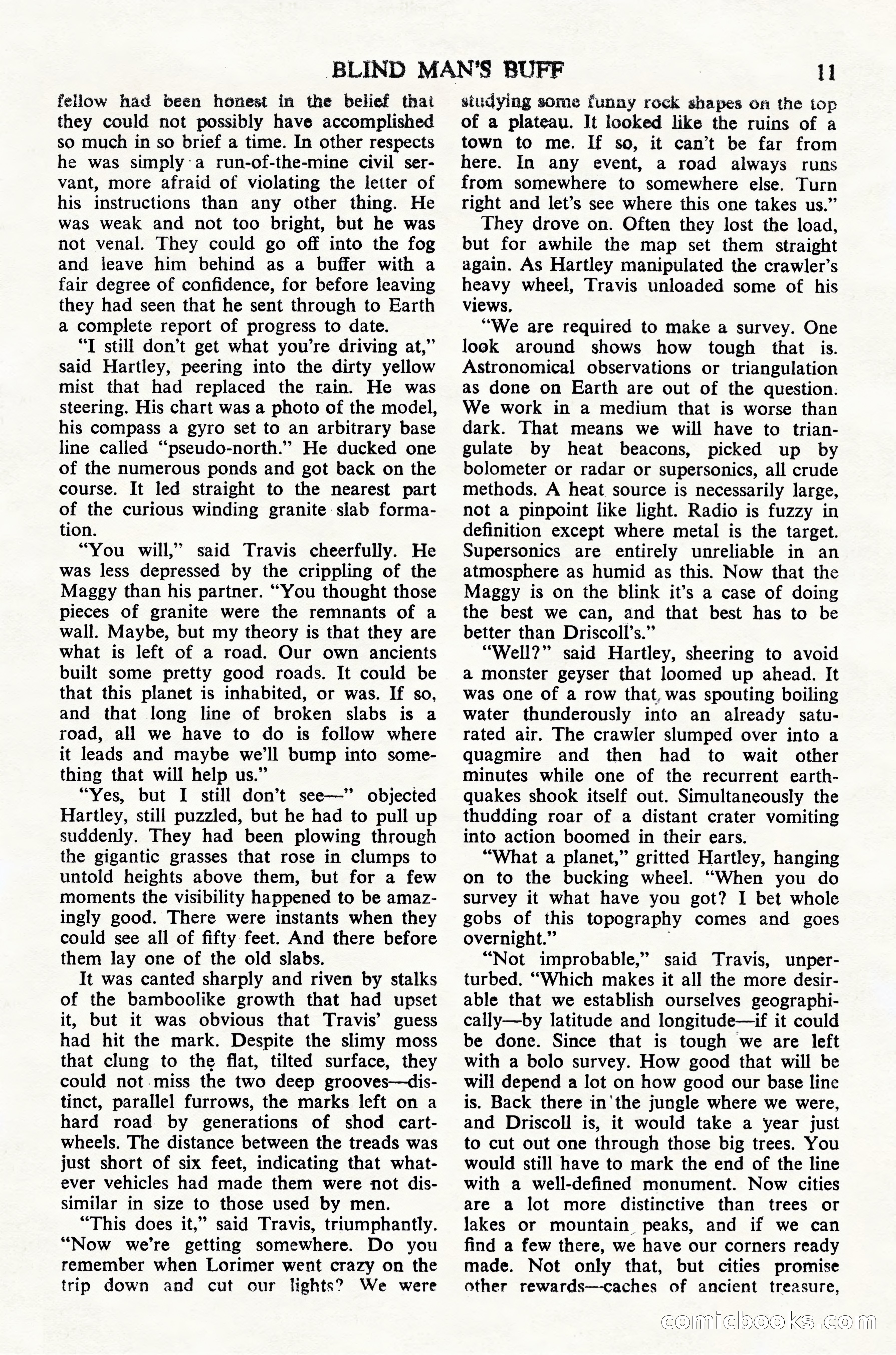
BLIND MAN'S BUFF | rT fellow had been honest in the belief thai they could not possibly have accomplished so much in so brief a time. In other respects he was simply-a run-of-the-mine civil ser- vant, more afraid of violating the letter of his instructions than any other thing. He was weak and not too bright, but he was not venal. They could go off into the fog and leave him behind as a buffer with a fair degree of confidence, for before leaving they had seen that he sent through to Earth a complete report of progress to date. “T still don’t get what you’re driving at,”’ said Hartley, peering into the dirty yellow mist that had replaced the rain. He was steering. His chart was a photo of the model, his compass a gyro set to an arbitrary base line called “pseudo-north.” He ducked one of the numerous ponds and got back on the course. It led straight to the nearest part of the curious winding granite slab forma- tion. “You will,” said Travis cheerfully. He was less depressed by the crippling of the Maggy than his partner. “You thought those pieces of granite were the remnants of a wall. Maybe, but my theory is that they are what is left of a road. Our own ancients built some pretty good roads. It could be that this planet is inhabited, or was. If so, and that long line of broken slabs is a road, all we have to do is follow where it leads and maybe we’ll bump into some- thing that will help us.” “Yes, but I still don’t see—’’ objected Hartley, still puzzled, but he had to pull up suddenly. They had been plowing through the gigantic grasses that rose in clumps to untold heights above them, but for a few moments the visibility happened to be amaz- ingly good. There were instants when they could see all of fifty feet. And there before them lay one of the old slabs. It was canted sharply and riven by stalks of the bamboolike growth that had upset it, but it was obvious that Travis’ guess had hit the mark. Despite the slimy moss that clung to the flat, tilted surface, they could not-.miss the two deep grooves—dis- tinct, parallel furrows, the marks left on a hard road by generations of shod cart- wheels. The distance between the treads was just short of six feet, indicating that what- ever vehicles had made them were not dis- similar in size to those used by men. “This does it,” said Travis, triumphantly. “Now we're getting somewhere. Do you remember when Lorimer went crazy on the trip down and cut our lights? We were studying some funny rock shapes on the top of a plateau. It looked like the ruins of a town to me. If so, it can’t be far from here. In any event, a road always runs from somewhere to somewhere else. Turn right and let’s see where this one takes us.” They drove on. Often they lost the load, but for awhile the map set them straight again. As Hartley manipulated the crawler’s heavy wheel, Travis unloaded some of his views. “We are required to make a survey. One look around shows how tough that is. Astronomical observations or triangulation as done on Earth are out of the question. We work in a medium that is worse than dark. That means we will have to trian- gulate by heat beacons, picked up by bolometer or radar or supersonics, all crude methods. A heat source is necessarily large, not a pinpoint like light. Radio is fuzzy in definition except where metal is the target. Supersonics are entirely unreliable in an atmosphere as humid as this. Now that the Maggy is on the blink it’s a case of doing the best we can, and that best has to be better than Driscoll’s.” “Well?” said Hartley, sheering to avoid a monster geyser that loomed up ahead. It was one of a row that, was spouting boiling water thunderously into an already satu- rated air. The crawler slumped over into a quagmire and then had to wait other minutes while one of the recurrent earth- quakes shook itself out. Simultaneously the thudding roar of a distant crater vomiting into action boomed in their ears. “What a planet,” gritted Hartley, hanging on to the bucking wheel. “When you do survey it what have you got? I bet whole gobs of this topography comes and goes overnight.” “Not improbable,” said Travis, unper- turbed. “Which makes it all the more desir- able that we establish ourselves geographi- cally—by latitude and longitude—if it could be done. Since that is tough we are left with a bolo survey. How good that will be will depend a lot on how good our base line is. Back there in'the jungle where we were, and Driscoll is, it would take a year just to cut out one through those big trees. You would still have to mark the end of the line with a well-defined monument. Now cities are a lot more distinctive than trees or lakes or mountain peaks, and if we can find a few there, we have our corners ready made. Not only that, but cities promise other rewards—caches of ancient treasure, comiclbooks ©