
Pulp Fiction, 1944 · page 66 of 68
Astounding Science Fiction (UK Edition) — page 66: what you’re looking at
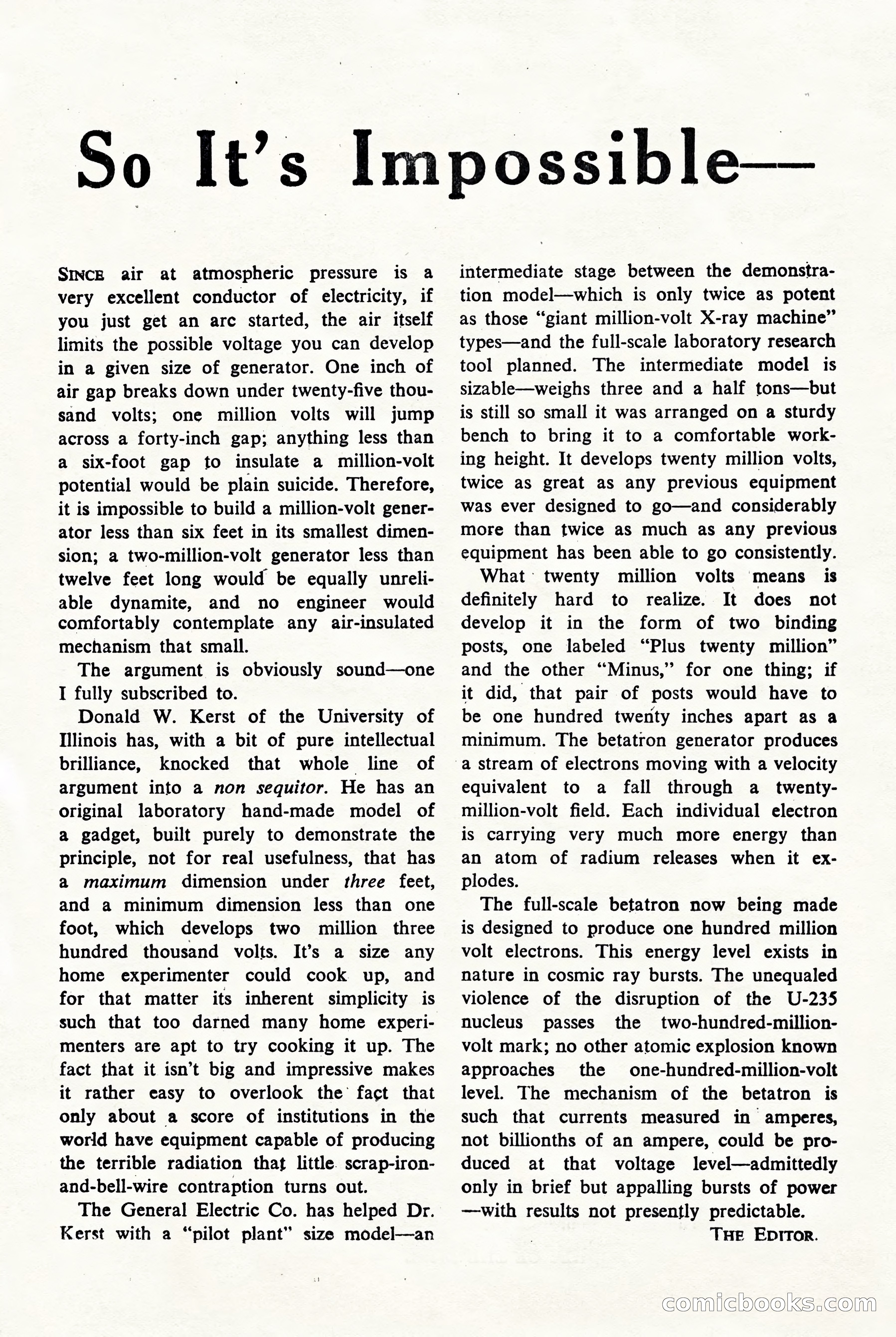
A restored page from Pulp Fiction, 1944. Page through the whole issue in the reader above.
📄 Transcribed text from this page (OCR, searchable)
Machine-transcribed from the original scan — historical spelling and the odd misread are preserved.
So It’s Impossible— SINCE air at atmospheric pressure is a very excellent conductor of electricity, if you just get an arc started, the air itself limits the possible voltage you can develop in a given size of generator. One inch of air gap breaks down under twenty-five thou- sand volts; one million volts will jump across a forty-inch gap; anything less than a six-foot gap to insulate a million-volt potential would be plain suicide. Therefore, it is impossible to build a million-volt gener- ator less than six feet in its smallest dimen- sion; a two-million-volt generator less than twelve feet long would be equally unreli- able dynamite, and no engineer would comfortably contemplate any air-insulated mechanism that small. The argument is obviously sound—one I fully subscribed to. Donald W. Kerst of the University of Illinois has, with a bit of pure intellectual brilliance, knocked that whole line of argument into a non sequitor. He has an original laboratory hand-made model of a gadget, built purely to demonstrate the principle, not for real usefulness, that has a maximum dimension under three feet, and a minimum dimension less than one foot, which develops two million three hundred thousand volts. It’s a size any home experimenter could cook up, and for that matter its inherent simplicity is such that too darned many home experi- menters are apt to try cooking it up. The fact that it isn’t big and impressive makes it rather easy to overlook the fact that only about a score of institutions in the world have equipment capable of producing the terrible radiation that little. scrap-iron- and-bell-wire contraption turns out. The General Electric Co. has helped Dr. Kerst with a “pilot plant” size model—an intermediate stage between the demonstra- tion model—which is only twice as potent as those “giant million-volt X-ray machine” types—and the full-scale laboratory research tool planned. The intermediate model is sizable—weighs three and a half tons—but is still so small it was arranged on a sturdy bench to bring it to a comfortable work- ing height. It develops twenty million volts, twice as great as any previous equipment was ever designed to go—and considerably more than twice as much as any previous equipment has been able to go consistently. What’ twenty million volts means is definitely hard to realize. It does not develop it in the form of two binding posts, one labeled “Plus twenty million” and the other “Minus,” for one thing; if it did, that pair of posts would have to be one hundred twenty inches apart as a minimum. The betatron generator produces a stream of electrons moving with a velocity equivalent to a fall through a_twenty- million-volt field. Each individual electron is carrying very much more energy than an atom of radium releases when it ex- plodes. The full-scale betatron now being made is designed to produce one hundred million volt electrons. This energy level exists in nature in cosmic ray bursts. The unequaled violence of the disruption of the U-235 nucleus passes the two-hundred-million- volt mark; no other atomic explosion known approaches the one-hundred-million-volt level. The mechanism of the betatron is such that currents measured in amperes, not billionths of an ampere, could be pro- duced at that voltage level—admittedly only in brief but appalling bursts of power —with results not presently predictable. THE EDITOR. Comiclbooks.c©