
Pulp Fiction, 1944 · page 65 of 68
Astounding Science Fiction (UK Edition) — page 65: what you’re looking at
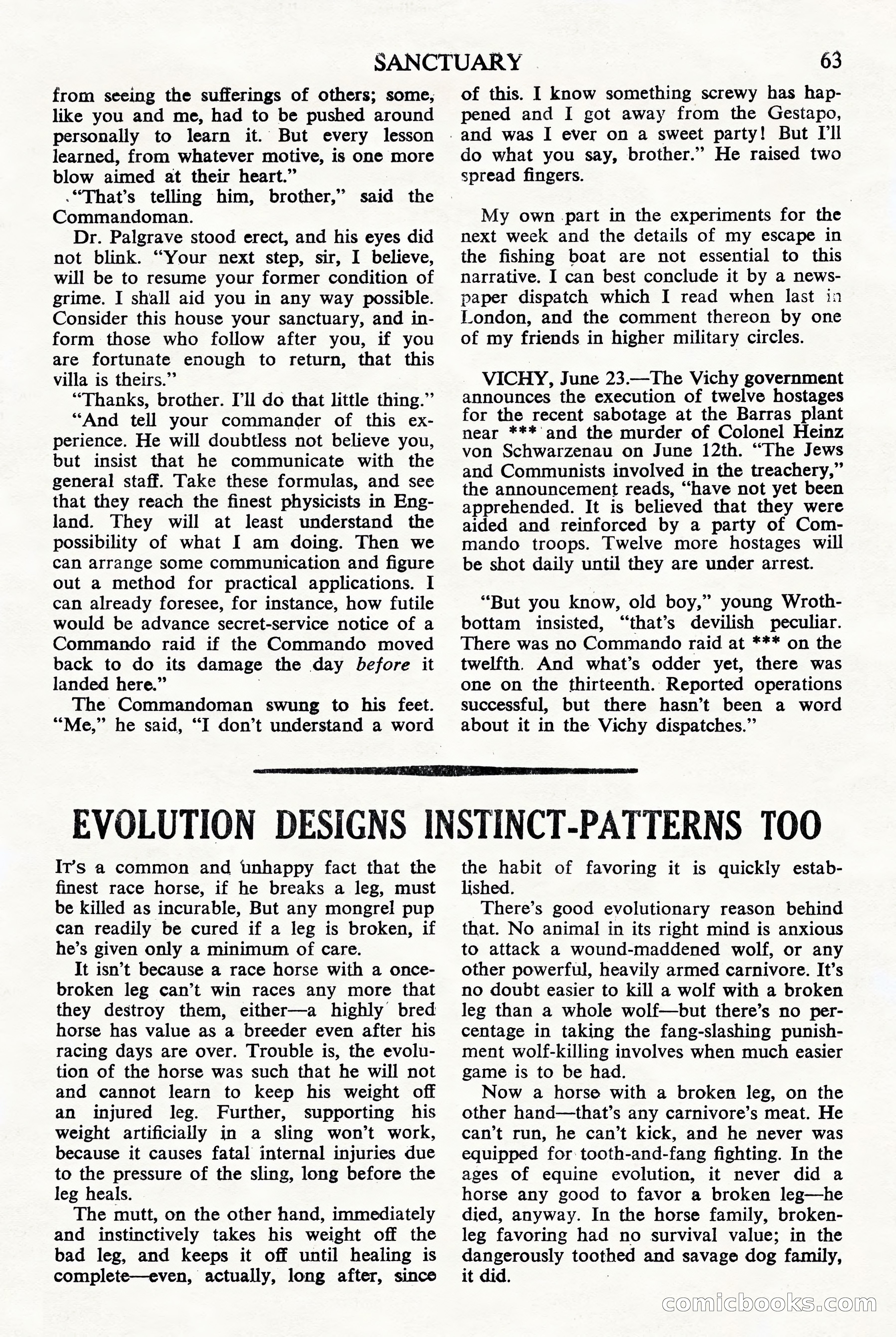
A restored page from Pulp Fiction, 1944. Page through the whole issue in the reader above.
📄 Transcribed text from this page (OCR, searchable)
Machine-transcribed from the original scan — historical spelling and the odd misread are preserved.
SANCTUARY from seeing the sufferings of others; some, like you and me, had to be pushed around personally to learn it. But every lesson learned, from whatever motive, is one more blow aimed at their heart.” .“That’s telling him, brother,” said the Commandoman. Dr. Palgrave stood erect, and his eyes did not blink. “Your next step, sir, I believe, will be to resume your former condition of grime. I shall aid you in any way possible. Consider this house your sanctuary, and in- form those who follow after you, if you are fortunate enough to return, that this villa is theirs.” “Thanks, brother. Ill do that little thing.” “And tell your commander of this ex- perience. He will doubtless not believe you, but insist that he communicate with the general staff. Take these formulas, and see that they reach the finest physicists in Eng- land. They will at least understand the possibility of what I am doing. Then we can arrange some communication and figure out a method for practical applications. I can already foresee, for instance, how futile would be advance secret-service notice of a Commando raid if the Commando moved back to do its damage the day before it landed here.” The Commandoman swung to his feet. “Me,” he said, “I don’t understand a word 63 of this. I know something screwy has hap- pened and I got away from the Gestapo, - and was I ever on a sweet party! But Ill do what you say, brother.” He raised two spread fingers. My own .part in the experiments for the i next week and the details of my escape in the fishing boat are not essential to this narrative. I can best conclude it by a news- paper dispatch which I read when last in London, and the comment thereon by one of my friends in higher military circles. VICHY, June 23.—The Vichy government announces the execution of twelve hostages for the recent sabotage at the Barras plant near *** and the murder of Colonel Heinz von Schwarzenau on June 12th. “The Jews and Communists involved in the treachery,” the announcement reads, “have not yet been apprehended. It is believed that they were aided and reinforced by a party of Com- mando troops. Twelve more hostages will be shot daily until they are under arrest. “But you know, old boy,” young Wroth- bottam insisted, “that’s devilish peculiar. There was no Commando raid at *** on the twelfth. And what’s odder yet, there was one on the thirteenth. Reported operations successful, but there hasn’t been a word about it in the Vichy dispatches.” aN TM IE RAN PLEIN Ee PIE RE IEE GA NI EVOLUTION DESIGNS INSTINCT-PATTERNS TOO It’s a common and unhappy fact that the finest race horse, if he breaks a leg, must be killed as incurable, But any mongrel pup can readily be cured if a leg is broken, if he’s given only a minimum of care. It isn’t because a race horse with a once- broken leg can’t win races any more that they destroy them, either—a highly bred horse has value as a breeder even after his racing days are over. Trouble is, the evolu- tion of the horse was such that he will not and cannot learn to keep his weight off an injured leg. Further, supporting his weight artificially in a sling won’t work, because it causes fatal internal injuries due to the pressure of the sling, long before the leg heals. The mutt, on the other hand, immediately and instinctively takes his weight off the bad leg, and keeps it off until healing is complete—even, actually, long after, since the habit of favoring it is quickly estab- lished. There’s good evolutionary reason behind that. No animal in its right mind is anxious to attack a wound-maddened wolf, or any other powerful, heavily armed carnivore. It’s no doubt easier to kill a wolf with a broken leg than a whole wolf—but there’s no per- centage in taking the fang-slashing punish- ment wolf-killing involves when much easier game is to be had. Now a horse with a broken leg, on the other hand—that’s any carnivore’s meat. He can’t run, he can’t kick, and he never was equipped for tooth-and-fang fighting. In the ages of equine evolution, it never did a horse any good to favor a broken leg—he died, anyway. In the horse family, broken- leg favoring had no survival value; in the dangerously toothed and savage dog family, it did. : comiicbooo S ©