
Pulp Fiction, 1944 · page 28 of 68
Astounding Science Fiction (UK Edition) — page 28: what you’re looking at
A restored page from Pulp Fiction, 1944. Page through the whole issue in the reader above.
📄 Transcribed text from this page (OCR, searchable)
Machine-transcribed from the original scan — historical spelling and the odd misread are preserved.
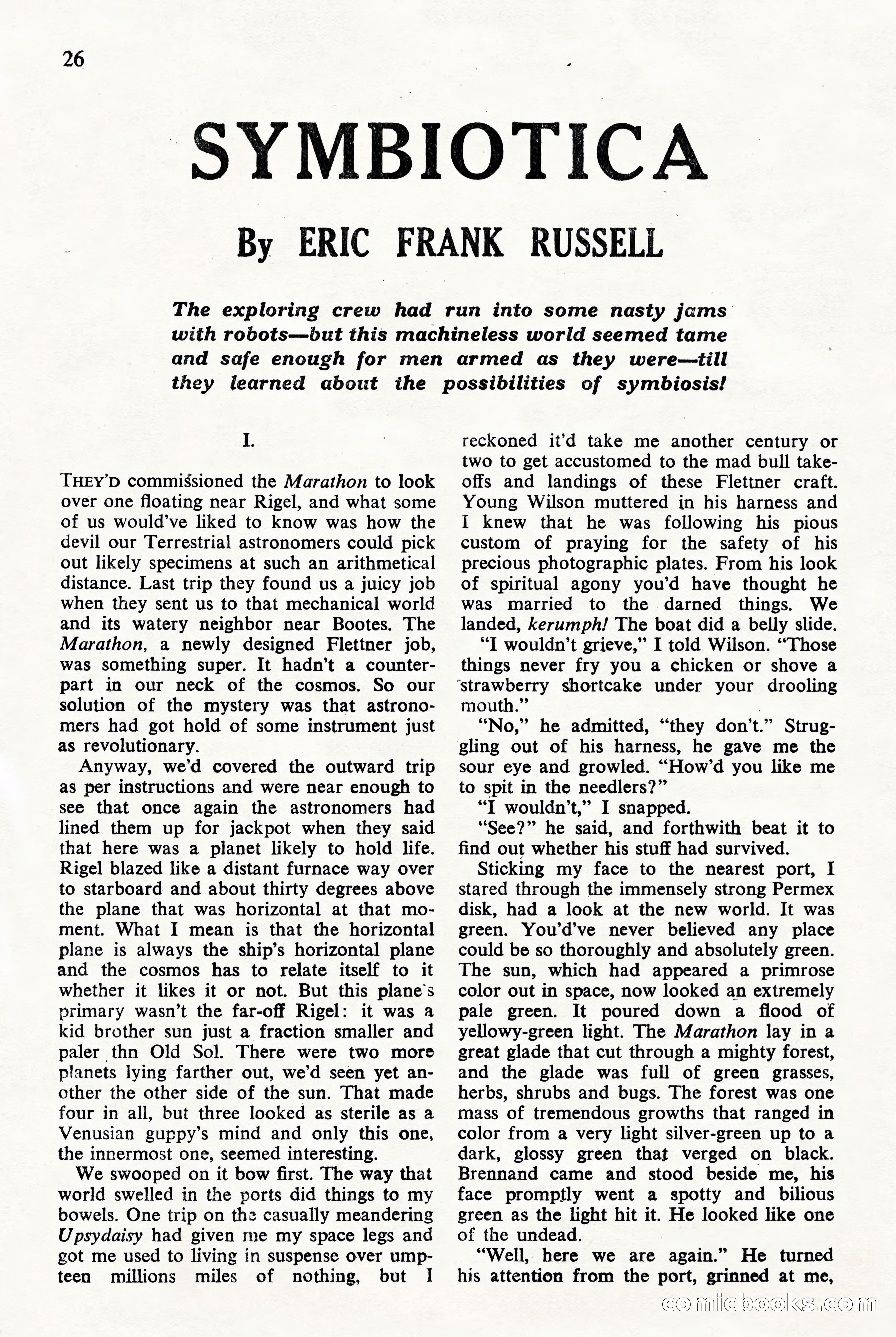
26 SYMBIOTICA By ERIC FRANK RUSSELL The exploring crew had run into some nasty jams with robots—but this machineless world seemed tame and safe enough for men armed as they were—iill they learned about ihe possibilities of symbiosis! I. THEY’D commissioned the Marathon to look over one floating near Rigel, and what some of us would’ve liked to know was how the devil our Terrestrial astronomers could pick out likely specimens at such an arithmetical distance. Last trip they found us a juicy job when they sent us to that mechanical world and its watery neighbor near Bootes. The Marathon, a newly designed Flettner job, was something super. It hadn’t a counter- part in our neck of the cosmos. So our solution of the mystery was that astrono- mers had got hold of some instrument just as revolutionary. Anyway, we'd covered the outward trip as per instructions and were near enough to see that once again the astronomers had lined them up for jackpot when they said that here was a planet likely to hold life. Rigel blazed like a distant furnace way over to starboard and about thirty degrees above the plane that was horizontal at that mo- ment. What I mean is that the horizontal plane is always the ship’s horizontal plane and the cosmos has to relate itself to it whether it likes it or not. But this planes primary wasn’t the far-off Rigel: it was a kid brother sun just a fraction smaller and paler thn Old Sol. There were two more planets lying farther out, we'd seen yet an- other the other side of the sun. That made four in all, but three looked as sterile as a Venusian guppy’s mind and only this one, the innermost one, seemed interesting. We swooped on it bow first. The way that world swelled in the ports did things to my bowels. One trip on the casually meandering Upsydaisy had given me my space legs and got me used to living in suspense over ump- teen millions miles of nothing, but I reckoned it'd take me another century or two to get accustomed to the mad bull take- offs and landings of these Flettner craft. Young Wilson muttered in his harness and I knew that he was following his pious custom of praying for the safety of his precious photographic plates. From his look of spiritual agony you’d have thought he was married to the darned things. We landed, kerumph! The boat did a belly slide. “TI wouldn’t grieve,” I told Wilson. ‘““Those things never fry you a chicken or shove a ‘strawberry shortcake under your drooling mouth.” “No,” he admitted, “they don’t.” Strug- gling out of his harness, he gave me the sour eye and growled. “How’d you like me to spit in the needlers?” “I wouldn't,” I snapped. “See?” he said, and forthwith beat it to find out whether his stuff had survived. Sticking my face to the nearest port, I stared through the immensely strong Permex disk, had a look at the new world. It was green. You’d’ve never believed any place could be so thoroughly and absolutely green. The sun, which had appeared a primrose color out in space, now looked an extremely pale green. It poured down a flood of yellowy-green light. The Marathon lay in a great glade that cut through a mighty forest, and the glade was full of green grasses, herbs, shrubs and bugs. The forest was one mass of tremendous growths that ranged in color from a very light silver-green up to a dark, glossy green that verged on_ black. Brennand came and stood beside me, his face promptly went a spotty and bilious green as the light hit it. He looked like one of the undead. “Well,- here we are Ati He turned his attention from the port, grinned at me, Comicbooks.c©