
Pulp Fiction, 1944 · page 27 of 68
Astounding Science Fiction (UK Edition) — page 27: what you’re looking at
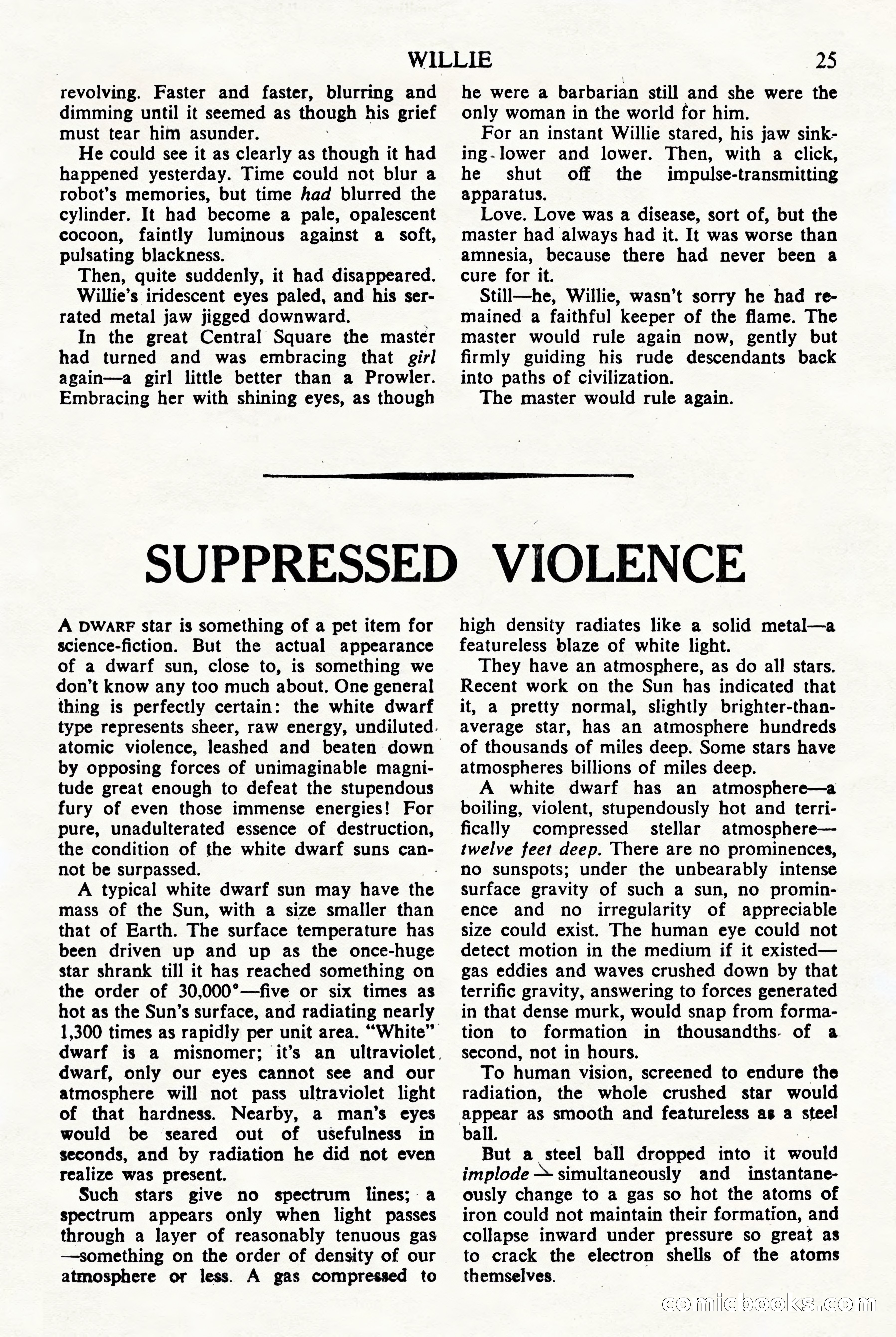
A restored page from Pulp Fiction, 1944. Page through the whole issue in the reader above.
📄 Transcribed text from this page (OCR, searchable)
Machine-transcribed from the original scan — historical spelling and the odd misread are preserved.
WILLIE revolving. Faster and faster, blurring and dimming until it seemed as though his grief must tear him asunder. He could see it as clearly as though it had happened yesterday. Time could not blur a robot’s memories, but time had blurred the cylinder. It had become a pale, opalescent cocoon, faintly luminous against a soft, pulsating blackness. Then, quite suddenly, it had disappeared. Willie’s iridescent eyes paled, and his ser- rated metal jaw jigged downward. In the great Central Square the master had turned and was embracing that girl again—a girl little better than a Prowler. Embracing her with shining eyes, as though 25 he were a barbarian still and she were the only woman in the world for him. For an instant Willie stared, his jaw sink- ing-lower and lower. Then, with a click, he shut off the impulse-transmitting apparatus. Love. Love was a disease, sort of, but the master had always had it. It was worse than amnesia, because there had never been a cure for it. | Still—he, Willie, wasn’t sorry he had re- mained a faithful keeper of the flame. The master would rule again now, gently but firmly guiding his rude descendants back into paths of civilization. The master would rule again. SUPPRESSED VIOLENCE A DwakF star is something of a pet item for science-fiction. But the actual appearance of a dwarf sun, close to, is something we don’t know any too much about. One general thing is perfectly certain: the white dwarf type represents sheer, raw energy, undiluted. atomic violence, leashed and beaten down by opposing forces of unimaginable magni- tude great enough to defeat the stupendous fury of even those immense energies! For pure, unadulterated essence of destruction, the condition of the white dwarf suns can- not be surpassed. ; A typical white dwarf sun may have the mass of the Sun, with a size smaller than that of Earth. The surface temperature has been driven up and up as the once-huge star shrank till it has reached something on the order of 30,000°—five or six times as hot as the Sun’s surface, and radiating nearly 1,300 times as rapidly per unit area. “White” dwarf is a misnomer; it’s an ultraviolet. dwarf, only our eyes cannot see and our atmosphere will not pass ultraviolet light of that hardness. Nearby, a man’s eyes would be seared out of usefulness in seconds, and by radiation he did not even realize was present. Such stars give no spectrum lines; a spectrum appears only when light passes through a layer of reasonably tenuous gas —something on the order of density of our atmosphere or less. A gas compressed to appear as smooth and featureless as a high density radiates like a solid metal—a featureless blaze of white light. They have an atmosphere, as do all stars. Recent work on the Sun has indicated that it, a pretty normal, slightly brighter-than- average star, has an atmosphere hundreds of thousands of miles deep. Some stars have atmospheres billions of miles deep. 3 A white dwarf has an atmosphere—a boiling, violent, stupendously hot and terri- fically compressed stellar atmosphere— twelve feet deep. There are no prominences, no sunspots; under the unbearably intense surface gravity of such a sun, no promin- ence and no irregularity of appreciable size could exist. The human eye could not detect motion in the medium if it existed— gas eddies and waves crushed down by that terrific gravity, answering to forces generated in that dense murk, would snap from forma- tion to formation in thousandths. of a second, not in hours. To human vision, screened to endure the radiation, the whole crushed star would steel ball. But a steel ball dropped into it would implode —- simultaneously and_instantane- ously change to a gas so hot the atoms of iron could not maintain their formation, and collapse inward under pressure so great as to crack the electron shells of the atoms themselves. comicbooao S (©