
Pulp Fiction, 1954 · page 34 of 132
Astounding Science Fiction, British Edition — page 34: what you’re looking at
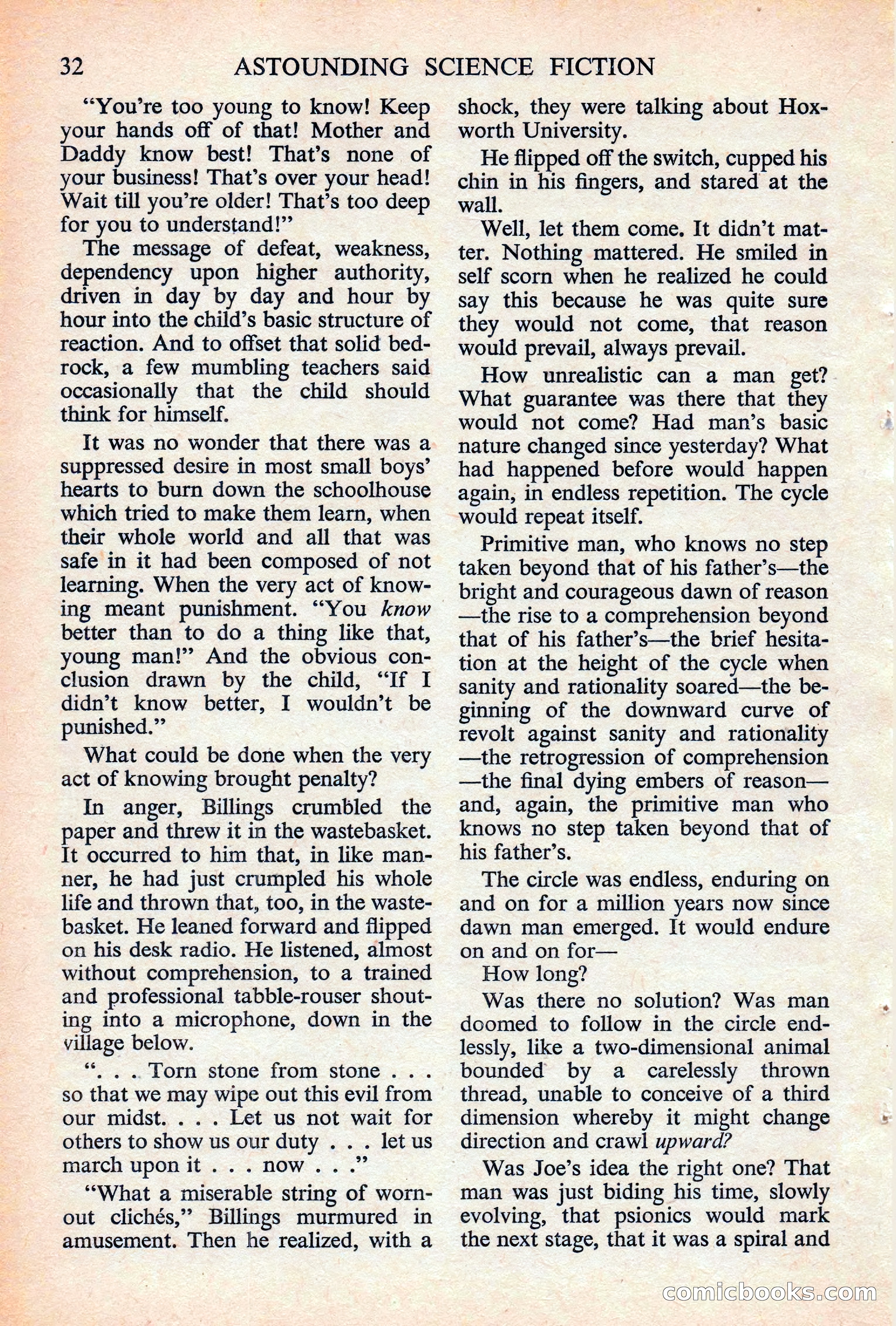
A restored page from Pulp Fiction, 1954. Page through the whole issue in the reader above.
📄 Transcribed text from this page (OCR, searchable)
Machine-transcribed from the original scan — historical spelling and the odd misread are preserved.
32 ASTOUNDING SCIENCE FICTION *““You’re too young to know! Keep your hands off of that! Mother and Daddy know best! That’s none of your business! That’s over your head! Wait till you’re older! That’s too deep for you to understand!” The message of defeat, weakness, dependency upon higher authority, driven in day by day and hour by hour into the child’s basic structure of reaction. And to offset that solid bed- rock, a few mumbling teachers said occasionally that the child should think for himself. It was no wonder that there was a suppressed desire in most small boys’ hearts to burn down the schoolhouse which tried to make them learn, when their whole world and all that was safe in it had been composed of not learning. When the very act of know- ing meant punishment. “You know better than to do a thing like that, young man!” And the obvious con- clusion drawn by the child, “If I didn’t know better, I wouldn’t be punished.” What could be done when the very act of knowing brought penalty? In anger, Billings crumbled the paper and threw it in the wastebasket. It occurred to him that, in like man- ner, he had just crumpled his whole life and thrown that, too, in the waste- basket. He leaned forward and flipped on his desk radio. He listened, almost without comprehension, to a trained and professional tabble-rouser shout- ing into a microphone, down in the village below. **. . . Yorn stone from stone... so that we may wipe out this evil from our midst. ... Let us not wait for others to show us our duty . . . let us march upon it . NOW: «5.3 “What a maiscmntle eae of worn- out clichés,” Billings murmured in amusement. Then he realized, with a shock, they were talking about Hox- worth University. He flipped off the switch, cupped his chin in his fingers, and stared at the wall. Well, let them come. It didn’t mat- ter. Nothing mattered. He smiled in self scorn when he realized he could say this because he was quite sure they would not come, that reason would prevail, always prevail. How unrealistic can a man get? What guarantee was there that they would not come? Had man’s basic nature changed since yesterday? What had happened before would happen again, in endless repetition. The cycle would repeat itself. Primitive man, who knows no step taken beyond that of his father’s—the bright and courageous dawn of reason —the rise to a comprehension beyond that of his father’s—the brief hesita- tion at the height of the cycle when sanity and rationality soared—the be- ginning of the downward curve of revolt against sanity and rationality —the retrogression of comprehension —the final dying embers of reason— and, again, the primitive man who knows no step taken beyond that of his father’s. The circle was endless, enduring on and on for a million years now since dawn man emerged. It would endure on and on for— How long? Was there no solution? Was man doomed to follow in the circle end- lessly, like a two-dimensional animal bounded by a carelessly thrown thread, unable to conceive of a third dimension whereby it might change direction and crawl upward? Was Joe’s idea the right one? That man was just biding his time, slowly evolving, that psionics would mark the next stage, that it was a spiral and connicloooks.c© iin