
Pulp Fiction, 1954 · page 33 of 132
Astounding Science Fiction, British Edition — page 33: what you’re looking at
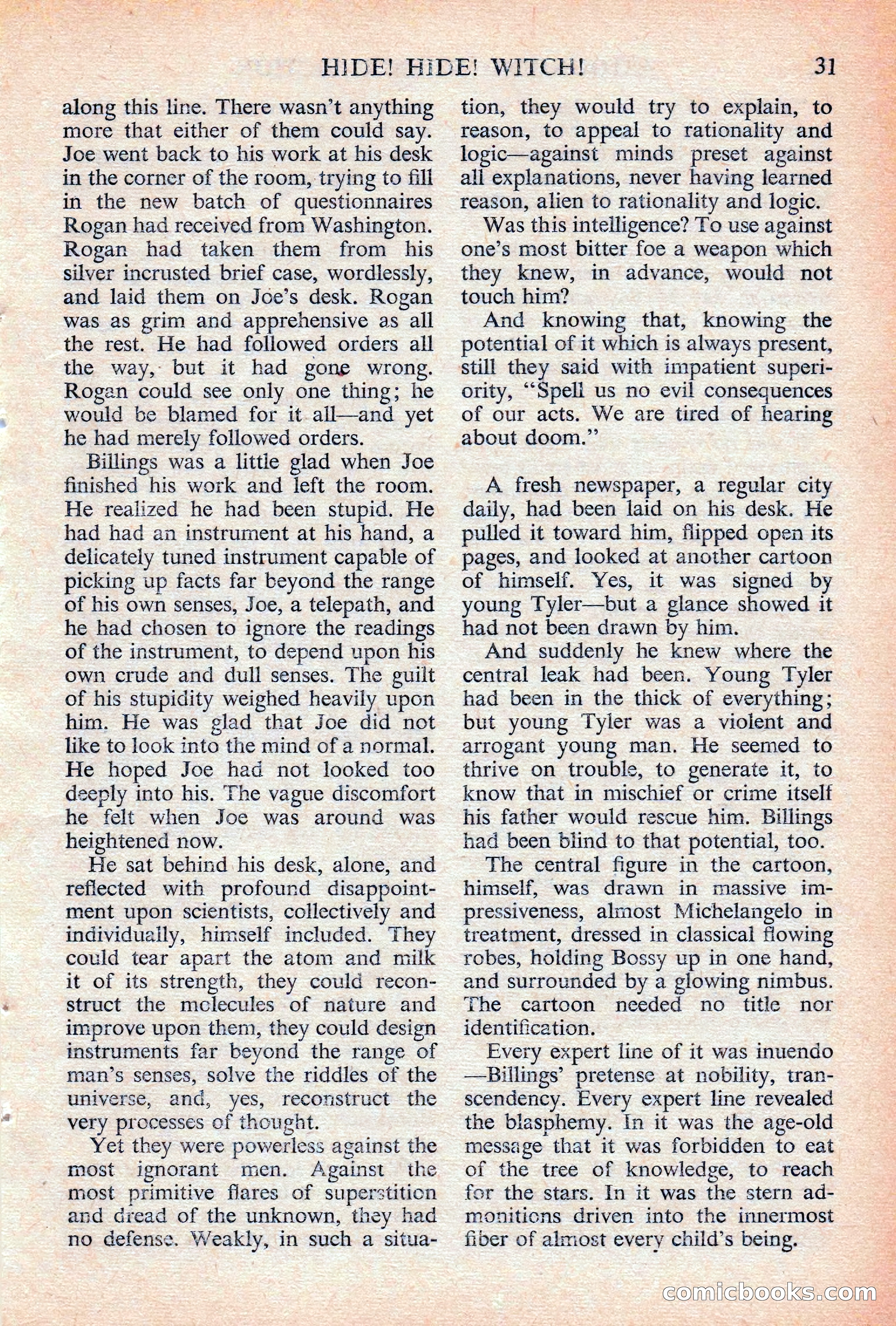
A restored page from Pulp Fiction, 1954. Page through the whole issue in the reader above.
📄 Transcribed text from this page (OCR, searchable)
Machine-transcribed from the original scan — historical spelling and the odd misread are preserved.
HIDE! HiDE! WITCH! along this line. There wasn’t anything more that either of them could say. Joe went back to his work at his desk in the corner of the room, trying to fill in the new batch of questionnaires Rogan had received from Washington. Rogan had taken them from his silver incrusted brief case, wordlessly, and laid them on Joe’s desk. Rogan was as grim and apprehensive as all the rest. He had followed orders all the way, but it had gone wrong. Rogan could see only one thing; he would be blamed for it.all—and yet he had merely followed orders. Billings was a little glad when Joe finished his work and left the room. He realized he had been stupid. He had had an instrument at his hand, a delicately tuned instrument capable of picking up facts far beyond the range of his own senses, Joe, a telepath, and he had chosen to ignore the readings of the instrument, to depend upon his own crude and dull senses. The guilt of his stupidity weighed heavily upon him. He was glad that Joe did not like to look into the mind of a normal. He hoped Joe had not looked too deeply into his. The vague discomfort he felt when Joe was around was heightened now. He sat behind his desk, alone, and reflected with profound disappoint- ment upon scientists, collectively and individually, himself included. They could tear apart the atom and milk it of its strength, they could recon- struct the mclecules of nature and improve upon them, they could design instruments far beyond the range of man’s senses, solve the riddles of the universe, and, yes, reconstruct the very processes of thought. Yet they were powerless against the most ignorant men. Against the most primitive flares of superstition and Gread of the unknown, they had no defense. Weakly, in such a situa- 31 tion, they would try to explain, to reason, to appeal to rationality and logic—against minds preset against ali explanations, never having learned reason, alien to rationality and logic. Was this intelligence? To use against one’s most bitter foe a weapon which they knew, in advance, would not touch him? And knowing that, knowing the potential of it which is always present, still they said with impatient superi- ority, “Spell us no evil consequences of our acts. We are tired of hearing about doom.” A. fresh newspaper, a regular city daily, had been laid on his desk. He pulled it toward him, flipped open its pages, and looked at another cartoon of himself. Yes, it was signed by young Tyler—but a glance showed it had not been drawn by him. And suddenly he knew where the ceniral leak had been. Young Tyler had been in the thick of everything; but young Tyler was a violent and arrogant young man. He seemed to thrive on trouble, to generate it, to know that in mischief or crime itself his father would rescue him. Billings had been biind to that potential, too. The central figure in the cartoon, himself, was drawn in massive im- pressiveness, almost Michelangelo in treatment, dressed in classical flowing robes, holding Bossy up in one hand, and surrounded by a glowing nimbus. The cartoon needed no title nor identification. Fvery expert line of it was inuendo —Billings’ pretense at nobility, tran- scendency. Every expert line revealed the blasphemy. In it was the age-old message that it was forbidden to eat of the tree of knowledge, to reach for the stars. In it was the stern ad- monitions driven into the innermost fiber of almost every child’s being. Conniclooolkks.Cc© im