
Pulp Fiction, 1954 · page 19 of 132
Astounding Science Fiction, British Edition — page 19: what you’re looking at
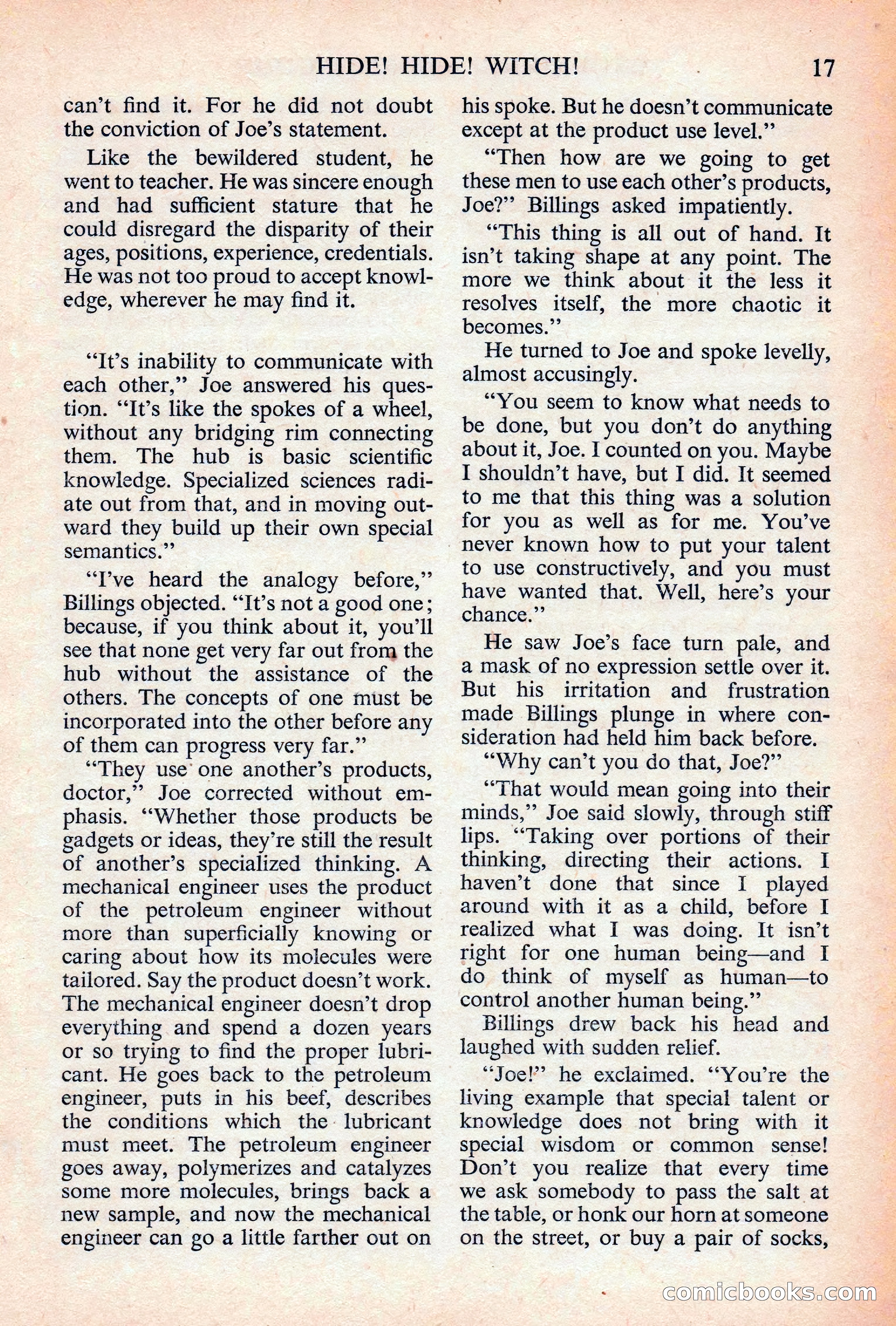
A restored page from Pulp Fiction, 1954. Page through the whole issue in the reader above.
📄 Transcribed text from this page (OCR, searchable)
Machine-transcribed from the original scan — historical spelling and the odd misread are preserved.
HIDE! HIDE! WITCH! . We can’t find it. For he did not doubt the conviction of Joe’s statement. Like the bewildered student, he went to teacher. He was sincere enough and had sufficient stature that he could disregard the disparity of their ages, positions, experience, credentials. He was not too proud to accept knowI- edge, wherever he may find it. “It’s inability to communicate with each other,” Joe answered his ques- tion. “It’s like the spokes of a wheel, without any bridging rim connecting them. The hub is basic scientific knowledge. Specialized sciences radi- ate out from that, and in moving out- ward they build up their own special semantics.” “T’ve heard the analogy before,” Billings objected. “It’s not a good one; because, if you think about it, you'll see that none get very far out from the hub without the assistance of the others. The concepts of one must be incorporated into the other before any of them can progress very far.” “They use’ one another’s products, doctor,’”” Joe corrected without em- phasis. ‘““Whether those products be gadgets or ideas, they’re still the result of another’s specialized thinking. A mechanical engineer uses the product of the petroleum engineer without more than superficially knowing or caring about how its molecules were tailored. Say the product doesn’t work. The mechanical engineer doesn’t drop everything and spend a dozen years or so trying to find the proper lubri- cant. He goes back to the petroleum engineer, puts in his beef, describes the conditions which the- lubricant must meet. The petroleum engineer goes away, polymerizes and catalyzes some more molecules, brings back a new sample, and now the mechanical engineer can go a little farther out on his spoke. But he doesn’t communicate except at the product use level.” “Then how are we going to get these men to use each other’s products, Joe?’ Billings asked impatiently. “This thing is all out of hand. It isn’t taking shape at any point. The more we think about it the less it resolves itself, the more chaotic it becomes.”’ He turned to Joe and spoke levelly, almost accusingly. “You seem to know what needs to be done, but you don’t do anything about it, Joe. I counted on you. Maybe I shouldn’t have, but I did. It seemed to me that this thing was a solution for you as well as for me. You’ve never known how to put your talent to use constructively, and you must have wanted that. Well, here’s your chance.” He saw Joe’s face turn pale, and a mask of no expression settle over it. But his irritation and frustration made Billings plunge in where con- sideration had held him back before. “Why can’t you do that, Joe?” “That would mean going into their minds,”’ Joe said slowly, through stiff lips. ““Taking over portions of their thinking, directing their actions. I haven’t done that since I played around with it as a child, before I realized what I was doing. It isn’t right for one human being—and I do think of myself as human—to control another human being.” Billings drew back his head and laughed with sudden relief. *“*Joe!’? he exclaimed. “‘You’re the living example that special talent or knowledge does not bring with it special wisdom or common sense! Don’t you realize that every time we ask somebody to pass the salt at the table, or honk our horn at someone on the street, or buy a pair of socks, Cconnicloooks.c© im