
Pulp Fiction, 1954 · page 18 of 132
Astounding Science Fiction, British Edition — page 18: what you’re looking at
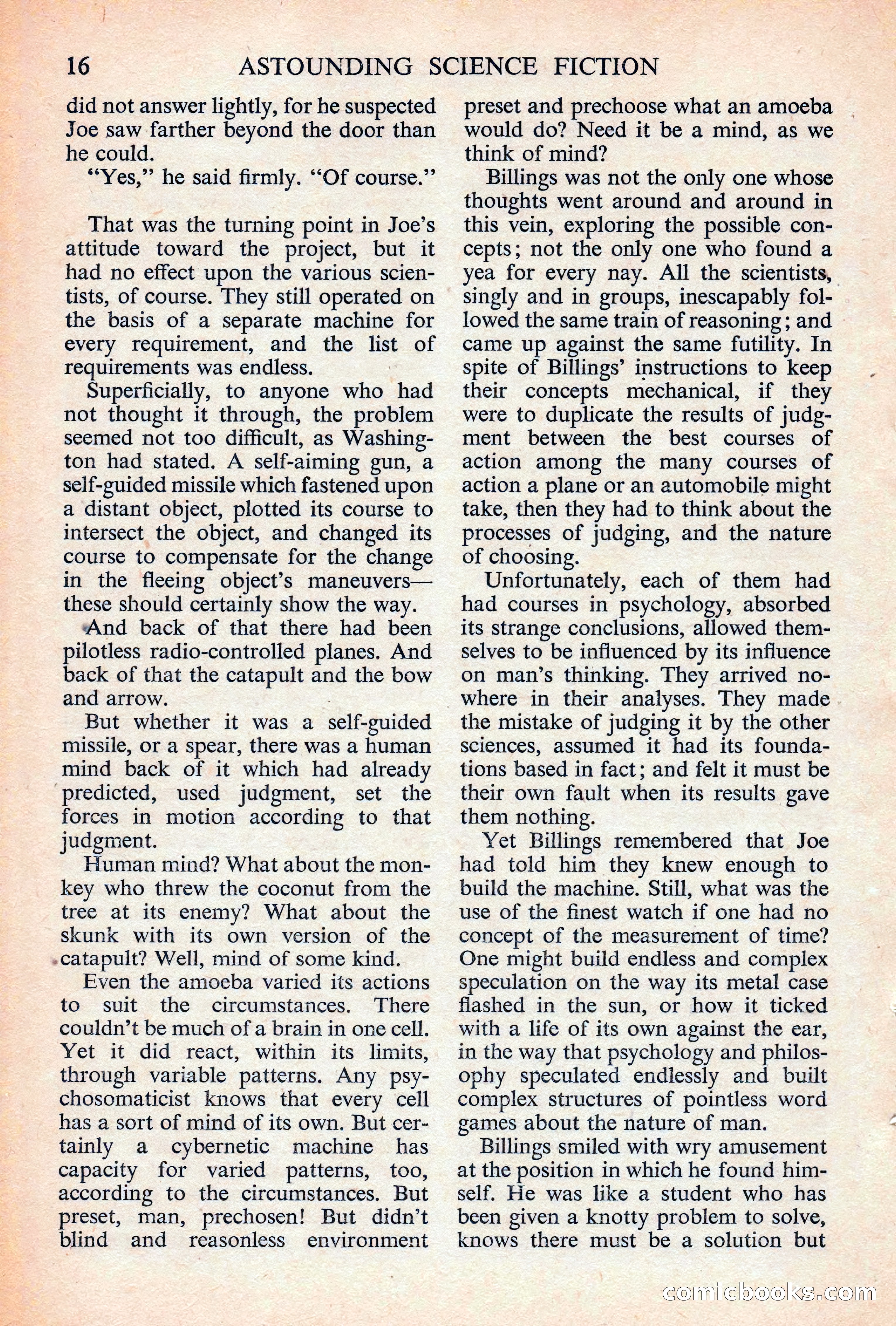
A restored page from Pulp Fiction, 1954. Page through the whole issue in the reader above.
📄 Transcribed text from this page (OCR, searchable)
Machine-transcribed from the original scan — historical spelling and the odd misread are preserved.
16 did not answer lightly, for he suspected Joe saw farther beyond the door than he could. **Yes,”’ he said firmly. ““Of course.” That was the turning point in Joe’s attitude toward the project, but it had no effect upon the various scien- tists, of course. They still operated on the basis of a separate machine for every requirement, and the list of requirements was endless. Superficially, to anyone who had not thought it through, the problem seemed not too difficult, as Washing- ton had stated. A self-aiming gun, a self-guided missile which fastened upon a distant object, plotted its course to intersect the object, and changed its course to compensate for the change in the fleeing object’s maneuvers— these should certainly show the way. “And back of that there had been pilotless radio-controlled planes. And back of that the catapult and the bow and arrow. But whether it was a self-guided missile, or a spear, there was a human mind back of it which had already predicted, used judgment, set the forces in motion according to that judgment. Human mind? What about the mon- key who threw the coconut from the tree at its enemy? What about the skunk with its own version of the -catapult? Well, mind of some kind. Fyen the amoeba varied its actions to suit the circumstances. There couldn’t be much of a brain in one cell. Yet it did react, within its limits, through variable patterns. Any psy- chosomaticist knows that every cell has a sort of mind of its own. But cer- tainly a cybernetic machine has capacity for varied patterns, too, according to the circumstances. But preset, man, prechosen! But didn’t blind and reasonless environment ASTOUNDING SCIENCE FICTION preset and prechoose what an amoeba would do? Need it be a mind, as we think of mind? Billings was not the only one whose thoughts went around and around in this vein, exploring the possible con- cepts; not the only one who found a yea for every nay. All the scientists, singly and in groups, inescapably fol- lowed the same train of reasoning; and came up against the same futility. In spite of Billings’ instructions to keep their concepts mechanical, if they were to duplicate the results of judg- ment between the best courses of action among the many courses of action a plane or an automobile might take, then they had to think about the processes of judging, and the nature of choosing. Unfortunately, each of them had had courses in psychology, absorbed its strange conclusions, allowed them- selves to be influenced by its influence on man’s thinking. They arrived no- _ where in their analyses. They made the mistake of judging it by the other sciences, assumed it had its founda- tions based in fact; and felt it must be their own fault when its results gave them nothing. Yet Billings remembered that Joe had told him they knew enough to build the machine. Still, what was the use of the finest watch if one had no concept of the measurement of time? One might build endless and complex speculation on the way its metal case flashed in the sun, or how it ticked with a life of its own against the ear, in the way that psychology and philos- ophy speculated endlessly and built complex structures of pointless word games about the nature of man. Billings smiled with wry amusement at the position in which he found him- self. He was like a student who has been given a knotty problem to solve, knows there must be a solution but connicloooks.c© ( im