
Pulp Fiction, 1954 · page 89 of 132
Astounding Science Fiction, British Edition — page 89: what you’re looking at
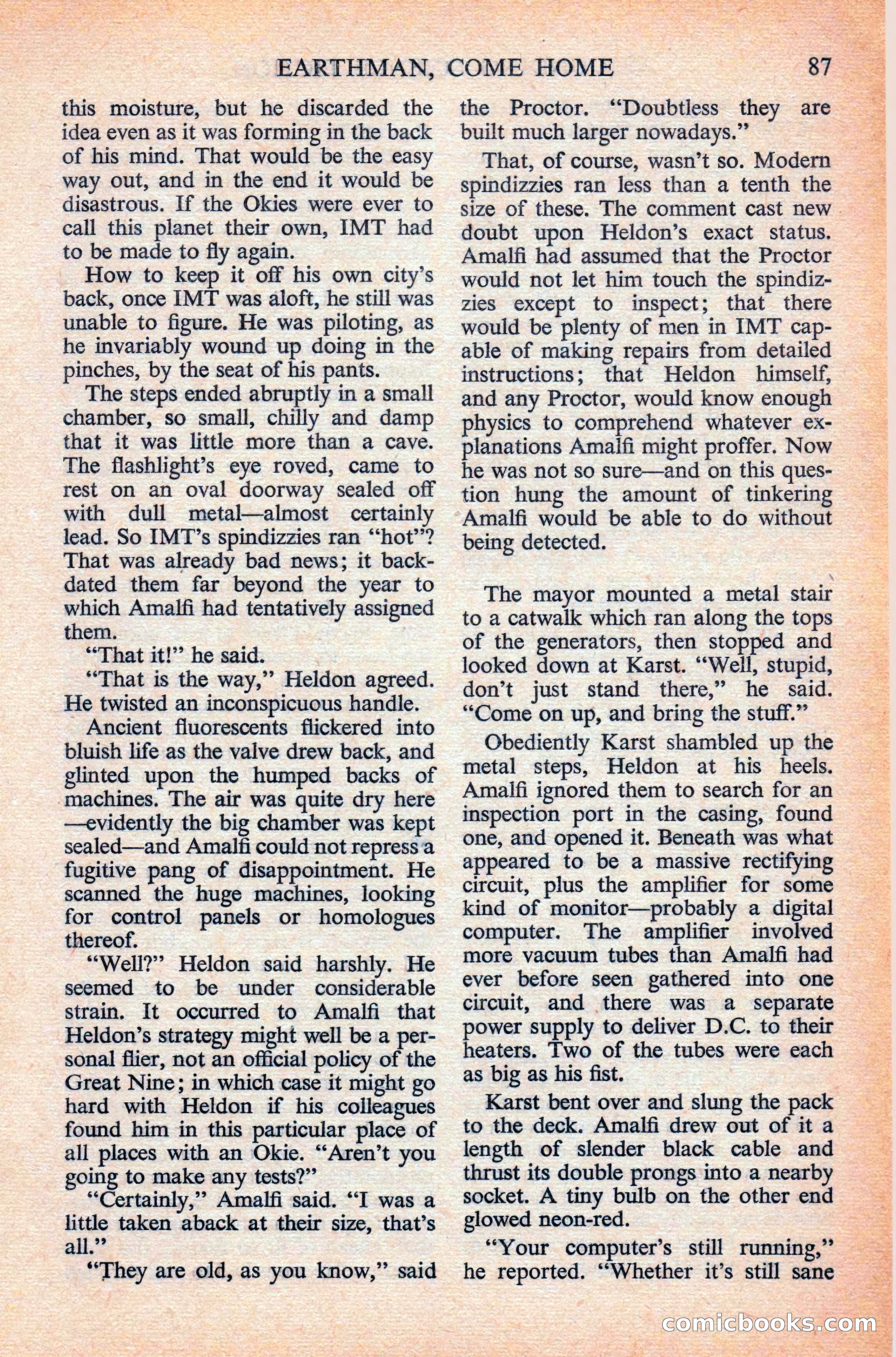
A restored page from Pulp Fiction, 1954. Page through the whole issue in the reader above.
📄 Transcribed text from this page (OCR, searchable)
Machine-transcribed from the original scan — historical spelling and the odd misread are preserved.
EARTHMAN, this moisture, but he discarded the idea even as it was forming in the back of his mind. That would be the easy way out, and in the end it would be disastrous. If the Okies were ever to call this planet their own, IMT had to be made to fly again. How to keep it off his own city’s back, once IMT was aloft, he still was unable to figure. He was piloting, as he invariably wound up doing in the pinches, by the seat of his pants. The steps ended abruptly in a small chamber, so small, chilly and damp that it was little more than a cave. The flashlight’s eye roved, came to rest on an oval doorway sealed off with dull metal—almost certainly lead. So IMT’s spindizzies ran “hot’’? That was already bad news; it back- dated them far beyond the year to which Amalfi had tentatively assigned them. “That it!” he said. “That is the way,’ Heldon agreed. He twisted an inconspicuous handle. Ancient fluorescents flickered into bluish life as the valve drew back, and glinted upon the humped backs of machines. The air was quite dry here —evidently the big chamber was kept sealed—and Amalfi could not repress a fugitive pang of disappointment. He scanned the huge machines, looking for control panels or homologues thereof. ““Well?”’ Heldon said harshly. He seemed to be under considerable strain. It occurred to Amalfi that Heldon’s strategy might well be a per- sonal flier, not an official policy of the Great Nine; in which case it might go hard with Heldon if his colleagues found him in this particular place of all places with an Okie. “Aren’t you going to make any tests?” “Certainly,” Amalfi said. “I was a little taken aback at their size, that’s all.” *“They are old, as you know,” said COME HOME the Proctor. “Doubtless they are built much larger nowadays.” That, of course, wasn’t so. Modern spindizzies ran less than a tenth the size of these. The comment cast new . doubt upon Heldon’s exact status. Amalfi had assumed that the Proctor would not let him touch the spindiz- zies except to inspect; that there would be plenty of men in IMT cap- able of making repairs from detailed instructions; that Heldon himself, and any Proctor, would know enough physics to comprehend whatever ex- planations Amalfi might proffer. Now he was not so sure—and on this ques- tion hung the amount of tinkering Amalfi would be able to do without being detected. The mayor mounted a metal stair to a catwalk which ran along the tops of the generators, then stopped and looked down at Karst. ‘Well, stupid, don’t just stand there,” he said. “Come on up, and bring the stuff.” Obediently Karst shambled up the metal steps, Heldon at his heels. Amalfi ignored them to search for an inspection port in the casing, found one, and opened it. Beneath was what appeared to be a massive rectifying circuit, plus the amplifier for some kind of monitor—probably a digital computer. The amplifier involved more vacuum tubes than Amalfi had ever before seen gathered into one circuit, and there was a separate power supply to deliver D.C. to their heaters. Two of the tubes were each as big as his fist. Karst bent over and slung the pack to the deck. Amalfi drew out of it a length of slender black cable and thrust its double prongs into a nearby socket. A tiny bulb on the other end glowed neon-red. “Your computer’s still running,” he reported. “Whether it’s still sane CoOmichbooks:co Of eae Ga m . ~~