
Pulp Fiction, 1954 · page 88 of 132
Astounding Science Fiction, British Edition — page 88: what you’re looking at
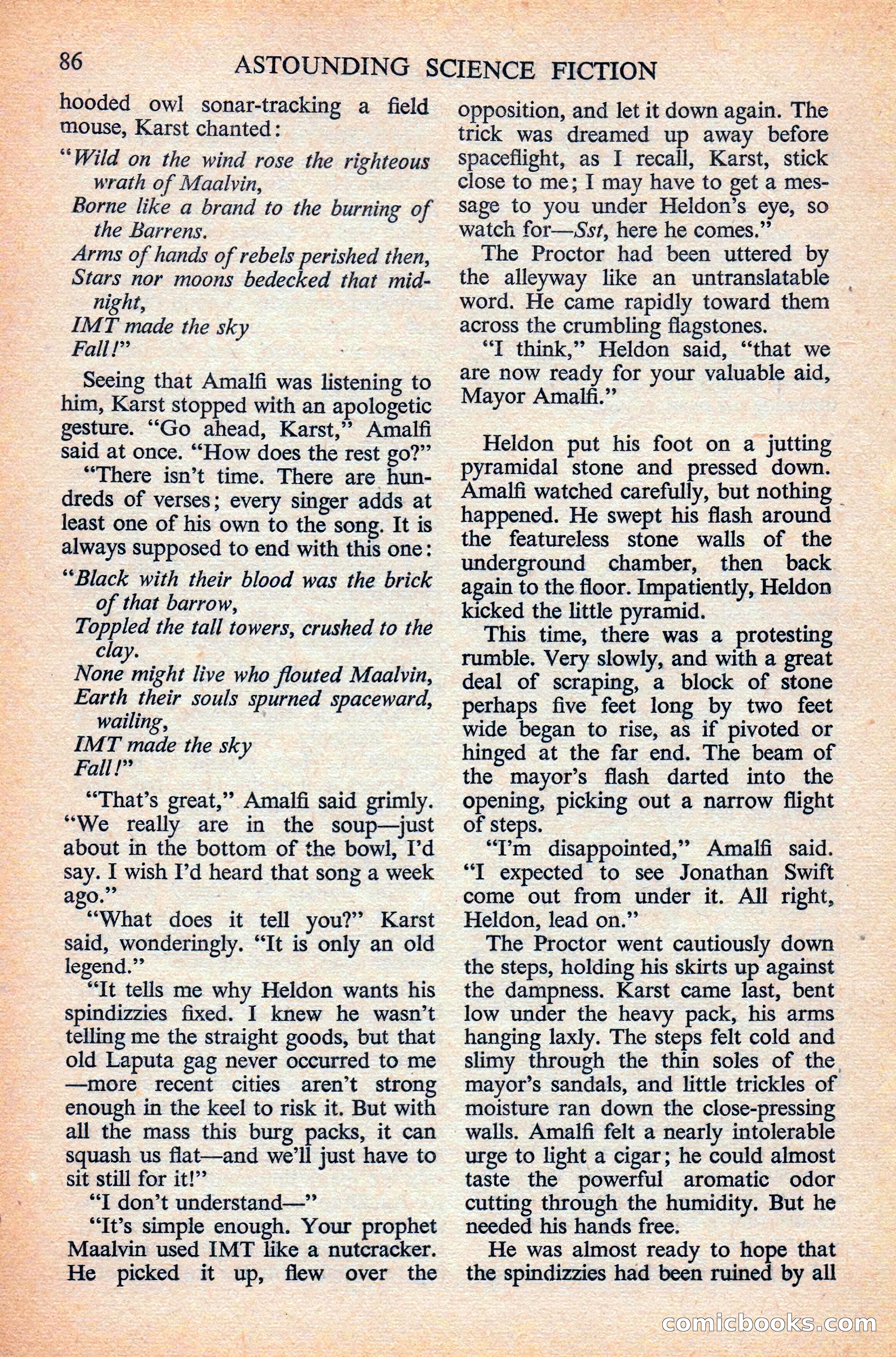
A restored page from Pulp Fiction, 1954. Page through the whole issue in the reader above.
📄 Transcribed text from this page (OCR, searchable)
Machine-transcribed from the original scan — historical spelling and the odd misread are preserved.
86 hooded owl sonar-tracking a field mouse, Karst chanted: “Wild on the wind rose the righteous wrath of Maalvin, Borne like a brand to the burning of the Barrens. Arms of hands of rebels perished then, Stars nor moons bedecked that mid- night, IMT made the sky Fall!’ Seeing that Amalfi was listening to him, Karst stopped with an apologetic gesture. “Go ahead, Karst,” Amalfi said at once. “How does the rest go?” “There isn’t time. There are hun- dreds of verses; every singer adds at least one of his own to the song. It is always supposed to end with this one: “Black with their blood was the brick of that barrow, Toppled the tall towers, crushed to the clay. None might live who flouted Maalvin, Earth their souls spurned spaceward, wailing, IMT made the sky Fall!” ‘“That’s great,’ Amalfi said grimly. “We really are in the soup—just about in the bottom of the bowl, I’d say. I wish I’d heard that song a week ago.” “What does it tell you?” Karst said, wonderingly. “It is only an old legend.” “It tells me why Heldon wants his spindizzies fixed. I knew he wasn’t telling me the straight goods, but that old Laputa gag never occurred to me —more recent cities aren’t strong enough in the keel to risk it. But with all the mass this burg packs, it can squash us flat—and we'll just have to sit still for it!” “TI don’t understand—” “It’s simple enough. Your prophet Maalvin used IMT like a nutcracker. He picked it up, flew over the ASTOUNDING SCIENCE FICTION opposition, and let it down again. The trick was dreamed up away before Spaceflight, as I recall, Karst, stick close to me; I may have to get a mes- Sage to you under Heldon’s eye, so watch for—=Sst, here he comes.” The Proctor had been uttered by the alleyway like an untranslatable | word. He came rapidly toward them across the crumbling flagstones. “IT think,” Heldon said, “that we are now ready for your valuable aid, Mayor Amalfi.” Heldon put his foot on a jutting pyramidal stone and pressed down. Amalfi watched carefully, but nothing happened. He swept his flash around | the featureless stone walls of the underground chamber, then back again to the floor. Impatiently, Heldon kicked the little pyramid. This time, there was a protesting rumble. Very slowly, and with a great deal of scraping, a block of stone perhaps five feet long by two feet wide began to rise, as if pivoted or hinged at the far end. The beam of the mayor’s flash darted into the opening, picking out a narrow flight of steps. “I’m disappointed,” Amalfi said. “T expected to see Jonathan Swift come out from under it. All right, Heldon, lead on.”’ The Proctor went cautiously down the steps, holding his skirts up against the dampness. Karst came last, bent low under the heavy pack, his arms hanging laxly. The steps felt cold and slimy through the thin soles of the, mayor’s sandals, and little trickles of moisture ran down the close-pressing walls. Amalfi felt a nearly intolerable urge to light a cigar; he could almost taste the powerful aromatic odor cutting through the humidity. But he needed his hands free. He was almost ready to hope that the spindizzies had been ruined by all Gomi Ghooksreo im