
Pulp Fiction, 1954 · page 82 of 132
Astounding Science Fiction, British Edition — page 82: what you’re looking at
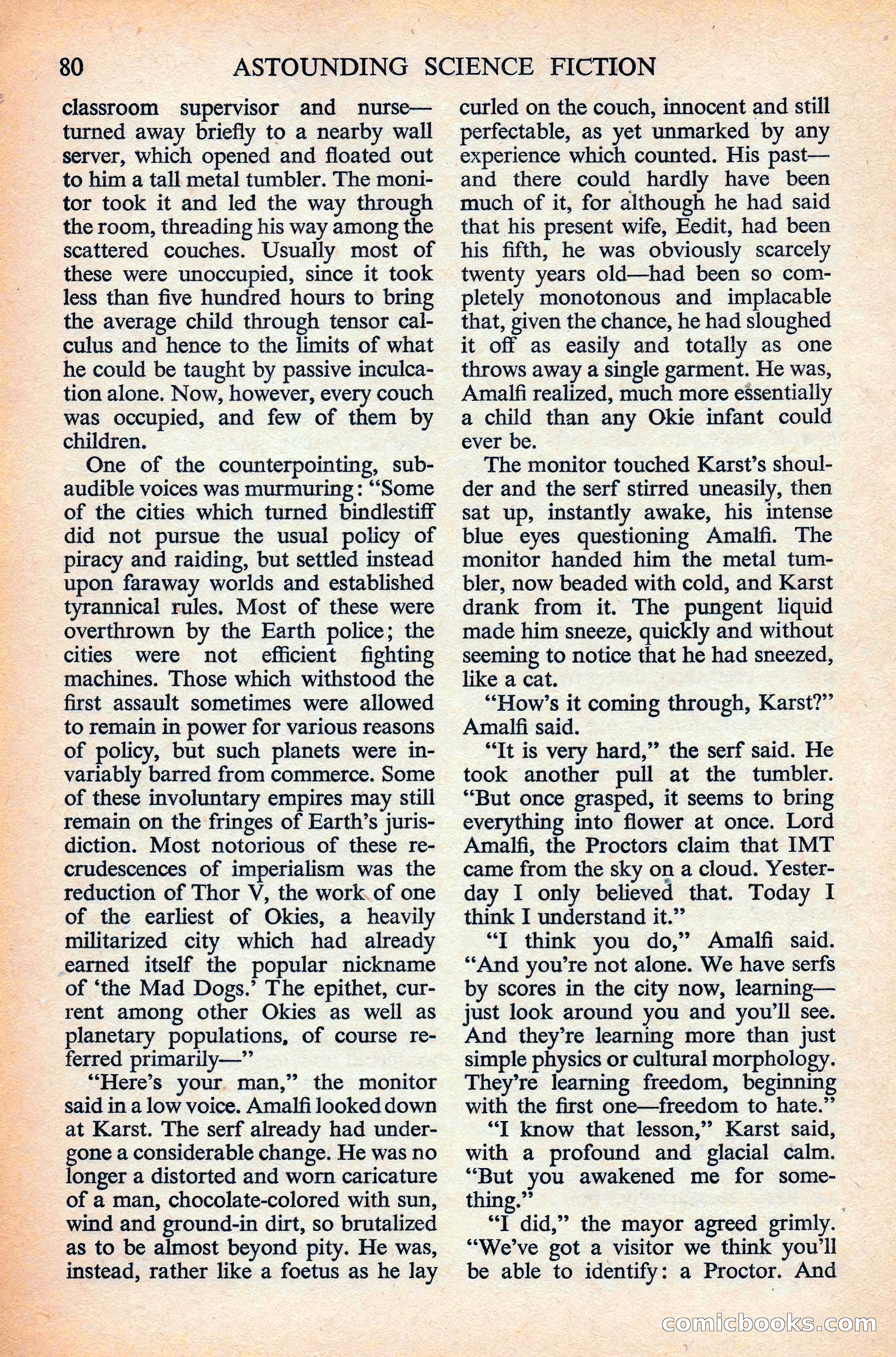
A restored page from Pulp Fiction, 1954. Page through the whole issue in the reader above.
📄 Transcribed text from this page (OCR, searchable)
Machine-transcribed from the original scan — historical spelling and the odd misread are preserved.
80 classroom supervisor and nurse— turned away briefly to a nearby wall server, which opened and floated out to him a tall metal tumbler. The moni- tor took it and led the way through the room, threading his way among the scattered couches. Usually most of these were unoccupied, since it took less than five hundred hours to bring the average child through tensor cal- culus and hence to the limits of what he could be taught by passive inculca- tion alone. Now, however, every couch was occupied, and few of them by children. One of the counterpointing, sub- audible voices was murmuring: “Some of the cities which turned bindlestiff did not pursue the usual policy of piracy and raiding, but settled instead upon faraway worlds and established tyrannical rules. Most of these were overthrown by the Earth police; the cities were not efficient fighting machines. Those which withstood the first assault sometimes were allowed to remain in power for various reasons of policy, but such planets were in- variably barred from commerce. Some of these involuntary empires may still remain on the fringes of Earth’s juris- diction. Most notorious of these re- crudescences of imperialism was the reduction of Thor V, the work. of one of the earliest of Okies, a heavily militarized city which had already earned itself the popular nickname of ‘the Mad Dogs.’ The epithet, cur- rent among other Okies as well as planetary populations, of course re- ferred primarily—” ““Here’s your. man,” the monitor said in a low voice. Amalfi looked down at Karst. The serf already had under- gone a considerable change. He was no longer a distorted and worn caricature of a man, chocolate-colored with sun, wind and ground-in dirt, so brutalized as to be almost beyond pity. He was, instead, rather like a foetus as he lay ASTOUNDING SCIENCE FICTION curled on the couch, innocent and still perfectable, as yet unmarked by any experience which counted. His past— and there could hardly have been much of it, for although he had said that his present wife, Eedit, had been his fifth, he was obviously scarcely twenty years old—had been so com- pletely monotonous and implacable that, given the chance, he had sloughed it off as easily and totally as one throws away a single garment. He was, Amalfi realized, much more essentially a child than any Okie infant could ever be. The monitor touched Karst’s shoul- der and the serf stirred uneasily, then sat up, instantly awake, his intense blue eyes questioning Amalfi. The monitor handed him the metal tum- bler, now beaded with cold, and Karst drank from it. The pungent liquid made him sneeze, quickly and without seeming to notice that he had sneezed, like a cat. ‘““How’s it coming through, Karst?” Amalfi said. “It is very hard,” the serf said. He took another pull at the tumbler. “But once grasped, it seems to bring everything into flower at once. Lord Amalfi, the Proctors claim that IMT came from the sky on a cloud. Yester- day I only believed that. Today I think I understand it.” “I think you do,” Amalfi said. ‘And you’re not alone. We have serfs by scores in the city now, learning— just look around you and you'll see. And they’re learning more than just simple physics or cultural morphology. They’re learning freedom, beginning with the first one—freedom to hate.” “I know that lesson,” Karst said, with a profound and glacial calm. “But you awakened me for some- thing.” “I did,” the mayor agreed grimly. “We've got a visitor we think you'll be able to identify: a Proctor. And connicloooks.c© im