
Pulp Fiction, 1954 · page 81 of 132
Astounding Science Fiction, British Edition — page 81: what you’re looking at
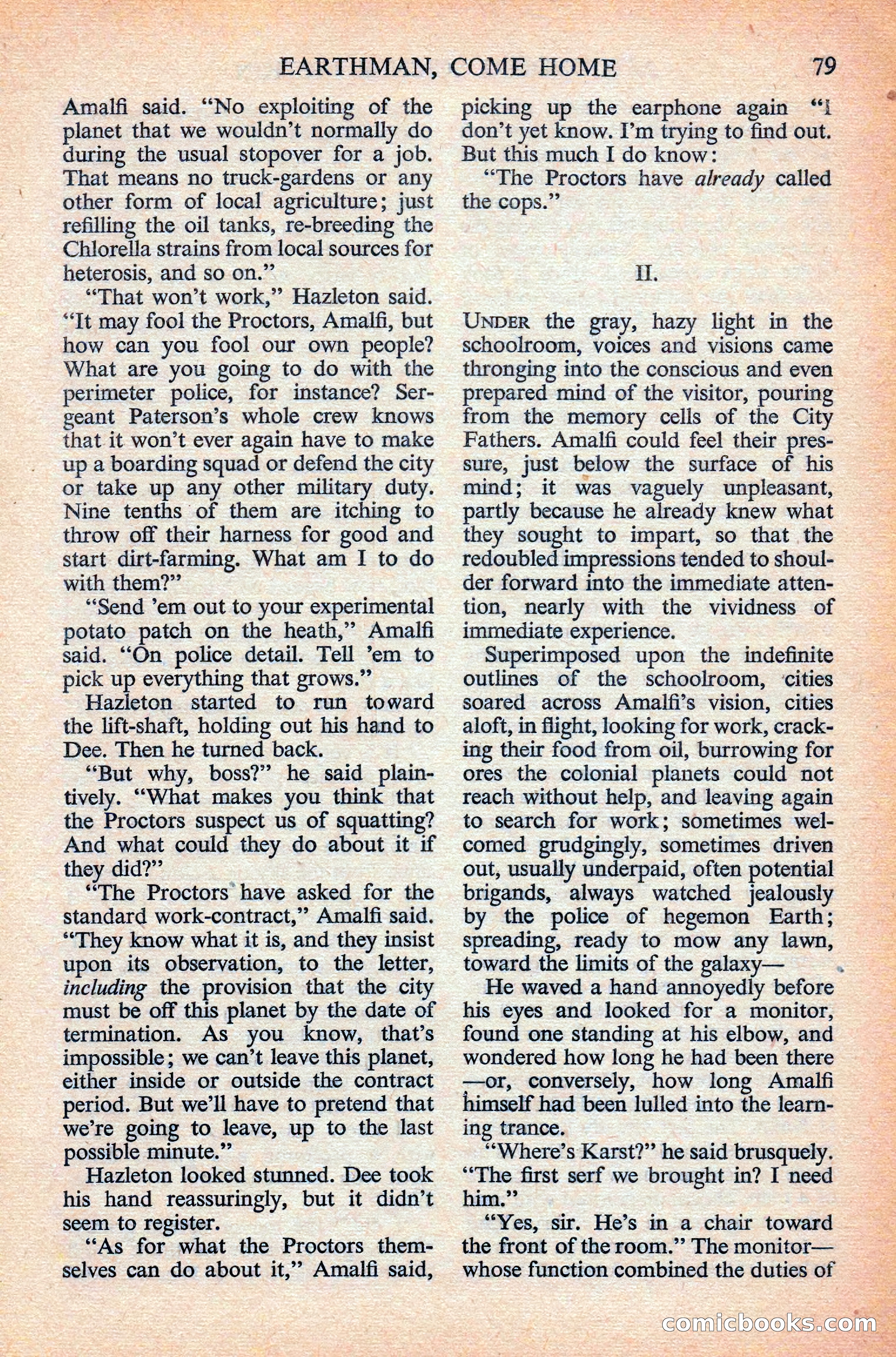
A restored page from Pulp Fiction, 1954. Page through the whole issue in the reader above.
📄 Transcribed text from this page (OCR, searchable)
Machine-transcribed from the original scan — historical spelling and the odd misread are preserved.
EARTHMAN, COME HOME ih Amalfi said. “No exploiting of the planet that we wouldn’t normally do during the usual stopover for a job. That means no truck-gardens or any other form of local agriculture; just refilling the oil tanks, re-breeding the Chlorella strains from local sources for heterosis, and so on.” “That won’t work,”’ Hazleton said. “Tt may fool the Proctors, Amalfi, but how can you fool our own people? What are you going to do with the perimeter police, for instance? Ser- geant Paterson’s whole crew knows that it won’t ever again have to make up a boarding squad or defend the city or take up any other military duty. Nine tenths of them are itching to throw off their harness for good and start dirt-farming. What am I to do with them?” ‘Send ’em out to your experimental potato patch on the heath,” Amalfi said. “On police detail. Tell ’em to pick up everything that grows.” Hazleton started to run toward the lift-shaft, holding out his hand to Dee. Then he turned back. “But why, boss?” he said plain- tively. “What makes you think that the Proctors suspect us of squatting? And what could they do about it if they did?” “The Proctors have asked for the standard work-contract,’’ Amalfi said. “They know what it is, and they insist upon its observation, to the letter, including the provision that the city must be off this planet by the date of termination. As you know, that’s impossible; we can’t leave this planet, either inside or outside the contract period. But we'll have to pretend that we're going to leave, up to the last possible minute.” Hazleton looked stunned. Dee took his hand reassuringly, but it didn’t seem to register. ‘As for what the Proctors them- selves can do about it,” Amalfi said, picking up the earphone again “i don’t yet know. I’m trying to find out. But this much I do know: “The Proctors have already called the cops.” iy, UNDER the gray, hazy light in the schoolroom, voices and visions came thronging into the conscious and even prepared mind of the visitor, pouring from the memory cells of the City Fathers. Amalfi could feel their pres- sure, just below the surface of his mind; it was vaguely unpleasant, partly because he already knew what they sought to impart, so that the redoubled impressions tended to shoul- der forward into the immediate atten- tion, nearly with the vividness of immediate experience. Superimposed upon the indefinite outlines of the schoolroom, cities soared across Amalfi’s vision, cities aloft, in flight, looking for work, crack- ing their food from oil, burrowing for ores the colonial planets could not reach without help, and leaving again to search for work; sometimes wel- comed grudgingly, sometimes driven out, usually underpaid, often potential brigands, always watched jealously by the police of hegemon Earth; spreading, ready to mow any lawn, toward the limits of the galaxy— He waved a hand annoyedly before his eyes and looked for a monitor, found one standing at his elbow, and wondered how long he had been there —or, conversely, how long Amalfi himself had been lulled into the learn- ing trance. ‘““Where’s Karst?” he said brusquely. ‘The first serf we brought in? I need him.” “Yes, sir. He’s in a chair toward the front of the room.”’ The monitor— whose function combined the duties of Comichbooksnco