
Pulp Fiction, 1954 · page 42 of 132
Astounding Science Fiction, British Edition — page 42: what you’re looking at
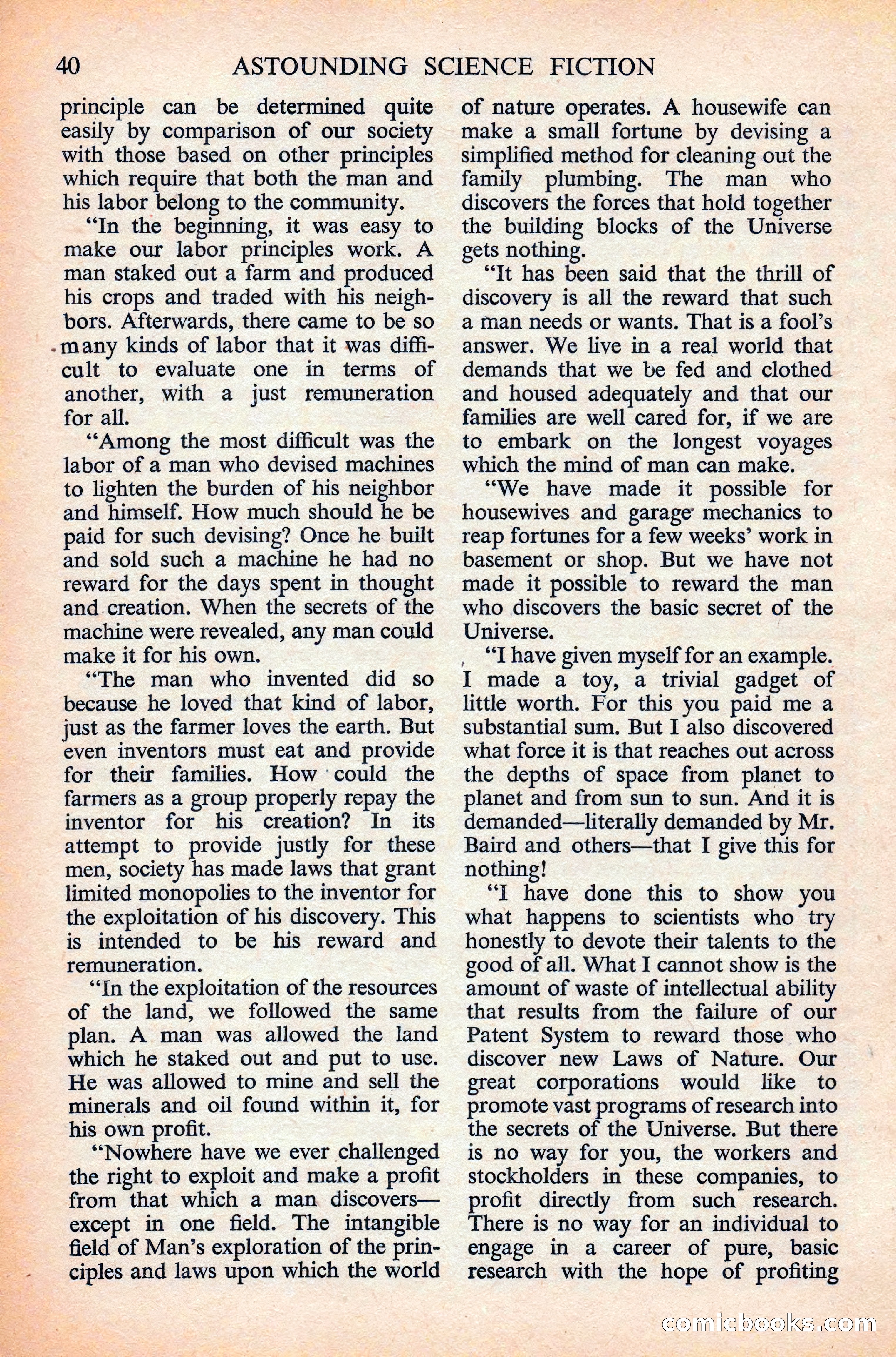
A restored page from Pulp Fiction, 1954. Page through the whole issue in the reader above.
📄 Transcribed text from this page (OCR, searchable)
Machine-transcribed from the original scan — historical spelling and the odd misread are preserved.
40 principle can be determined quite easily by comparison of our society with those based on other principles which require that both the man and his labor belong to the community. “In the beginning, it was easy to make our labor principles work. A man staked out a farm and produced his crops and traded with his neigh- bors. Afterwards, there came to be so -many kinds of labor that it was diffi- cult to evaluate one in terms of another, with a just remuneration for all. ‘““Among the most difficult was the labor of a man who devised machines to lighten the burden of his neighbor and himself. How much should he be paid for such devising? Once he built and sold such a machine he had no reward for the days spent in thought and creation. When the secrets of the machine were revealed, any man could make it for his own. “The man who invented did so because he loved that kind of labor, just as the farmer loves the earth. But even inventors must eat and provide for their families. How ‘could the farmers as a group properly repay the inventor for his creation? In its attempt to provide justly for these men, society has made laws that grant limited monopolies to the inventor for the exploitation of his discovery. This is intended to be his reward and remuneration. “In the exploitation of the resources of the land, we followed the same plan. A man was allowed the land which he staked out and put to use. He was allowed to mine and sell the minerals and oil found within it, for his own profit. “Nowhere have we ever challenged the right to exploit and make a profit from that which a man discovers— except in one field. The intangible field of Man’s exploration of the prin- ciples and laws upon which the world ASTOUNDING SCIENCE FICTION of nature operates. A housewife can make a small fortune by devising a simplified method for cleaning out the family plumbing. The man who discovers the forces that hold together the building blocks of the Universe gets nothing. “It has been said that the thrill of discovery is all the reward that such a man needs or wants. That is a fool’s answer. We live in a real world that demands that we be fed and clothed and housed adequately and that our families are well cared for, if we are to embark on the longest voyages which the mind of man can make. ‘We have made it possible for housewives and garage mechanics to reap fortunes for a few weeks’ work in basement or shop. But we have not made it possible to reward the man who discovers the basic secret of the Universe. “I have given myself for an example. I made a toy, a trivial gadget of little worth. For this you paid me a substantial sum. But I also discovered what force it is that reaches out across the depths of space from planet to planet and from sun to sun. And it is demanded—literally demanded by Mr. Baird and others—that I give this for nothing! “I have done this to show you what happens to scientists who try honestly to devote their talents to the good of all. What I cannot show is the amount of waste of intellectual ability that results from the failure of our Patent System to reward those who discover new Laws of Nature. Our great corporations would like to promote vast programs of research into the secrets of the Universe. But there is no way for you, the workers and stockholders in these companies, to profit directly from such research. There is no way for an individual to engage in a career of pure, basic research with the hope of profiting ComMmichooksnco im