
Pulp Fiction, 1954 · page 41 of 132
Astounding Science Fiction, British Edition — page 41: what you’re looking at
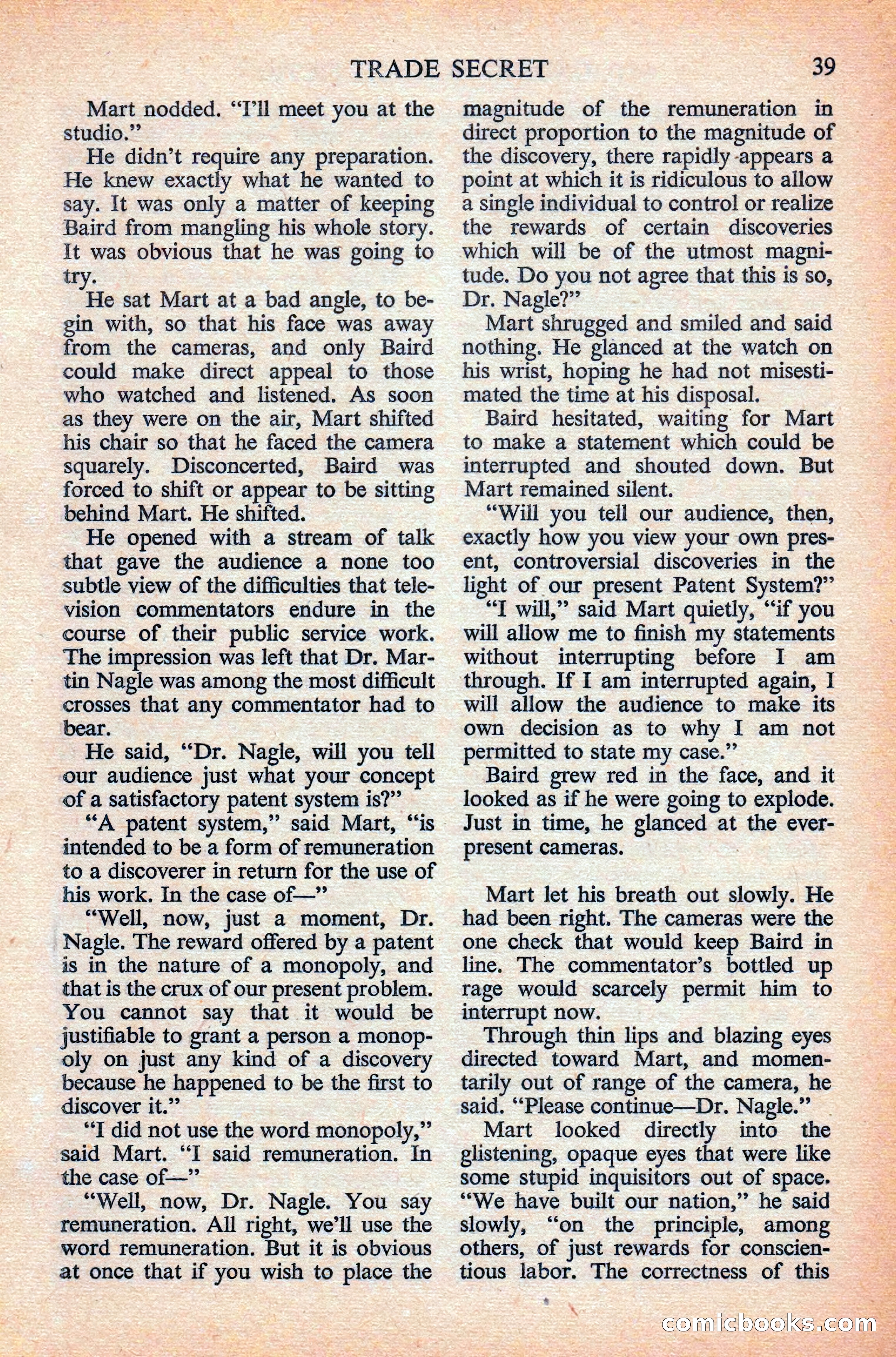
A restored page from Pulp Fiction, 1954. Page through the whole issue in the reader above.
📄 Transcribed text from this page (OCR, searchable)
Machine-transcribed from the original scan — historical spelling and the odd misread are preserved.
TRADE SECRET 39 Mart nodded. “Pll meet you at the studio.” He didn’t require any preparation. He knew exactly what he wanted to say. It was only a matter of keeping Baird from mangling his whole story. It was obvious that he was going to try. “He sat Mart at a bad angle, to be- gin with, so that his face was away from the cameras, and only Baird could make direct appeal to those who watched and listened. As soon as they were on the air, Mart shifted his chair so that he faced the camera squarely. Disconcerted, Baird was forced to shift or appear to be sitting behind Mart. He shifted. He opened with a stream of talk that gave the audience a none too subtle view of the difficulties that tele- vision commentators endure in the course of their public service work. The impression was left that Dr. Mar- tin Nagle was among the most difficult crosses that any commentator had to bear. He said, “Dr. Nagle, will you tell our audience just what your concept of a satisfactory patent system is?” “A patent system,” said Mart, intended to be a form of hee to a discoverer in return for the use of his work. In the case of— “Well, now, just a moment, Dr. Nagle. The reward offered by a patent is in the nature of a monopoly, and that is the crux of our present problem. You cannot say that it would be justifiable to grant a person a monop- oly on just any kind of a discovery because he happened to be the first to discover it.” “IT did not use the word monopoly,” said Mart. “I said remuneration. In the case of—” “Well, now, Dr. Nagle. You say remuneration. All right, we'll use the word remuneration. But it is obvious at once that if you wish to place the magnitude of the remuneration in direct proportion to the magnitude of the discovery, there rapidly appears a point at which it is ridiculous to allow a single individual to control or realize the rewards of certain discoveries which will be of the utmost magni- tude. Do you not agree that this is so, Dr. Nagle?” Mart shrugged and smiled and said nothing. He glanced at the watch on his wrist, hoping he had not misesti- mated the time at his disposal. Baird hesitated, waiting for Mart to make a statement which could be interrupted and shouted down. But Mart remained silent. “Will you tell our audience, then, exactly how you view your own pres- ent, controversial discoveries in the light of our present Patent System?” “I will,” said Mart quietly, “if you will allow me to finish my statements without interrupting before I am through. If I am interrupted again, I will allow the audience to make its own decision as to why I am not permitted to state my case.” Baird grew red in the face, and it looked as if he were going to explode. Just in time, he glanced at the ever- present cameras. Mart let his breath out slowly. He had been right. The cameras were the one check that would keep Baird in line. The commentator’s bottled up tage would scarcely permit him to interrupt now. Through thin lips and blazing eyes directed toward Mart, and momen- tarily out of range of the camera, he said. “Please continue—Dr. Nagle.” | Mart looked directly into the glistening, opaque eyes that were like some stupid inquisitors out of space. “We have built our nation,” he said Slowly, “on the principle, among others, of just rewards for conscien- tious labor. The correctness of this im) com Ehbooksnco