
Pulp Fiction, 1954 · page 14 of 132
Astounding Science Fiction, British Edition — page 14: what you’re looking at
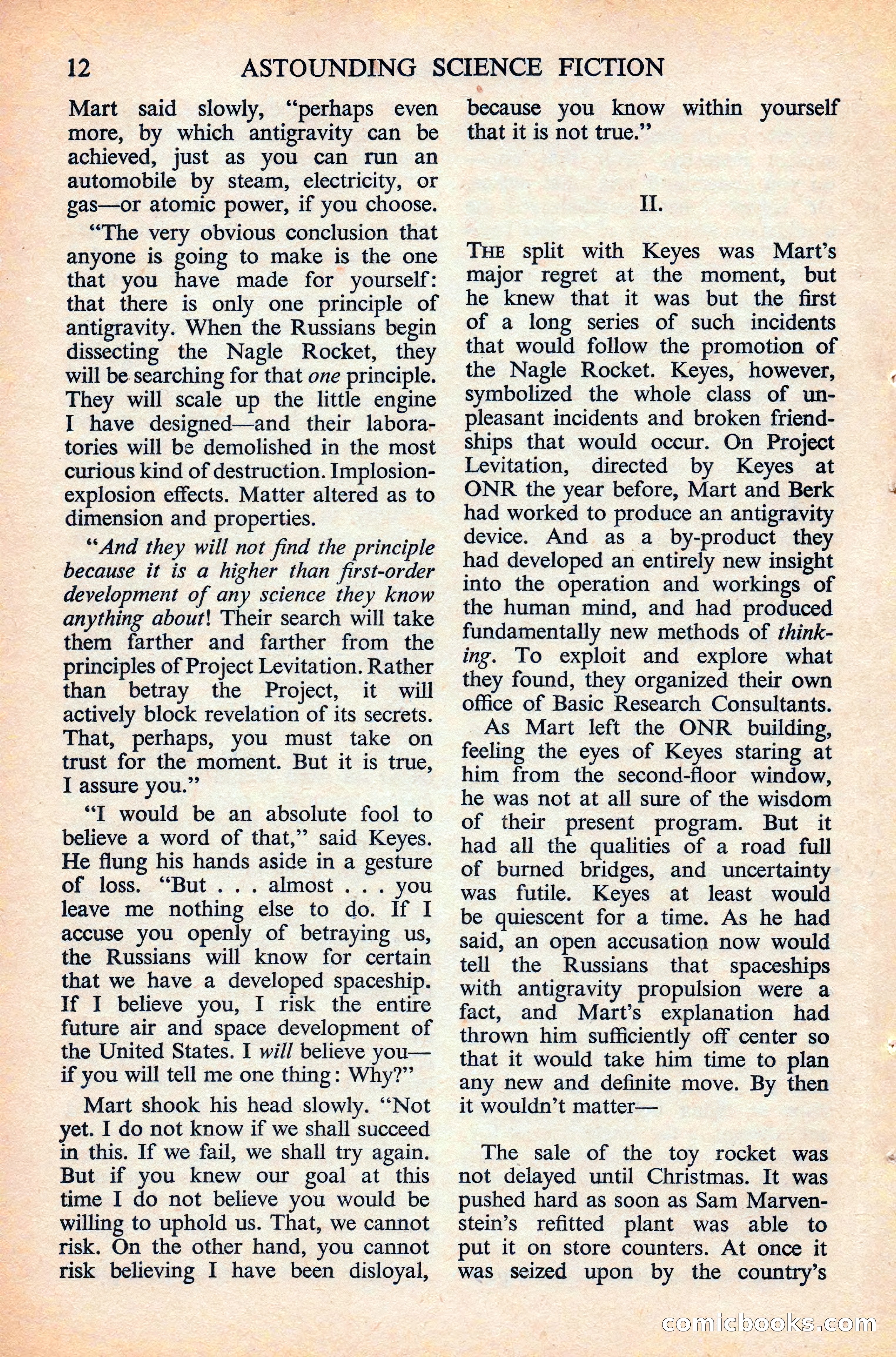
A restored page from Pulp Fiction, 1954. Page through the whole issue in the reader above.
📄 Transcribed text from this page (OCR, searchable)
Machine-transcribed from the original scan — historical spelling and the odd misread are preserved.
12 ASTOUNDING SCIENCE FICTION Mart said slowly, “perhaps even more, by which antigravity can be achieved, just as you can run an automobile by steam, electricity, or gas—or atomic power, if you choose. “The very obvious conclusion that anyone is going to make is the one that you have made for yourself: that there is only one principle of antigravity. When the Russians begin dissecting the Nagle Rocket, they will be searching for that one principle. They will scale up the little engine I have designed—and their labora- tories will be demolished in the most curious kind of destruction. Implosion- explosion effects. Matter altered as to dimension and properties. “And they will not find the principle because it is a higher than first-order development of any science they know anything about! Their search will take them farther and farther from the principles of Project Levitation. Rather than betray the Project, it will actively block revelation of its secrets. That, perhaps, you must take on trust for the moment. But it is true, I assure you.” “I would be an absolute fool to believe a word of that,’ said Keyes. He flung his hands aside in a gesture of loss. “But... almost... you leave me nothing else to do. If I accuse you openly of betraying us, the Russians will know for certain that we have a developed spaceship. If I believe you, I risk the entire future air and space development of the United States. I will believe you— if you will tell me one thing: Why?” Mart shook his head slowly. “‘Not yet. I do not know if we shall succeed in this. If we fail, we shall try again. But if you knew our goal at this time I do not believe you would be willing to uphold us. That, we cannot risk. On the other hand, you cannot risk believing I have been disloyal, because you know within yourself that it is not true.” II. THE split with Keyes was Mart’s major regret at the moment, but he knew that it was but the first of a long series of such incidents that would follow the promotion of the Nagle Rocket. Keyes, however, symbolized the whole class of un- pleasant incidents and broken friend- ships that would occur. On Project Levitation, directed by Keyes at ONR the year before, Mart and Berk had worked to produce an antigravity device. And as a by-product they had developed an entirely new insight into the operation and workings of the human mind, and had produced fundamentally new methods of think- ing. To exploit and explore what they found, they organized their own office of Basic Research Consultants. As Mart left the ONR building, feeling the eyes of Keyes staring at him from the second-floor window, he was not at all sure of the wisdom of their present program. But it had all the qualities of a road full of burned bridges, and uncertainty was futile. Keyes at least would be quiescent for a time. As he had said, an open accusation now would tell the Russians that spaceships with antigravity propulsion were a fact, and Mart’s explanation had thrown him sufficiently off center so that it would take him time to plan any new and definite move. By then it wouldn’t matter— The sale of the toy rocket was not delayed until Christmas. It was pushed hard as soon as Sam Marven- stein’s refitted plant was able to put it on store counters. At once it was seized upon by the country’s Cconniclooolkks.c© iin