
Pulp Fiction, 1954 · page 13 of 132
Astounding Science Fiction, British Edition — page 13: what you’re looking at
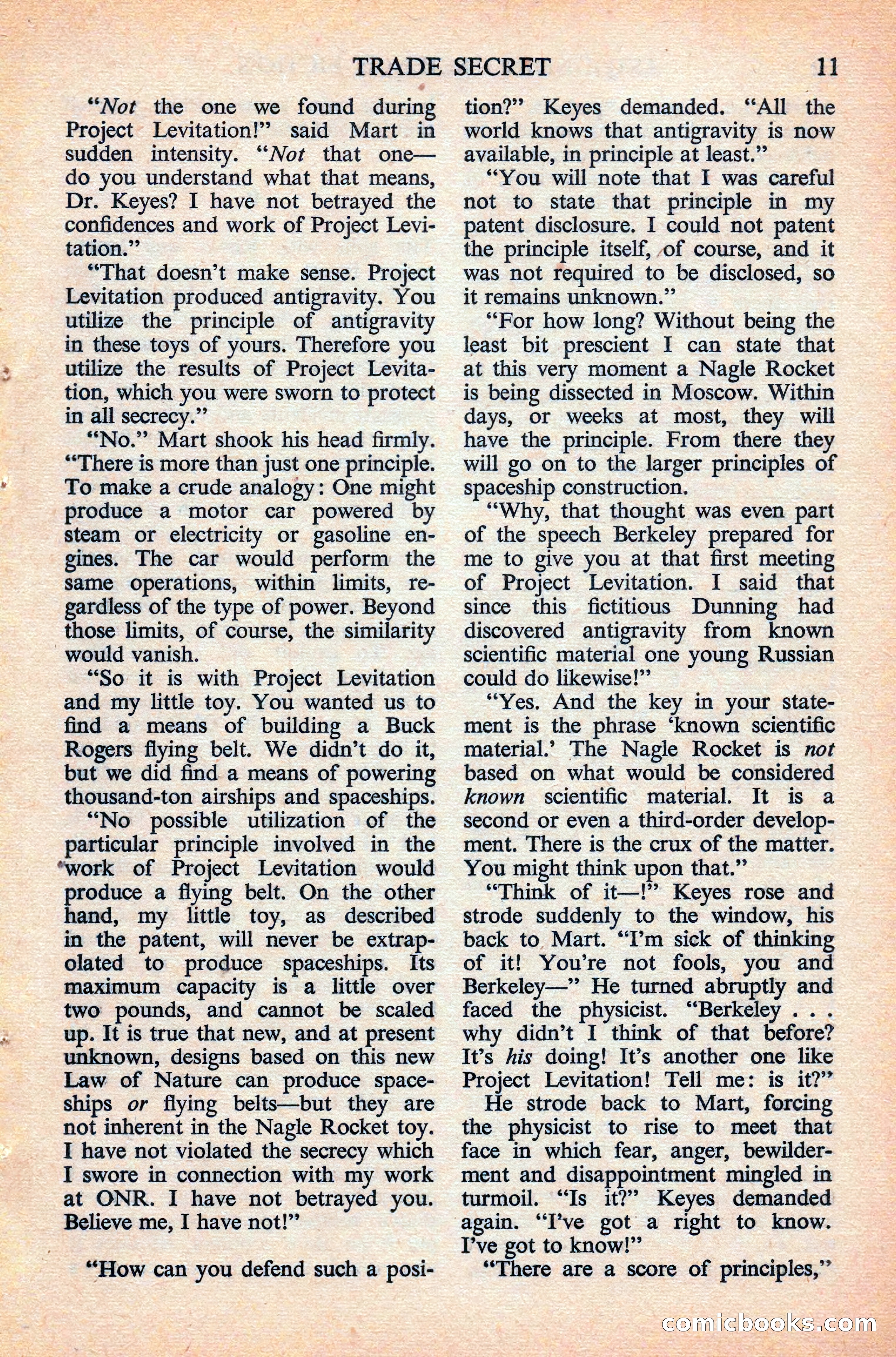
A restored page from Pulp Fiction, 1954. Page through the whole issue in the reader above.
📄 Transcribed text from this page (OCR, searchable)
Machine-transcribed from the original scan — historical spelling and the odd misread are preserved.
{+ TRADE SECRET 3 11 “Not the one we found during Project Levitation!’ said Mart in sudden intensity. “Not that one— do you understand what that means, Dr. Keyes? I have not betrayed the confidences and work of Project Levi- tation.” “That doesn’t make sense. Project Levitation produced antigravity. You utilize the principle of antigravity in these toys of yours. Therefore you utilize the results of Project Levita- tion, which you were sworn to protect in all secrecy.” *“No.”’ Mart shook his head firmly. “There is more than just one principle. To make a crude analogy: One might produce a motor car powered by steam or electricity or gasoline en- gines. The car would perform the same operations, within limits, re- gardless of the type of power. Beyond those limits, of course, the similarity -~ would vanish. “So it is with Project Levitation and my little toy. You wanted us to find a means of building a Buck Rogers flying belt. We didn’t do it, but we did find a means of powering thousand-ton airships and spaceships. “No possible utilization of the particular principle involved in the ‘work of Project Levitation would produce a flying belt. On the other hand, my little toy, as described in the patent, will never be extrap- olated to produce spaceships. Its maximum capacity is a little over two pounds, and cannot be scaled up. It is true that new, and at present unknown, designs based on this new Law of Nature can produce space- ships or flying belts—but they are not inherent in the Nagle Rocket toy. I have not violated the secrecy which I swore in connection with my work at ONR. I have not betrayed you. Believe me, I have not!”’ “How can you defend such a posi- tion?” Keyes demanded. “All the world knows that antigravity is now available, in principle at least.” “You will note that I was careful not to state that principle in my patent disclosure. I could not patent the principle itself, of course, and it was not required to be disclosed, so it remains unknown.” “For how long? Without being the least bit prescient I can state that at this very moment a Nagle Rocket is being dissected in Moscow. Within days, or weeks at most, they will have the principle. From there they will go on to the larger principles of spaceship construction. “Why, that thought was even part of the speech Berkeley prepared for me to give you at that first meeting of Project Levitation. I said that since this fictitious Dunning had discovered antigravity from known scientific material one young Russian could do likewise!”’ “Yes. And the key in your state- ment is the phrase “known scientific material.” The Nagle Rocket is not based on what would be considered known scientific material. It is a second or even a third-order develop- ment. There is the crux of the matter. You might think upon that.” “Think of it—!’’ Keyes rose and strode suddenly to the window, his back to Mart. “I’m sick of thinking of it! You’re not fools, you and Berkeley—’’ He turned abruptly and faced the physicist. “Berkeley A why didn’t I think of that before? It’s his doing! It’s another one like Project Levitation! Tell me: is it?” He strode back to Mart, forcing the physicist to rise to meet that face in which fear, anger, bewilder- ment and disappointment mingled in turmoil. “Is it?” Keyes demanded again. “I’ve got a right to know. I’ve got to know!” “There are a score of principles,” EComichookssco im