
Pulp Fiction, 1954 · page 129 of 132
Astounding Science Fiction, British Edition — page 129: what you’re looking at
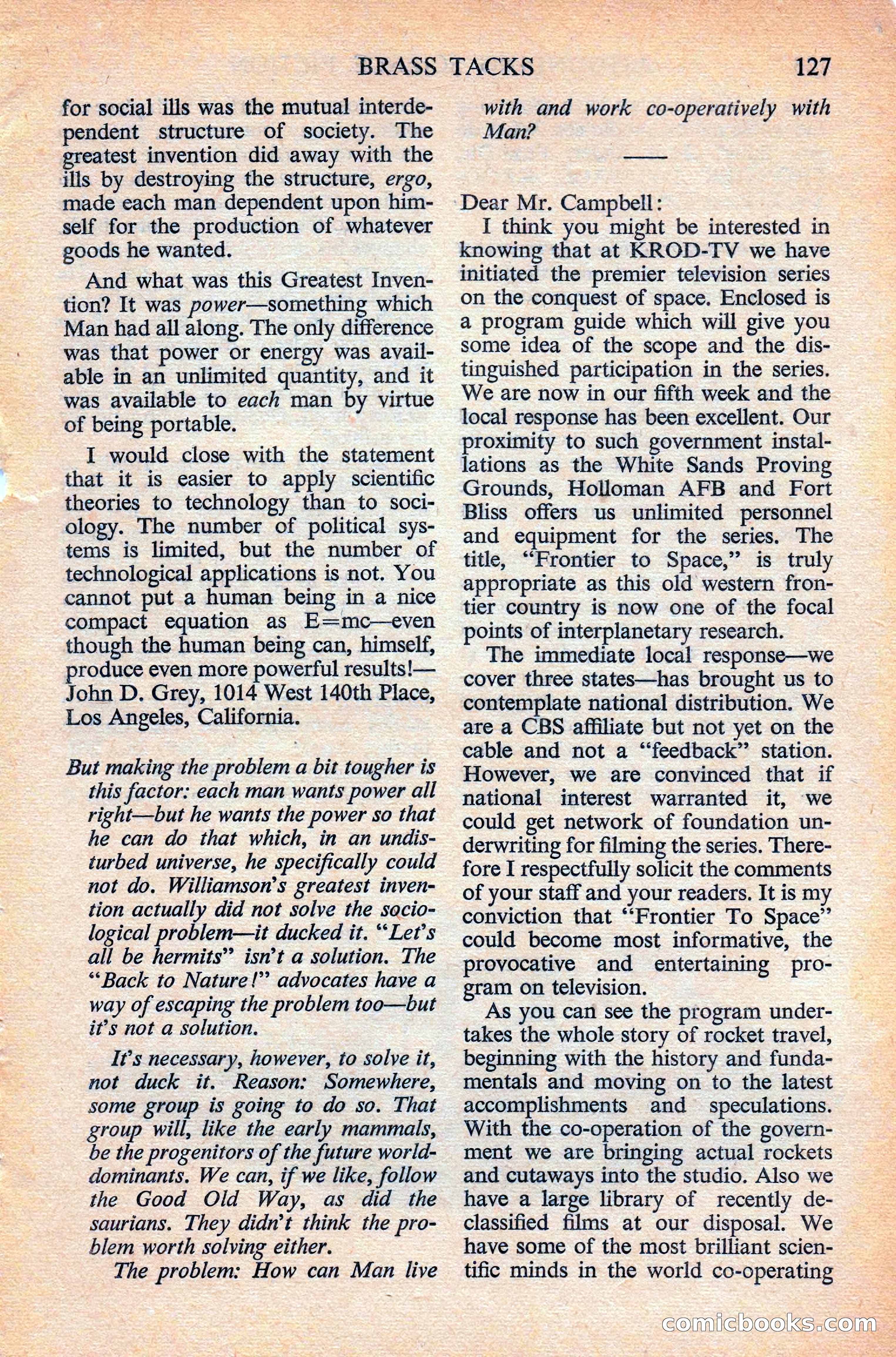
A restored page from Pulp Fiction, 1954. Page through the whole issue in the reader above.
📄 Transcribed text from this page (OCR, searchable)
Machine-transcribed from the original scan — historical spelling and the odd misread are preserved.
BRASS TACKS for social ills was the mutual interde- pendent structure of society. The greatest invention did away with the ills by destroying the structure, ergo, made each man dependent upon him- self for the production of whatever goods he wanted. And what was this Greatest Inven- tion? It was power—something which Man had all along. The only difference was that power or energy was avail- able in an unlimited quantity, and it was available to each man by virtue of being portable. I would close with the statement that it is easier to apply scientific theories to technology than to soci- ology. The number of political sys- tems is limited, but the number of technological applications is not. You cannot put a human being in a nice compact equation as E=mc—even though the human being can, himself, produce even more powerful results!— John D. Grey, 1014 West 140th Place, Los Angeles, California. But making the problem a bit tougher is this factor: each man wants power all right—but he wants the power so that he can do that which, in an undis- turbed universe, he specifically could not do. Williamson’s greatest inven- tion actually did not solve the sacio- logical problem—it ducked it. ““Let’s all be hermits” isn’t a solution. The “Back to Nature!” advocates have a way of escaping the problem too—but it’s not a solution. It’s necessary, however, to solve it, not duck it. Reason: Somewhere, some group is going to do so. That group will, like the early mammals, be the progenitors of the future world- dominants. We can, if we like, follow the Good Old Way, as did the saurians. They didn’t think the pro- blem worth solving either. The problem: How can Man live 127 with and work co-operatively with Man? Dear Mr. Campbell: I think you might be interested in knowing that at KROD-TV we have initiated the premier television series on the conquest of space. Enclosed is a program guide which will give you some idea of the scope and the dis- tinguished participation in the series. We are now in our fifth week and the local response has been excellent. Our proximity to such government instal- lations as the White Sands Proving Grounds, Holloman AFB and Fort Bliss offers us unlimited personnel and equipment for the series. The title, “Frontier to Space,” is truly appropriate as this old western fron- tier country is now one of the focal points of interplanetary research. The immediate local response—we cover three states—has brought us to contemplate national distribution. We are a CBS affiliate but not yet on the cable and not a “feedback” station. However, we are convinced that if national interest warranted it, we could get network of foundation un- derwriting for filming the series. There- fore I respectfully solicit the comments of your staff and your readers, It is my conviction that “‘Frontier To Space” could become most informative, the provocative and entertaining pro- gram on television. As you can see the program under- takes the whole story of rocket travel, beginning with the history and funda- mentals and moving on to the latest accomplishments and _ speculations. With the co-operation of the govern- ment we are bringing actual rockets and cutaways into the studio. Also we have a large library of recently de- classified films at our disposal. We have some of the most brilliant scien- tific minds in the world co-operating CONNIE OOOKSa(eO