
Pulp Fiction, 1954 · page 128 of 132
Astounding Science Fiction, British Edition — page 128: what you’re looking at
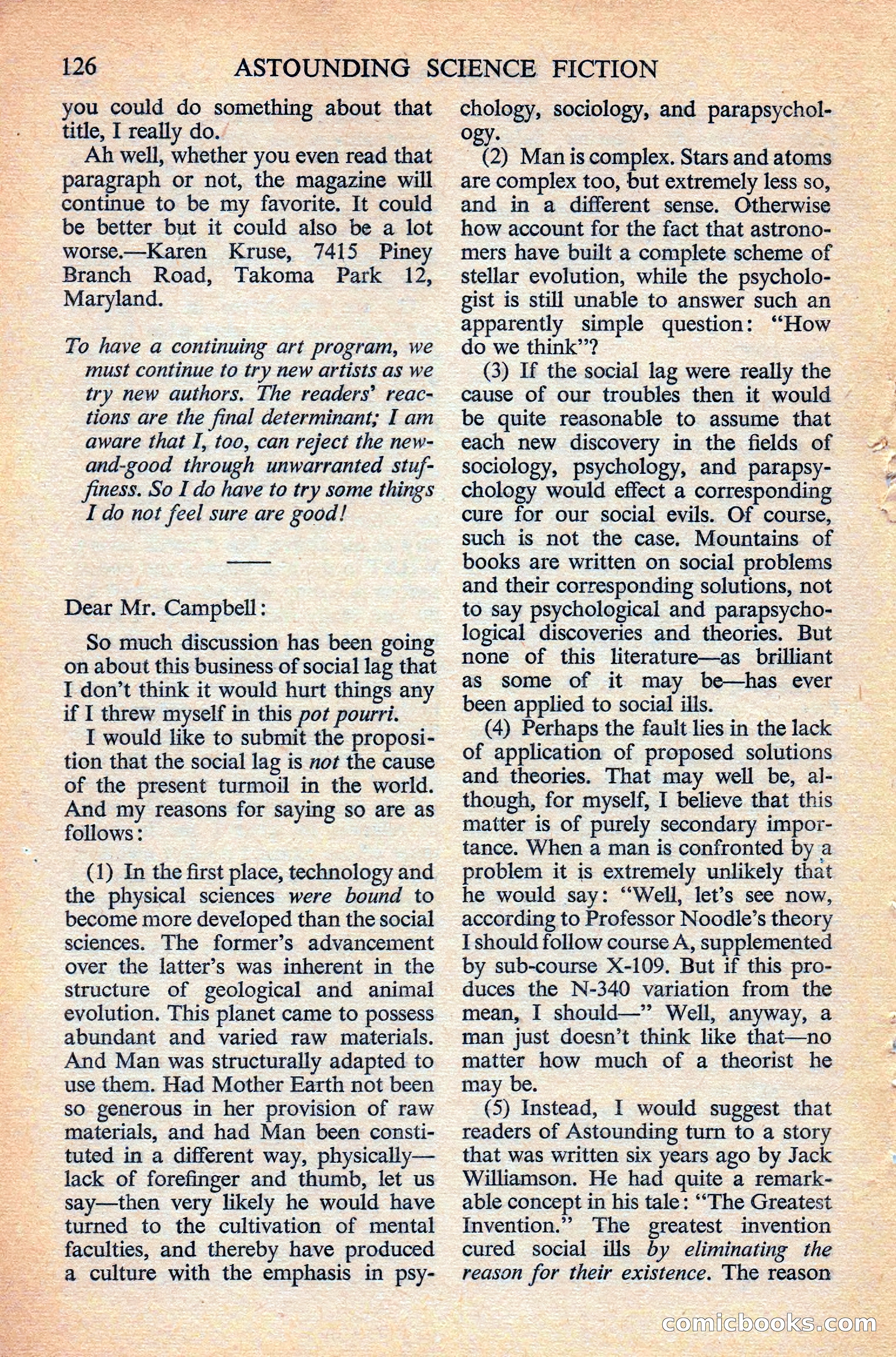
A restored page from Pulp Fiction, 1954. Page through the whole issue in the reader above.
📄 Transcribed text from this page (OCR, searchable)
Machine-transcribed from the original scan — historical spelling and the odd misread are preserved.
126 ASTOUNDING SCIENCE FICTION you could do something about that title, I really do. Ah well, whether you even read that paragraph or not, the magazine will continue to be my favorite. It could be better but it could also be a lot worse.—Karen Kruse, 7415 Piney Branch Road, Takoma Park 12, Maryland. To have a continuing art program, we must continue to try new artists as we try new authors. The readers’ reac- tions are the final determinant; I am aware that I, too, can reject the new- and-good through unwarranted stuf- finess. So I do have to try some things I do not feel sure are good! Dear Mr. Campbell: So much discussion has been going on about this business of social lag that I don’t think it would hurt things any if I threw myself in this pot pourri. I would like to submit the proposi- tion that the social lag is not the cause of the present turmoil in the world. And my reasons for saying so are as follows: (1) In the first place, technology and the physical sciences were bound to become more developed than the social sciences. The former’s advancement over the latter’s was inherent in the structure of geological and animal evolution. This planet came to possess abundant and varied raw materials. And Man was structurally adapted to use them. Had Mother Earth not been so generous in her provision of raw materials, and had Man been consti- tuted in a different way, physically— lack of forefinger and thumb, let us say—then very likely he would have turned to the cultivation of mental faculties, and thereby have produced a culture with the emphasis in psy- chology, sociology, and parapsychol- “Q) Man is complex. Stars and atoms are complex too, but extremely less so, and in a different sense. Otherwise how account for the fact that astrono- mers have built a complete scheme of stellar evolution, while the psycholo- gist is still unable to answer such an apparently simple question: “How do we think’’? (3) If the social lag were really the cause of our troubles then it would be quite reasonable to assume that each new discovery in the fields of sociology, psychology, and parapsy- chology would effect a corresponding cure for our social evils. Of course, such is not the case. Mountains of books are written on social problems and their corresponding solutions, not to say psychological and parapsycho- logical discoveries and theories. But none of this literature—as brilliant as some of it may be—has ever been applied to social ills. : (4) Perhaps the fault lies in the lack of application of proposed solutions and theories. That may well be, al- though, for myself, I believe that this matter is of purely secondary impor- tance. When a man is confronted by a problem it is extremely unlikely that he would say: “‘Well, let’s see now, according to Professor ‘Noodle’s theory I should follow course A, supplemented by sub-course X-109, But if this pro- duces the N-340 variation from the mean, I should—” Well, anyway, a man just doesn’t think like that—no matter how much of a theorist he may be. (5) Instead, I would suggest that readers of Astounding turn to a story that was written six years ago by Jack Williamson. He had quite a remark- able concept in his tale: ““The Greatest Invention.” The greatest invention cured social ills by eliminating the reason for their existence. The reason EComiGhooks.jco Im :