
Pulp Fiction, 1954 · page 91 of 133
Astounding Science Fiction (British Edition) — page 91: what you’re looking at
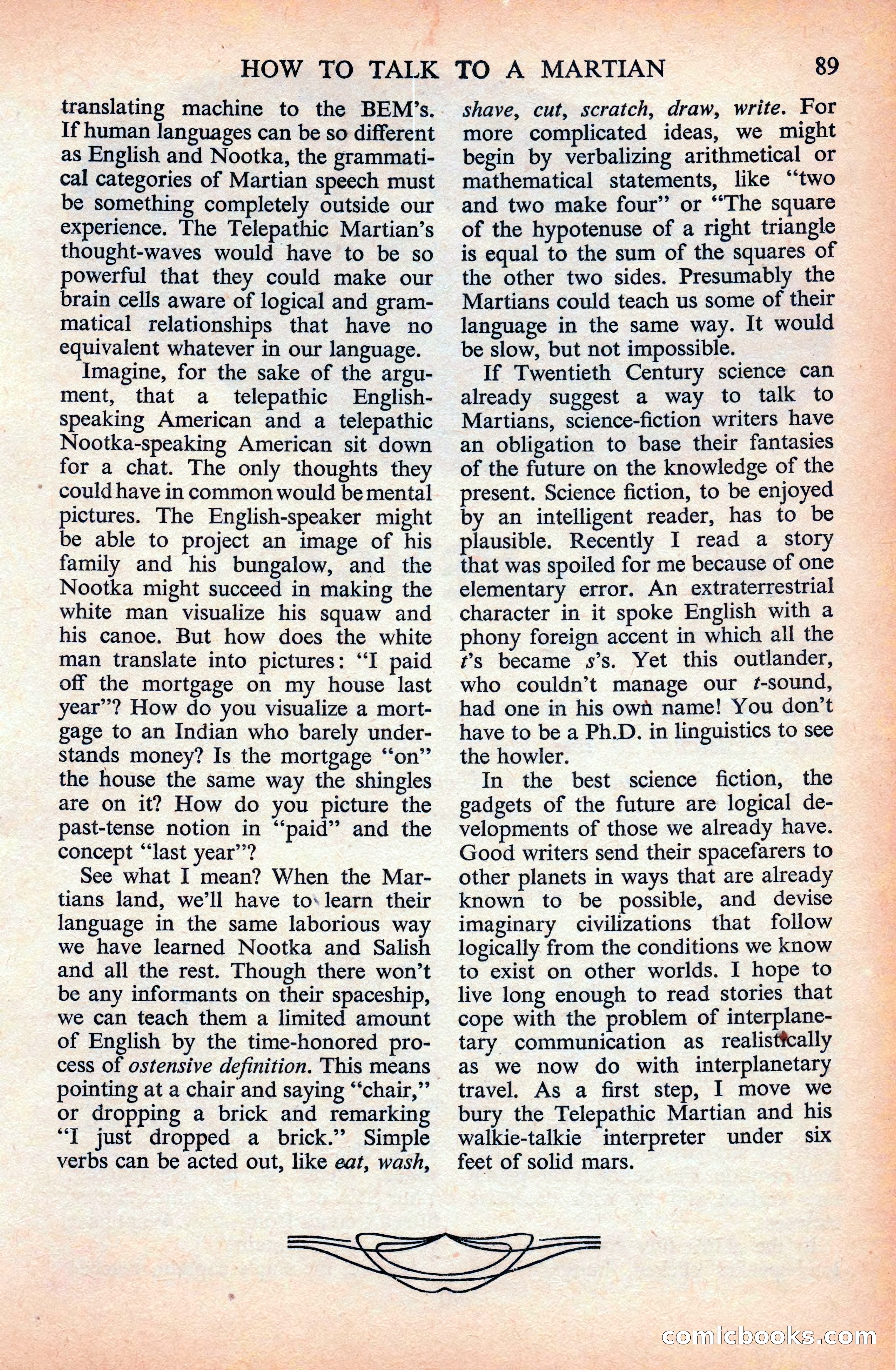
A restored page from Pulp Fiction, 1954. Page through the whole issue in the reader above.
📄 Transcribed text from this page (OCR, searchable)
Machine-transcribed from the original scan — historical spelling and the odd misread are preserved.
-HOW TO TALK TO A MARTIAN 89 translating machine to the BEM’s. If human languages can be so different as English and Nootka, the grammati- cal categories of Martian speech must be something completely outside our experience. The Telepathic Martian’s thought-waves would have to be so powerful that they could make our brain cells aware of logical and gram- matical relationships that have no equivalent whatever in our language. Imagine, for the sake of the argu- ment, that a _ telepathic English- speaking American and a telepathic Nootka-speaking American sit down for a chat. The only thoughts they * could have in common would be mental pictures. The English-speaker might be able to project an image of his family and his bungalow, and the Nootka might succeed in making the white man visualize his squaw and his canoe. But how does the white man translate into pictures: “I paid off the mortgage on my house last year’? How do you visualize a mort- gage to an Indian who barely under- stands money? Is the mortgage “‘on” the house the same way the shingles are on it? How do you picture the past-tense notion in “paid” and the concept “‘last year’’? See what I mean? When the Mar- tians land, we’ll have to: learn their language in the same laborious way we have learned Nootka and Salish and all the rest. Though there won’t be any informants on their spaceship, we can teach them a limited amount of English by the time-honored pro- cess of ostensive definition. This means pointing at a chair and saying “‘chair,”’ or dropping a brick and remarking “I just dropped a brick.’ Simple verbs can be acted out, like eat, wash, shave, cut, scratch, draw, write. For more complicated ideas, we might begin by verbalizing arithmetical or mathematical statements, like “two and two make four” or “The square of the hypotenuse of a right triangle is equal to the sum of the squares of the other two sides. Presumably the Martians could teach us some of their language in the same way. It would be slow, but not impossible. If Twentieth Century science can already suggest a way to talk to Martians, science-fiction writers have an obligation to base their fantasies of the future on the knowledge of the present. Science fiction, to be enjoyed by an intelligent reader, has to be plausible. Recently I read a story that was spoiled for me because of one elementary error. An extraterrestrial character in it spoke English with a phony foreign accent in which all the t’s became s’s. Yet this outlander, who couldn’t manage our /¢-sound, had one in his own name! You don't have to be a Ph.D. in linguistics to see the howler. In the best science fiction, the gadgets of the future are logical de- velopments of those we already have. Good writers send their spacefarers to other planets in ways that are already known to be possible, and devise imaginary civilizations that follow logically from the conditions we know to exist on other worlds. I hope to live long enough to read stories that cope with the problem of interplane- tary communication as realisttcally as we now do with interplanetary travel. As a first step, I move we bury the Telepathic Martian and his walkie-talkie interpreter under six feet of solid mars. <—S- Comichbooksnco im