
Pulp Fiction, 1954 · page 90 of 133
Astounding Science Fiction (British Edition) — page 90: what you’re looking at
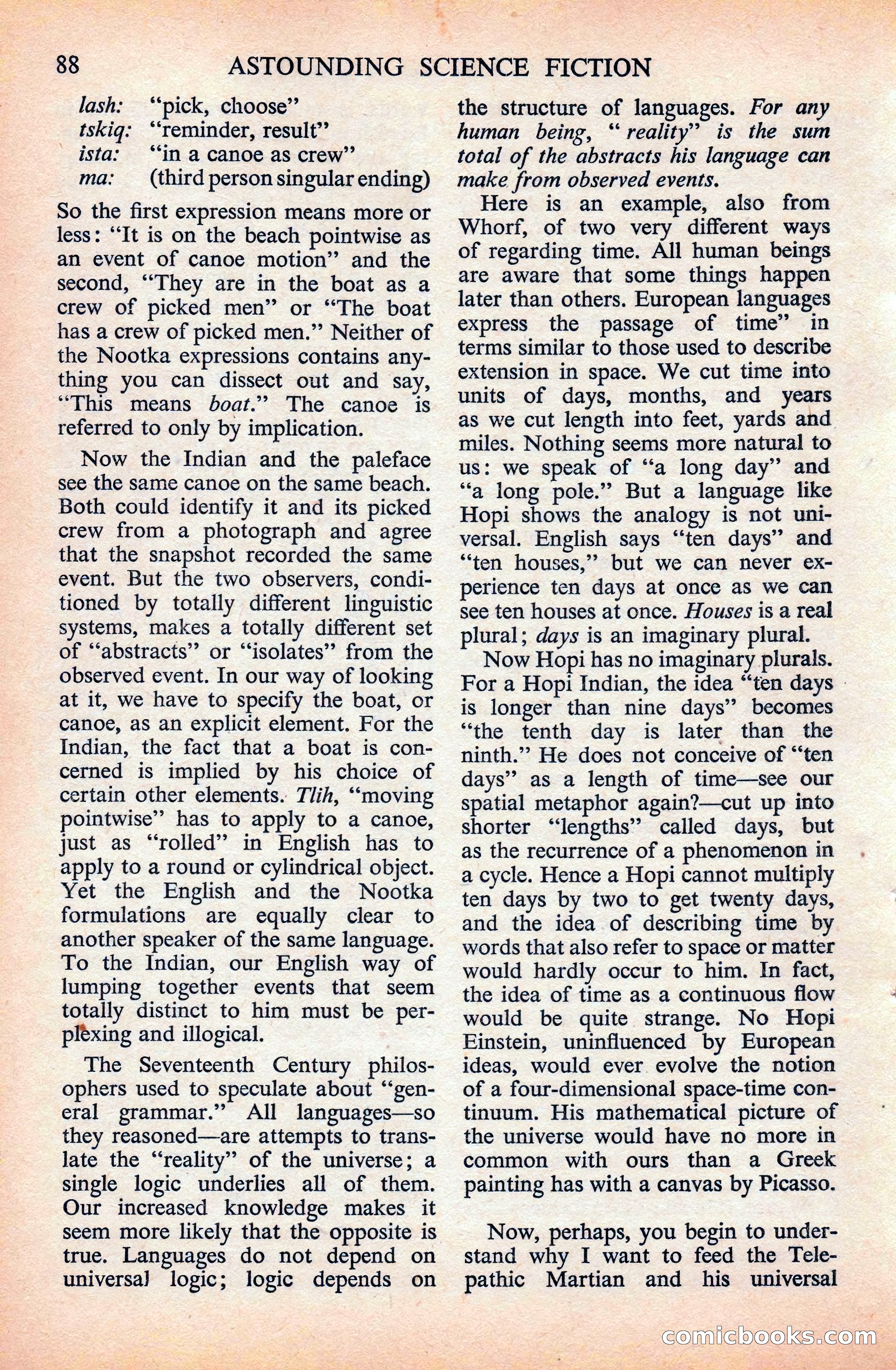
A restored page from Pulp Fiction, 1954. Page through the whole issue in the reader above.
📄 Transcribed text from this page (OCR, searchable)
Machine-transcribed from the original scan — historical spelling and the odd misread are preserved.
88 lash: “pick, choose” tskiq: “reminder, result” ista: ‘‘in a canoe as crew” ma: (third person singular ending) So the first expression means more or less: “It is on the beach pointwise as an event of canoe motion” and the second, “They are in the boat as a crew of picked men” or ‘“‘The boat has a crew of picked men.” Neither of the Nootka expressions contains any- thing you can dissect out and say, “This means boat.” The canoe is referred to only by implication. Now the Indian and the paleface see the same canoe on the same beach. Both could identify it and its picked crew from a photograph and agree that the snapshot recorded the same event. But the two observers, condi- tioned by totally different linguistic systems, makes a totally different set of “abstracts” or “isolates” from the observed event. In our way of looking at it, we have to specify the boat, or canoe, as an explicit element. For the Indian, the fact that a boat is con- cerned is implied by his choice of certain other elements. Tlih, ‘“‘moving pointwise’’ has to apply to a canoe, just as “rolled” in English has to apply to a round or cylindrical object. Yet the English and the Nootka formulations are equally clear to another speaker of the same language. To the Indian, our English way of lumping together events that seem totally distinct to him must be per- plexing and illogical. The Seventeenth Century philos- ophers used to speculate about “‘gen- eral grammar.” All languages—so they reasoned—are attempts to trans- late the “reality” of the universe; a single logic underlies all of them. Our increased knowledge makes it seem more likely that the opposite is true. Languages do not depend on universa] logic; logic depends on ASTOUNDING SCIENCE FICTION the structure of languages. For any human being, “reality” is the sum total of the abstracts his language can make from observed events. Here is an example, also from Whorf, of two very different ways of regarding time. All human beings are aware that some things happen later than others. European languages express the passage of time” in terms similar to those used to describe extension in space. We cut time into units of days, months, and years as we cut length into feet, yards and miles. Nothing seems more natural to us: we speak of “fa long day’ and ‘a long pole.” But a language like Hopi shows the analogy is not uni- versal. English says “ten days’? and “‘ten houses,” but we can never ex- perience ten days at once as we can see ten houses at once. Houses is a real plural; days is an imaginary plural. Now Hopi has no imaginary plurals. For a Hopi Indian, the idea “ten days © is longer than nine days’? becomes “the tenth day is later than the ninth.”” He does not conceive of “ten days” as a length of time—see our spatial metaphor again?—cut up into shorter “lengths” called days, but as the recurrence of a phenomenon in a cycle. Hence a Hopi cannot multiply ten days by two to get twenty days, and the idea of describing time by words that also refer to space or matter would hardly occur to him. In fact, the idea of time as a continuous flow would be quite strange. No Hopi Einstein, uninfluenced by European ideas, would ever evolve the notion of a four-dimensional space-time con- tinuum. His mathematical picture of the universe would have no more in common with ours than a Greek painting has with a canvas by Picasso. Now, perhaps, you begin to under- stand why I want to feed the Tele- pathic Martian and his universal Comichooks co im