
Pulp Fiction, 1954 · page 9 of 133
Astounding Science Fiction (British Edition) — page 9: what you’re looking at
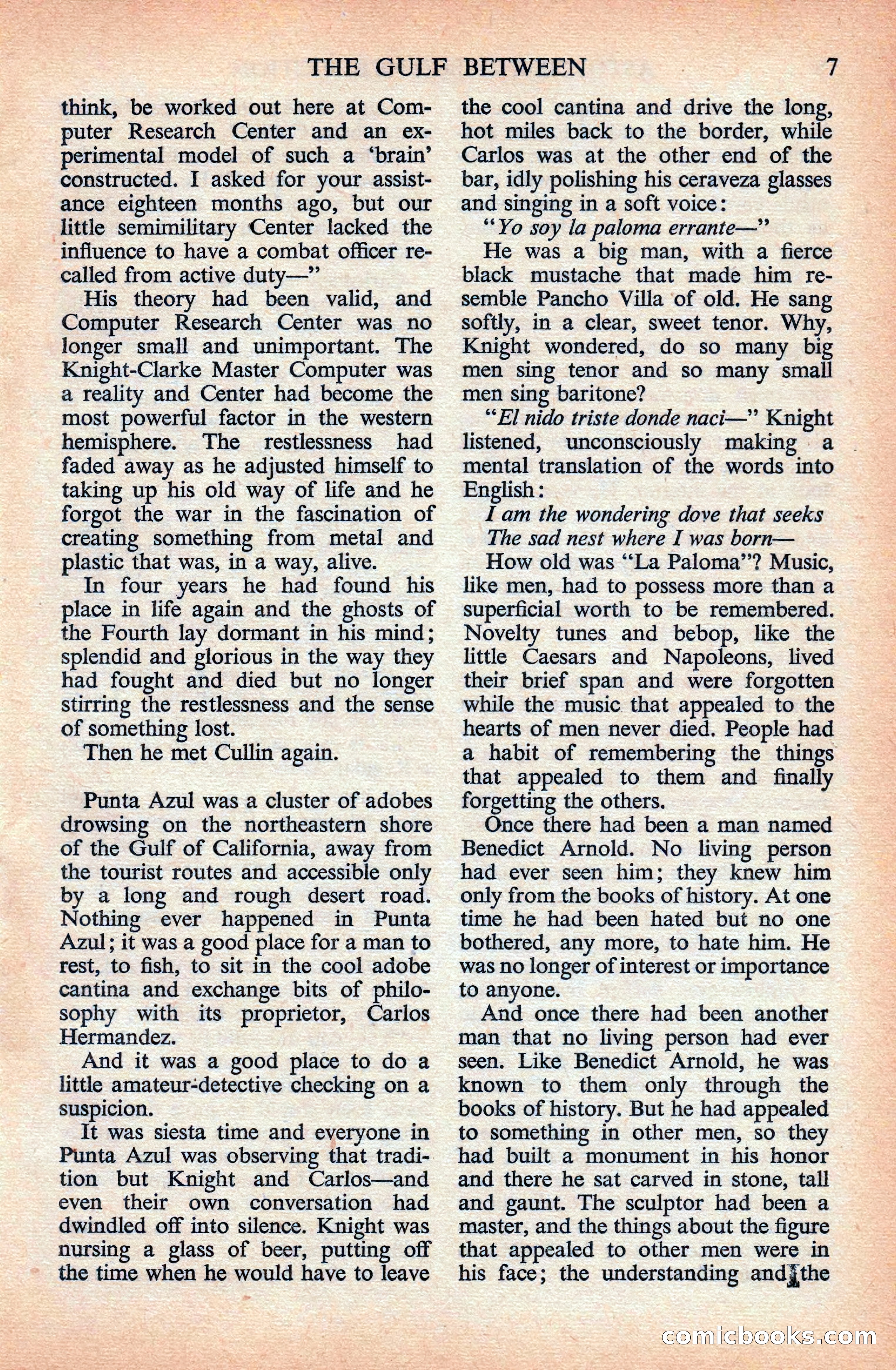
A restored page from Pulp Fiction, 1954. Page through the whole issue in the reader above.
📄 Transcribed text from this page (OCR, searchable)
Machine-transcribed from the original scan — historical spelling and the odd misread are preserved.
THE GULF think, be worked out here at Com- puter Research Center and an ex- perimental model of such a ‘brain’ constructed. I asked for your assist- ance eighteen months ago, but our little semimilitary Center lacked the influence to have a combat officer re- called from active duty—” His theory had been valid, and Computer Research Center was no longer small and unimportant. The Knight-Clarke Master Computer was a reality and Center had become the most powerful factor in the western hemisphere. The restlessness had faded away as he adjusted himself to taking up his old way of life and he forgot the war in the fascination of creating something from metal and plastic that was, in a way, alive. In four years he had found his place in life again and the ghosts of the Fourth lay dormant in his mind; splendid and glorious in the way they had fought and died but no longer stirring the restlessness and the sense of something lost. Then he met Cullin again. Punta Azul was a cluster of adobes drowsing on the northeastern shore of the Gulf of California, away from the tourist routes and accessible only by a long and rough desert road. Nothing ever happened in Punta Azul; it was a good place for a man to rest, to fish, to sit in the cool adobe cantina and exchange bits of philo- sophy with its proprietor, Carlos Hermandez. And it was a good place to do a little amateur-detective checking on a suspicion. It was siesta time and everyone in Punta Azul was observing that tradi- tion but Knight and Carlos—and even their own conversation had dwindled off into silence. Knight was nursing a glass of beer, putting off the time when he would have to leave BETWEEN . 7 the cool cantina and drive the long, hot miles back to the border, while Carlos was at the other end of the bar, idly polishing his ceraveza glasses and singing in a soft voice: “Yo soy la paloma errante—” He was a big man, with a fierce black mustache that made him re- semble Pancho Villa of old. He sang softly, in a clear, sweet tenor. Why, Knight wondered, do so many big men sing tenor and so many small men sing baritone? “EI nido triste donde naci—” Knight listened, unconsciously making a | mental translation of the words into English: Iam the wondering dove that seeks The sad nest where I was born— How old was ‘“‘La Paloma’’? Music, like men, had to possess more than a superficial worth to be remembered. Novelty tunes and bebop, like the little Caesars and Napoleons, lived their brief span and were forgotten while the music that appealed to the hearts of men never died. People had a habit of remembering the things that appealed to them and _ finally forgetting the others. Once there had been a man named Benedict Arnold. No living person had ever seen him; they knew him only from the books of history. At one time he had been hated but no one bothered, any more, to hate him. He was no longer of interest or importance to anyone. And once there had been another man that no living person had ever seen. Like Benedict Arnold, he was known to them only through the books of history. But he had appealed to something in other men, so they had built a monument in his honor and there he sat carved in stone, tall and gaunt. The sculptor had been a master, and the things about the figure that appealed to other men were in his face; the understanding andjthe EComichookssco Al