
Pulp Fiction, 1954 · page 8 of 133
Astounding Science Fiction (British Edition) — page 8: what you’re looking at
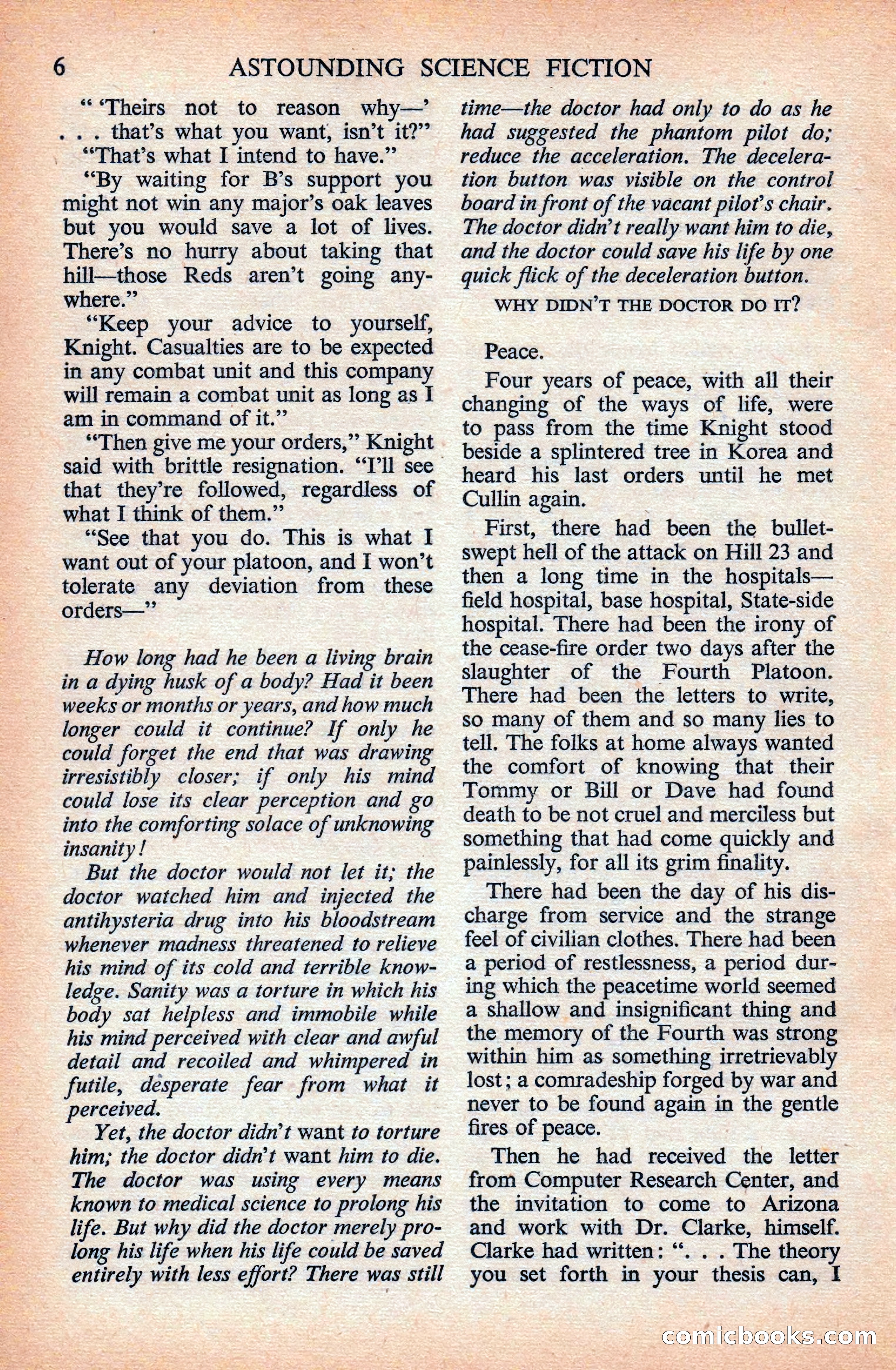
A restored page from Pulp Fiction, 1954. Page through the whole issue in the reader above.
📄 Transcribed text from this page (OCR, searchable)
Machine-transcribed from the original scan — historical spelling and the odd misread are preserved.
“*Theirs not to reason why—’ . . . that’s what you want, isn’t it?” “That’s what I intend to have.” “By waiting for B’s support you might not win any major’s oak leaves but you would save a lot of lives. There’s no hurry about taking that hill—those Reds aren’t going any- where.” “Keep your advice to yourself, Knight. Casualties are to be expected in any combat unit and this company will remain a combat unit as long as I am in command of it.” “Then give me your orders,” Knight said with brittle resignation. “Tl see that they’re followed, regardless of what I think of them.” “See that you do. This is what I want out of your platoon, and I won’t tolerate any deviation from these orders—”’ How long had he been a living brain in a dying husk of a body? Had it been weeks or months or years, and how much longer could it continue? If only he could forget the end that was drawing irresistibly closer; if only his mind could lose its clear perception and go into the comforting solace of unknowing insanity ! : But the doctor would not let it; th doctor watched him and injected the antihysteria drug into his bloodstream whenever madness threatened to relieve his mind of its cold and terrible know- ledge. Sanity was a torture in which his body sat helpless and immobile while his mind perceived with clear and awful detail and recoiled and whimpered in futile, desperate fear from what it perceived. Yet, the doctor didn’t want to torture him; the doctor didn’t want him to die. The doctor was using every means known to medical science to prolong his life. But why did the doctor merely pro- long his life when his life could be saved entirely with less effort? There was still ASTOUNDING SCIENCE FICTION time—the doctor had only to do as he had suggested the phantom pilot do; reduce the acceleration. The decelera- tion button was visible on the control board in front of the vacant pilot’s chair. The doctor didn’t really want him to die, and the doctor could save his life by one guick flick of the deceleration button. WHY DIDN’T THE DOCTOR DO IT? Peace. Four years of peace, with all their changing of the ways of life, were to pass from the time Knight stood beside a splintered tree in Korea and heard his last orders until he met Cullin again. First, there had been the bullet- swept hell of the attack on Hill 23 and then a long time in the hospitals— field hospital, base hospital, State-side hospital. There had been the irony of the cease-fire order two days after the slaughter of the Fourth Platoon. There had been the letters to write, so many of them and so many lies to tell. The folks at home always wanted the comfort of knowing that their Tommy or Bill or Dave had found death to be not cruel and merciless but something that had come quickly and painlessly, for all its grim finality. There had been the day of his dis- charge from service and the strange feel of civilian clothes. There had been a period of restlessness, a period dur- ing which the peacetime world seemed a shallow and insignificant thing and the memory of the Fourth was strong within him as something irretrievably lost ; a comradeship forged by war and never to be found again in the gentle fires of peace. Then he had received the letter from Computer Research Center, and the invitation to come to Arizona and work with Dr. Clarke, himself. Clarke had written: “. . . The theory you set forth in your thesis can, I Comichboo SaEO) im