
Pulp Fiction, 1954 · page 83 of 133
Astounding Science Fiction (British Edition) — page 83: what you’re looking at
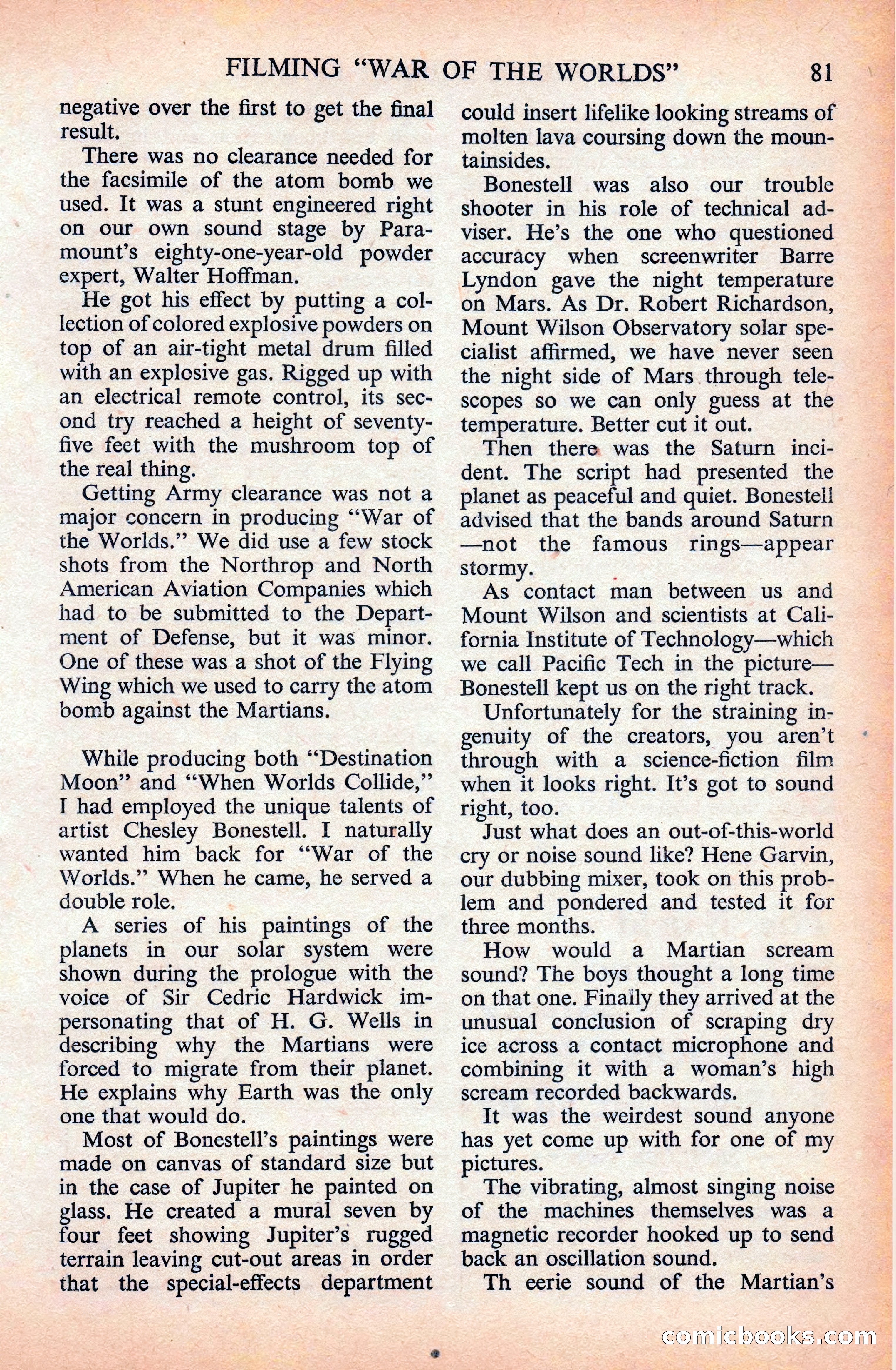
A restored page from Pulp Fiction, 1954. Page through the whole issue in the reader above.
📄 Transcribed text from this page (OCR, searchable)
Machine-transcribed from the original scan — historical spelling and the odd misread are preserved.
FILMING “WAR OF THE WORLDS” 81 negative over the first to get the final result. There was no clearance needed for the facsimile of the atom bomb we used. It was a stunt engineered right on our own sound stage by Para- mount’s eighty-one-year-old powder expert, Walter Hoffman. He got his effect by putting a col- lection of colored explosive powders on top of an air-tight metal drum filled with an explosive gas. Rigged up with an electrical remote control, its sec- ond try reached a height of seventy- five feet with the mushroom top of the real thing. Getting Army clearance was not a major concern in producing ‘“‘War of the Worlds.”’ We did use a few stock shots from the Northrop and North American Aviation Companies which had to be submitted to the Depart- ment of Defense, but it was minor. One of these was a shot of the Flying Wing which we used to carry the atom bomb against the Martians. While producing both “Destination Moon” and “‘When Worlds Collide,” I had employed the unique talents of artist Chesley Bonestell. I naturally wanted him back for “War of the Worlds.’ When he came, he served a double role. A series of his paintings of the planets in our solar system were shown during the prologue with the voice of Sir Cedric Hardwick im- personating that of H. G. Wells in describing why the Martians were forced to migrate from their planet. He explains why Earth was the only one that would do. Most of Bonestell’s paintings were made on canvas of standard size but in the case of Jupiter he painted on glass. He created a mural seven by four feet showing Jupiter’s rugged terrain leaving cut-out areas in order that the special-effects department could insert lifelike looking streams of molten lava coursing down the moun- tainsides. Bonestell was also our trouble shooter in his role of technical ad- viser. He’s the one who questioned accuracy when screenwriter Barre Lyndon gave the night temperature on Mars. As Dr. Robert Richardson, Mount Wilson Observatory solar spe- cialist affirmed, we have never seen the night side of Mars through tele- scopes so we can only guess at the temperature. Better cut it out. Then there was the Saturn inci- dent. The script had presented the planet as peaceful and quiet. Bonestel! advised that the bands around Saturn —not the famous rings—appear stormy. ; As contact man between us and Mount Wilson and scientists at Cali- fornia Institute of Technology—which we call Pacific Tech in the picture— Bonestell kept us on the right track. Unfortunately for the straining in- genuity of the creators, you aren’t through with a science-fiction film when it looks right. It’s got to sound right, too. Just what does an out-of-this-world cry or noise sound like? Hene Garvin, our dubbing mixer, took on this prob- lem and pondered and tested it for three months. How would a Martian scream sound? The boys thought a long time on that one. Finaily they arrived at the unusual conclusion of scraping dry ice across a contact microphone and combining it with a woman’s high scream recorded backwards. It was the weirdest sound anyone has yet come up with for one of my pictures. The vibrating, almost singing noise of the machines themselves was a magnetic recorder hooked up to send back an oscillation sound. Th eerie sound of the Martian’s EComichooksco im