
Pulp Fiction, 1954 · page 82 of 133
Astounding Science Fiction (British Edition) — page 82: what you’re looking at
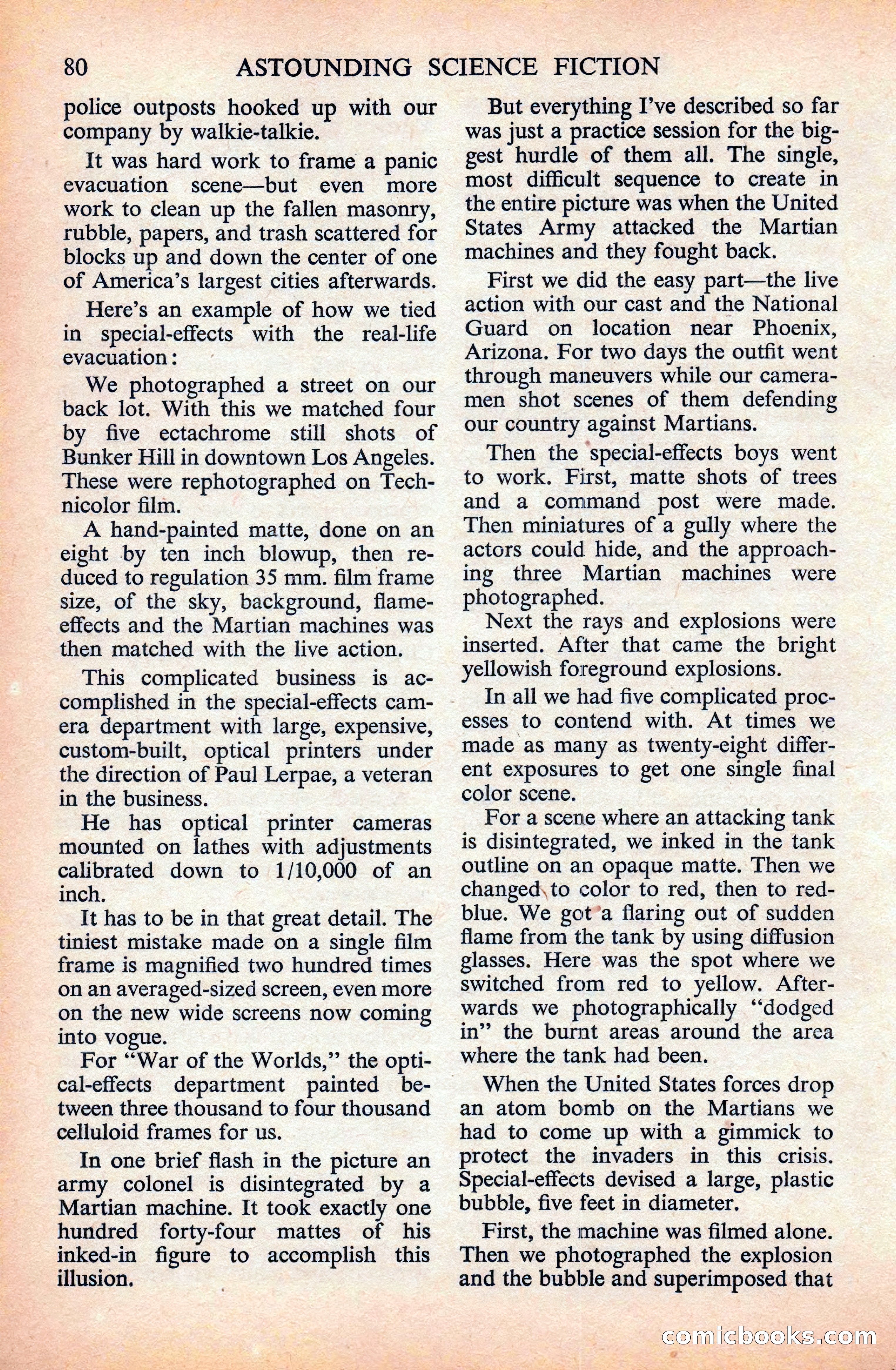
A restored page from Pulp Fiction, 1954. Page through the whole issue in the reader above.
📄 Transcribed text from this page (OCR, searchable)
Machine-transcribed from the original scan — historical spelling and the odd misread are preserved.
80 ASTOUNDING SCIENCE FICTION police outposts hooked up with our company by walkie-talkie. It was hard work to frame a panic evacuation scene—but even more work to clean up the fallen masonry, rubble, papers, and trash scattered for blocks up and down the center of one of America’s largest cities afterwards. Here’s an example of how we tied in special-effects with the real-life evacuation : We photographed a street on our back lot. With this we matched four by five ectachrome still shots of Bunker Hill in downtown Los Angeles. These were rephotographed on Tech- nicolor film. A hand-painted matte, done on an eight by ten inch blowup, then re- duced to regulation 35 mm. film frame size, of the sky, background, flame- effects and the Martian machines was then matched with the live action. This complicated business is ac- complished in the special-effects cam- era department with large, expensive, custom-built, optical printers under the direction of Paul Lerpae, a veteran in the business. He has optical printer cameras mounted on lathes with adjustments calibrated down to 1/10,000 of an inch. It has to be in that great detail. The tiniest mistake made on a single film frame is magnified two hundred times on an averaged-sized screen, even more on the new wide screens now coming into vogue. For “War of the Worlds,”’ the opti- cal-effects department painted be- tween three thousand to four thousand celluloid frames for us. In one brief flash in the picture an army colonel is disintegrated by a Martian machine. It took exactly one hundred forty-four mattes of his inked-in figure to accomplish this illusion. But everything I’ve described so far was just a practice session for the big- gest hurdle of them all. The single, most difficult sequence to create in the entire picture was when the United States Army attacked the Martian machines and they fought back. First we did the easy part—the live action with our cast and the National Guard on location near Phoenix, Arizona. For two days the outfit went through maneuvers while our camera- men shot scenes of them defending our country against Martians. Then the special-effects boys went to work. First, matte shots of trees and a command post were made. Then miniatures of a gully where the actors could hide, and the approach- ing three Martian machines were photographed. Next the rays and explosions were inserted. After that came the bright yellowish foreground explosions. In all we had five complicated proc- esses to contend with. At times we made as many as twenty-eight differ- ent exposures to get one single final color scene. For a scene where an attacking tank is disintegrated, we inked in the tank outline on an opaque matte. Then we changed, to color to red, then to red- blue. We got’a flaring out of sudden flame from the tank by using diffusion glasses. Here was the spot where we switched from red to yellow. After- wards we photographically “dodged in” the burnt areas around the area where the tank had been. When the United States forces drop an atom bomb on the Martians we had to come up with a gimmick to protect the invaders in this crisis. Special-effects devised a large, plastic bubble, five feet in diameter, First, the machine was filmed alone. Then we photographed the explosion and the bubble and superimposed that Comichbooks.co Ps) Al