
Pulp Fiction, 1954 · page 48 of 132
Astounding Science Fiction, British Edition — page 48: what you’re looking at
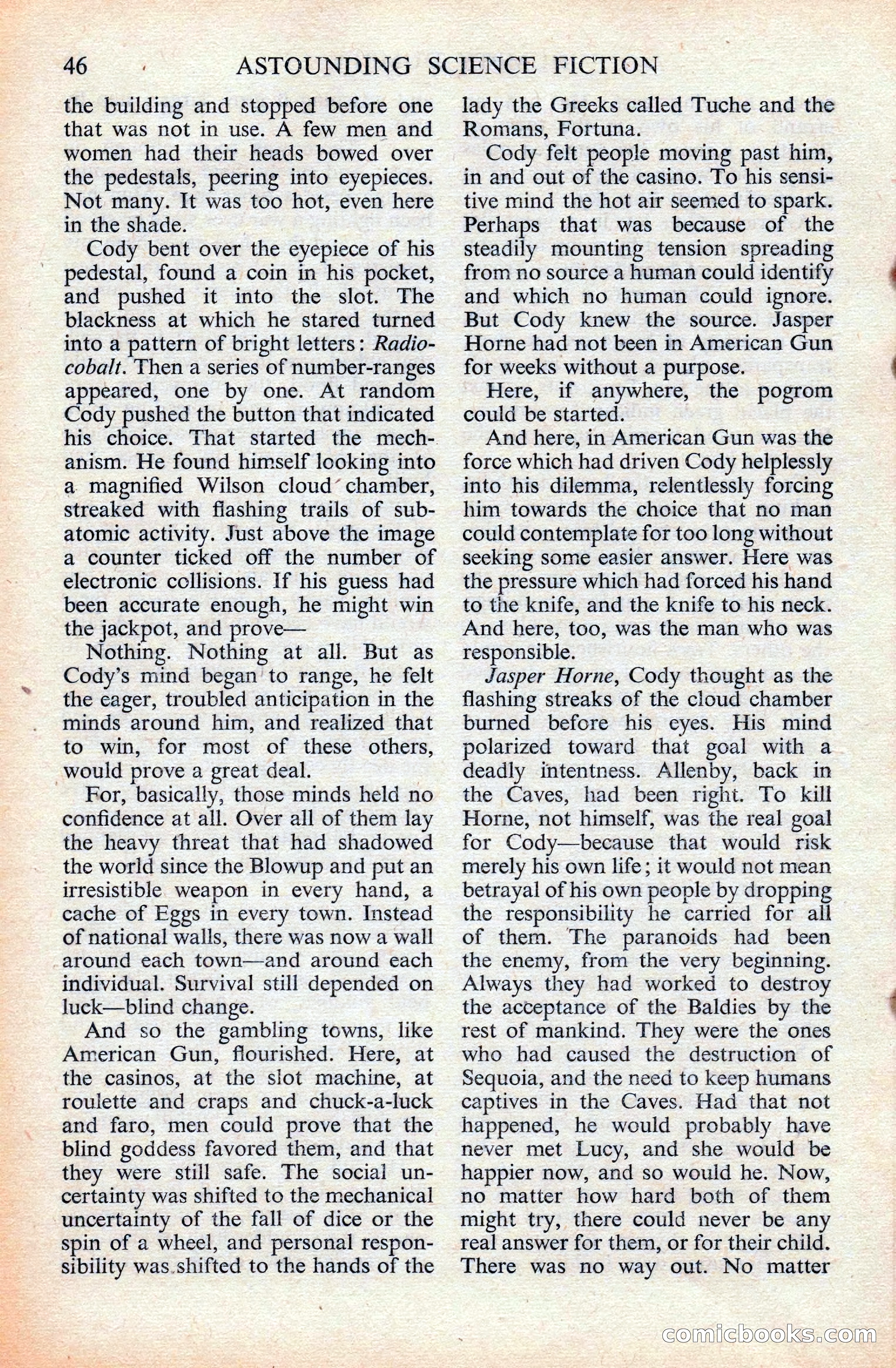
A restored page from Pulp Fiction, 1954. Page through the whole issue in the reader above.
📄 Transcribed text from this page (OCR, searchable)
Machine-transcribed from the original scan — historical spelling and the odd misread are preserved.
46 ‘ ASTOUNDING SCIENCE FICTION the building and stopped before one that was not in use. A few men and women had their heads bowed over the pedestals, peering into eyepieces. Not many. It was too hot, even here in the shade. Cody bent over the eyepiece of his pedestal, found a coin in his pocket, and pushed it into the slot. The blackness at which he stared turned into a pattern of bright letters: Radio- cobalt. Then a series of number-ranges appeared, one by one. At random Cody pushed the button that indicated his choice. That started the mech- anism. He found himself looking into a magnified Wilson cloud’ chamber, streaked with flashing trails of sub- atomic activity. Just above the image a counter ticked off the number of electronic collisions. If his guess had been accurate enough, he might win the jackpot, and prove— Nothing. Nothing at all. But as Cody’s mind began to range, he felt the eager, troubled anticipation in the minds around him, and realized that to win, for most of these others, would prove a great deal. For, basically, those minds held no confidence at all. Over all of them lay the heavy threat that had shadowed the world since the Blowup and put an irresistible weapon in every hand, a cache of Eggs in every town. Instead of national walls, there was now a wall _around each town—and around each individual. Survival still depended on luck—blind change. And so the gambling towns, like American Gun, flourished. Here, at the casinos, at the slot machine, at roulette and craps and chuck-a-luck and faro, men could prove that the blind goddess favored them, and that they were still safe. The sociai un- certainty was shifted to the mechanical uncertainty of the fall of dice or the spin of a wheel, and personal respon- sibility was.shifted to the hands of the lady the Greeks called Tuche and the Romans, Fortuna. Cody felt people moving past him, in and out of the casino. To his sensi- tive mind the hot air seemed to spark. Perhaps that was because of the steadily mounting tension spreading from no source a human could identify and which no human could ignore. But Cody knew the source. Jasper Horne had not been in American Gun for weeks without a purpose. Here, if anywhere, the pogrom could be started. And here, in American Gun was the force which had driven Cody helplessly into his dilemma, relentlessly forcing him towards the choice that no man could contemplate for too long without seeking some easier answer. Here was the pressure which had forced his hand to the knife, and the knife to his neck. And here, too, was the man who was responsible. Jasper Horne, Cody thought as the flashing streaks of the cloud chamber burned before his eyes. His mind polarized toward that goal with a deadly intentness. Allenby, back in the Caves, had been right. To kill Horne, not himself, was the real goal for Cody—because that would risk merely his own life; it would not mean betrayal of his own people by dropping the responsibility he carried for all of them. The paranoids had been the enemy, from the very beginning. Always they had worked to destroy the acceptance of the Baldies by the rest of mankind. They were the ones who had caused the destruction of Sequoia, and the need to keep humans captives in the Caves. Had that not happened, he would probably have never met Lucy, and she would be happier now, and so would he. Now, no matter how hard both of them might try, there could never be any real answer for them, or for their child. There was no way out. No matter Cconnicloooks.€© inal