
Pulp Fiction, 1954 · page 47 of 132
Astounding Science Fiction, British Edition — page 47: what you’re looking at
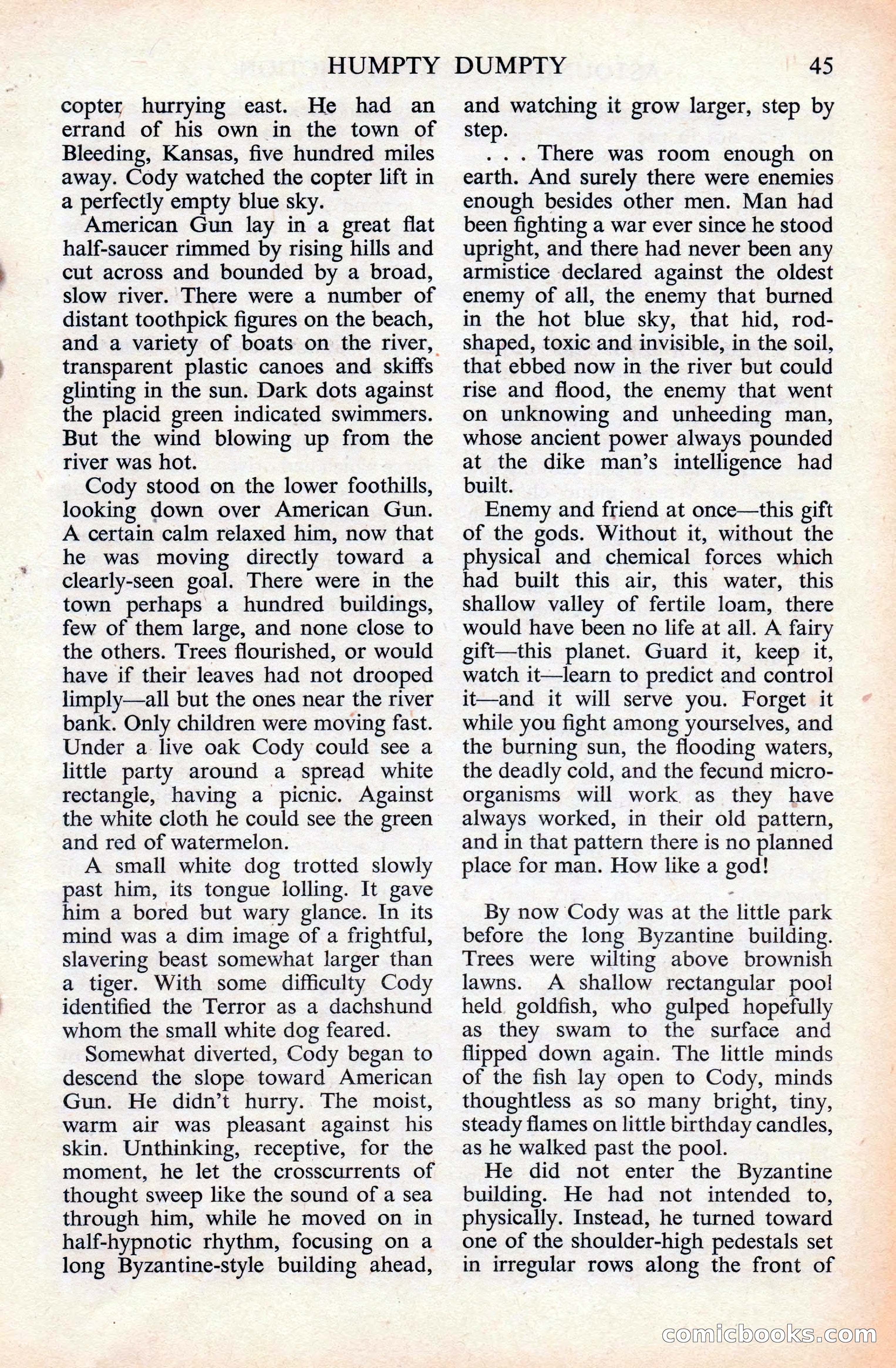
A restored page from Pulp Fiction, 1954. Page through the whole issue in the reader above.
📄 Transcribed text from this page (OCR, searchable)
Machine-transcribed from the original scan — historical spelling and the odd misread are preserved.
HUMPTY DUMPTY 45 copter hurrying east. He had an errand of his own in the town of Bleeding, Kansas, five hundred miles away. Cody watched the copter lift in a perfectly empty blue sky. American Gun lay in a great flat half-saucer rimmed by rising hills and cut across and bounded by a broad, slow river. There were a number of distant toothpick figures on the beach, and a variety of boats on the river, transparent plastic canoes and skiffs, glinting in the sun. Dark dots against the placid green indicated swimmers. But the wind blowing up from the river was hot. Cody stood on the lower foothills, looking down over American Gun. A certain calm relaxed him, now that he was moving directly toward a clearly-seen goal. There were in the town perhaps a hundred buildings, few of them large, and none close to the others. Trees flourished, or would have if their leaves had not drooped limply—all but the ones near the river bank. Only children were moving fast. Under a live oak Cody could see a little party around a spread white rectangle, having a picnic. Against the white cloth he could see the green and red of watermelon. A small white dog trotted slowly past him, its tongue lolling. It gave him a bored but wary glance. In its mind was a dim image of a frightful, slavering beast somewhat larger than a tiger. With some difficulty Cody identified the Terror as a dachshund whom the small white dog feared. Somewhat diverted, Cody began to descend the slope toward American Gun. He didn’t hurry. The moist, warm air was pleasant against his skin. Unthinking, receptive, for the moment, he let the crosscurrents of thought sweep like the sound of a sea through him, while he moved on in half-hypnotic rhythm, focusing on a long Byzantine-style building ahead, and watching it grow larger, step by step. . . There was room enough on earth. And surely there were enemies enough besides other men. Man had been fighting a war ever since he stood upright, and there had never been any armistice declared against the oldest enemy of all, the enemy that burned in the hot blue sky, that hid, rod- shaped, toxic and invisible, in the soil, that ebbed now in the river but could rise and flood, the enemy that went on unknowing and unheeding man, whose ancient power always pounded at the dike man’s intelligence had built. Enemy and friend at once—this gift of the gods. Without it, without the physical and chemical forces which had built this air, this water, this shallow valley of fertile loam, there would have been no life at all. A fairy gift—this planet. Guard it, keep it, watch it—learn to predict and control it—and it will serve you. Forget it while you fight among yourselves, and the burning sun, the flooding waters, the deadly cold, and the fecund micro- organisms will work as they have always worked, in their old pattern, and in that pattern there is no planned place for man. How like a god! By now Cody was at the little park before the long Byzantine building. Trees were wilting above brownish lawns. A shallow rectangular pool! held goldfish, who gulped hopefully as they swam to the surface and flipped down again. The little minds of the fish lay open to Cody, minds thoughtless as so many bright, tiny, steady flames on little birthday candles, as he walked past the pool. He did not enter the Byzantine building. He had not intended to, physically. Instead, he turned toward one of the shoulder-high pedestals set in irregular rows along the front of conniicloooks.c© im