
Pulp Fiction, 1954 · page 43 of 132
Astounding Science Fiction, British Edition — page 43: what you’re looking at
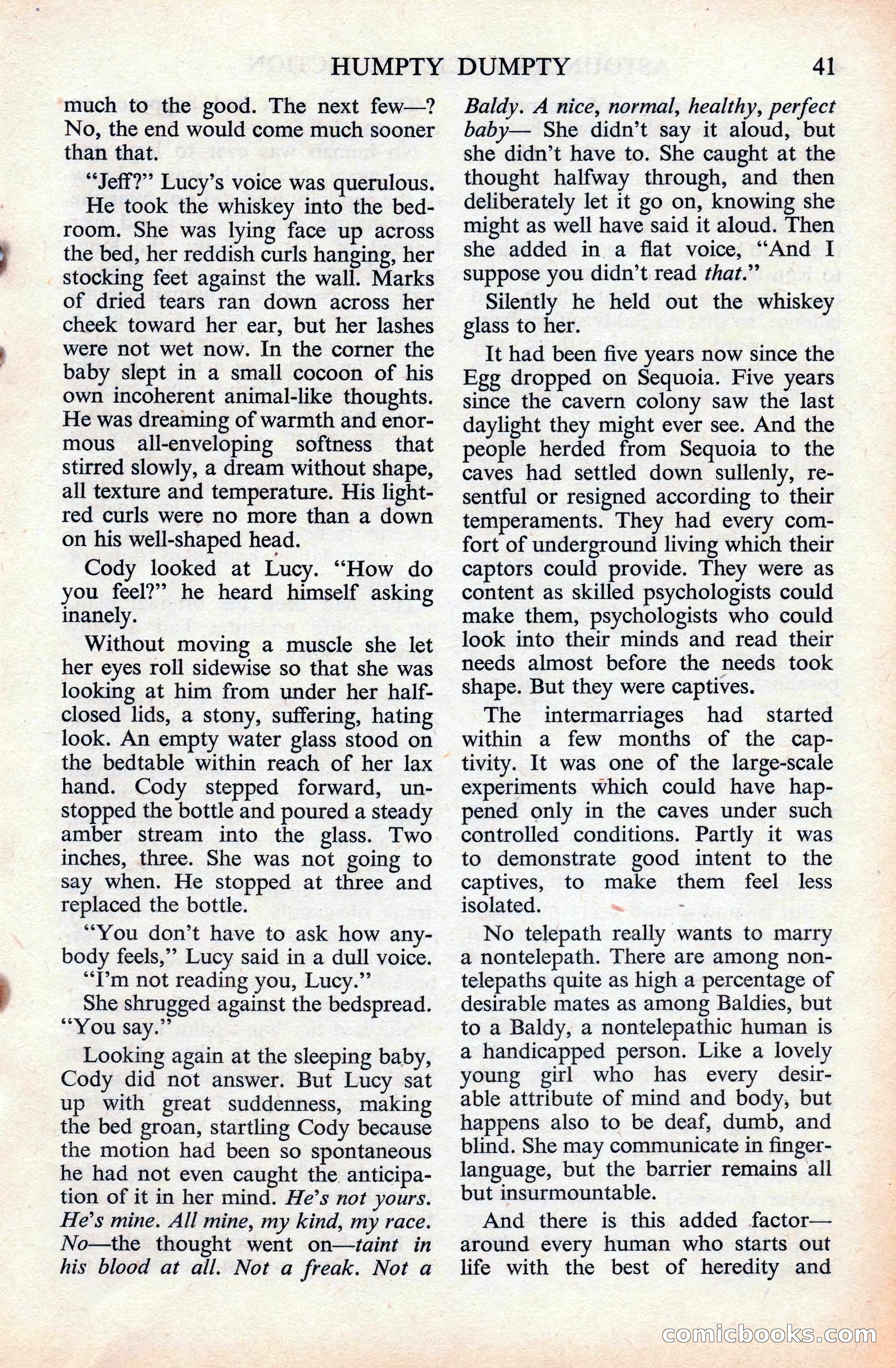
A restored page from Pulp Fiction, 1954. Page through the whole issue in the reader above.
📄 Transcribed text from this page (OCR, searchable)
Machine-transcribed from the original scan — historical spelling and the odd misread are preserved.
HUMPTY DUMPTY 41 much to the good. The next few—? No, the end would come much sooner than that. ‘Jeff?’ Lucy’s voice was querulous. He took the whiskey into the bed- room. She was lying face up across the bed, her reddish curls hanging, her stocking feet against the wall. Marks of dried tears ran down across her cheek toward her ear, but her lashes were not wet now. In the corner the baby slept in a small cocoon of his own incoherent animal-like thoughts. He was dreaming of warmth and enor- mous all-enveloping softness that stirred slowly, a dream without shape, all texture and temperature. His light- red curls were no more than a down on his well-shaped head. Cody looked at Lucy. ““How do you feel?’ he heard himself asking inanely. Without moving a muscle she let her eyes roll sidewise so that she was looking at him from under her half- closed lids, a stony, suffering, hating look. An empty water glass stood on the bedtable within reach of her lax hand. Cody stepped forward, un- stopped the bottle and poured a steady amber stream into the glass. Two inches, three. She was not going to say when. He stopped at three and replaced the bottle. “You don’t have to ask how any- body feels,”” Lucy said in a dull voice. “T’m not reading you, Lucy.” She shrugged against the bedspread. “You say.” Looking again at the sleeping baby, Cody did not answer. But Lucy sat up with great suddenness, making the bed groan, startling Cody because the motion had been so spontaneous he had not even caught the anticipa- tion of it in her mind. He’s not yours. He’s mine. All mine, my kind, my race. No—the thought went on—taint in his blood at all. Not a freak. Not a Baldy. A nice, normal, healthy, perfect baby— She didn’t say it aloud, but she didn’t have to. She caught at the thought halfway through, and then deliberately let it go on, knowing she might as well have said it aloud. Then she added in a flat voice, “And I suppose you didn’t read that.” Silently he held out the whiskey glass to her. It had been five years now since the Egg dropped on Sequoia. Five years since the cavern colony saw the last daylight they might ever see. And the people herded from Sequoia to the caves had settled down sullenly, re- sentful or resigned according to their temperaments. They had every com- fort of underground living which their captors could provide. They were as content as skilled psychologists could make them, psychologists who could look into their minds and read their needs almost before the needs took shape. But they were captives. The intermarriages had started within a few months of the cap- tivity. It was one of the large-scale experiments which could have hap- pened only in the caves under such controlled conditions. Partly it was to demonstrate good intent to the captives, to make them feel less isolated. : No telepath really wants to marry a nontelepath. There are among non- telepaths quite as high a percentage of desirable mates as among Baldies, but to a Baldy, a nontelepathic human is a handicapped person. Like a lovely young girl who has every desir- able attribute of mind and body, but happens also to be deaf, dumb, and blind. She may communicate in finger- language, but the barrier remains all but insurmountable. And there is this added factor— around every human who starts out life with the best of heredity and connicloooks.c© im