
Pulp Fiction, 1954 · page 29 of 132
Astounding Science Fiction, British Edition — page 29: what you’re looking at
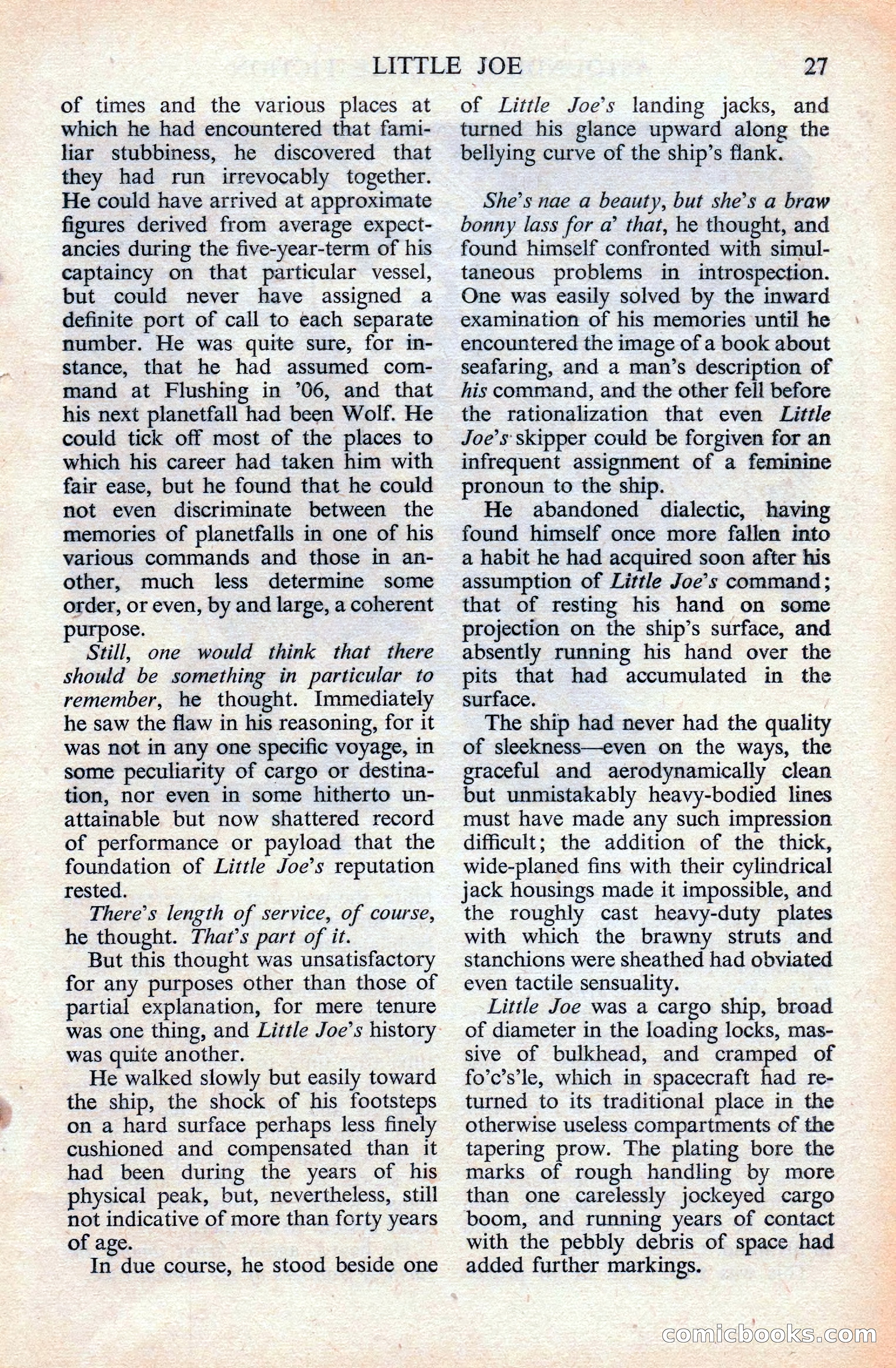
A restored page from Pulp Fiction, 1954. Page through the whole issue in the reader above.
📄 Transcribed text from this page (OCR, searchable)
Machine-transcribed from the original scan — historical spelling and the odd misread are preserved.
LITTLE JOE of times and the various places at which he had encountered that fami- liar stubbiness, he discovered that they had run irrevocably together. He could have arrived at approximate figures derived from average expect- ancies during the five-year-term of his captaincy on that particular vessel, but could never have assigned a definite port of call to each separate number. He was quite sure, for in- stance, that he had assumed com- mand at Flushing in ’06, and that his next planetfall had been Wolf. He could tick off most of the places to which his career had taken him with fair ease, but he found that he could not even discriminate between the memories of planetfalls in one of his various commands and those in an- other, much less determine some order, or even, by and large, a coherent purpose. Still, one would think that there should be something in particular to remember, he thought. Immediately he saw the flaw in his reasoning, for it was not in any one specific voyage, in some peculiarity of cargo or destina- tion, nor even in some hitherto un- attainable but now shattered record of performance or payload that the foundation of Little Joe’s reputation rested. There’s length of service, of course, he thought. That’s part of it. But this thought was unsatisfactory for any purposes other than those of partial explanation, for mere tenure was one thing, and Little Joe’s history was quite another. He walked slowly but easily toward the ship, the shock of his footsteps on a hard surface perhaps less finely cushioned and compensated than it had been during the years of his physical peak, but, nevertheless, still not indicative of more than forty years of age. In due course, he stood beside one 27 of Little Joe’s landing jacks, and turned his glance upward along the bellying curve of the ship’s flank. She’s nae a beauty, but she’s a braw bonny lass for a that, he thought, and found himself confronted with simul- taneous problems in introspection. One was easily solved by the inward examination of his memories until he encountered the image of a book about seafaring, and a man’s description of his command, and the other fell before the rationalization that even Little Joe’s skipper could be forgiven for an infrequent assignment of a feminine pronoun to the ship. He abandoned dialectic, having found himself once more fallen into a habit he had acquired soon after his assumption of Little Joe’s command; that of resting his hand on some projection on the ship’s surface, and absently running his hand over the pits that had accumulated in the surface. The ship had never had the quality of sleekness—even on the ways, the graceful and aerodynamically clean but unmistakably heavy-bodied lines must have made any such impression difficult; the addition of the thick, wide-planed fins with their cylindrical jack housings made it impossible, and the roughly cast heavy-duty plates with which the brawny struts and stanchions were sheathed had obviated even tactile sensuality. Little Joe was a cargo ship, broad of diameter in the loading locks, mas- sive of bulkhead, and cramped of fo’c’s’le, which in spacecraft had re- turned to its traditional place in the otherwise useless compartments of the tapering prow. The plating bore the marks of rough handling by more than one carelessly jockeyed cargo boom, and running years of contact with the pebbly debris of space had added further markings. conicbooks.co in