
Pulp Fiction, 1954 · page 28 of 132
Astounding Science Fiction, British Edition — page 28: what you’re looking at
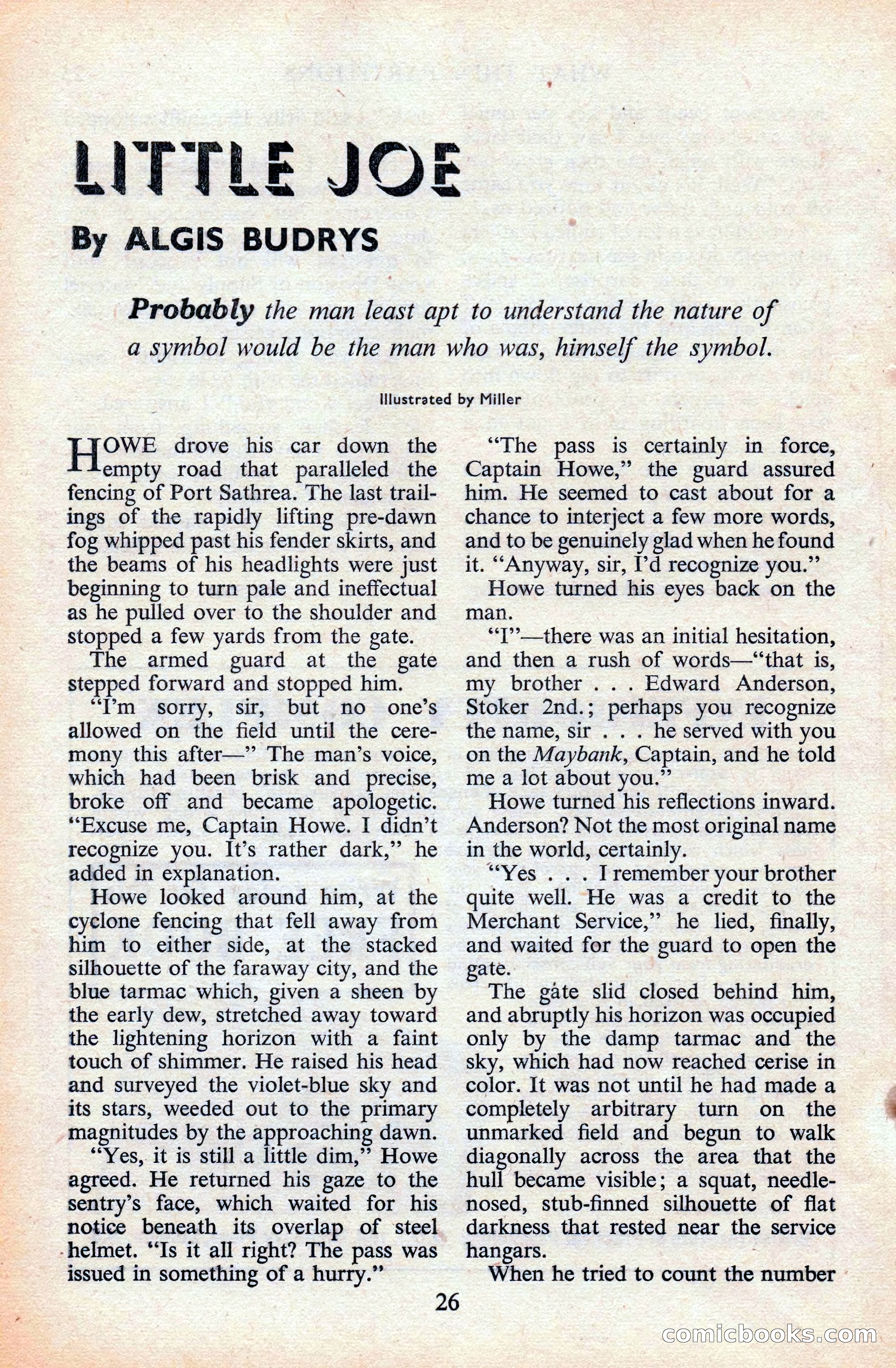
A restored page from Pulp Fiction, 1954. Page through the whole issue in the reader above.
📄 Transcribed text from this page (OCR, searchable)
Machine-transcribed from the original scan — historical spelling and the odd misread are preserved.
LiTTLe JOe By ALGIS BUDRYS Probably the man least apt to understand the nature of a symbol would be the man who was, himself the symbol. Illustrated by Miller OWE drove his car down the empty road that paralleled the fencing of Port Sathrea. The last trail- ings of the rapidly lifting pre-dawn fog whipped past his fender skirts, and the beams of his headlights were just beginning to turn pale and ineffectual as he pulled over to the shoulder and stopped a few yards from the gate. The armed guard at the gate stepped forward and stopped him. “Tm sorry, sir, but no _ one’s allowed on the field until the cere- mony this after—” The man’s voice, which had been brisk and precise, broke off and became apologetic. “Excuse me, Captain Howe. I didn’t recognize you. It’s rather dark,” he added in explanation. Howe looked around him, at the cyclone fencing that fell away from him to either side, at the stacked silhouette of the faraway city, and the blue tarmac which, given a sheen by the early dew, stretched away toward the lightening horizon with a faint touch of shimmer. He raised his head and surveyed the violet-blue sky and its stars, weeded out to the primary magnitudes by the approaching dawn. “Yes, it is still a little dim,’’ Howe agreed. He returned his gaze to the sentry’s face, which waited for his notice beneath its overlap of steel -helmet. “Is it all right? The pass was issued in something of a hurry.” 26 “The pass is certainly in force, Captain Howe,” the guard assured him. He seemed to cast about for a chance to interject a few more words, and to be genuinely glad when he found it. “Anyway, sir, P’'d recognize you.” Howe turned his eyes back on the man. **]’>there was an initial hesitation, and then a rush of words—‘‘that is, my brother . . . Edward Anderson, Stoker 2nd.; perhaps you recognize the name, sir . . . he served with you on the Maybank, Captain, and he told me a lot about you.”’ Howe turned his reflections inward. Anderson? Not the most original name in the world, certainly. “Yes . . . Iremember your brother quite well. He was a credit to the Merchant Service,’ he lied, finally, and waited for the guard to open the ate. : The gate slid closed behind him, and abruptly his horizon was occupied only by the damp tarmac and the sky, which had now reached cerise in color. It was not until he had made a completely arbitrary turn on the unmarked field and begun to walk diagonally across the area that the hull became visible; a squat, needle- nosed, stub-finned silhouette of flat darkness that rested near the service hangars. When he tried to count the number conniclooolkks.c© iim