
Pulp Fiction, 1954 · page 22 of 132
Astounding Science Fiction, British Edition — page 22: what you’re looking at
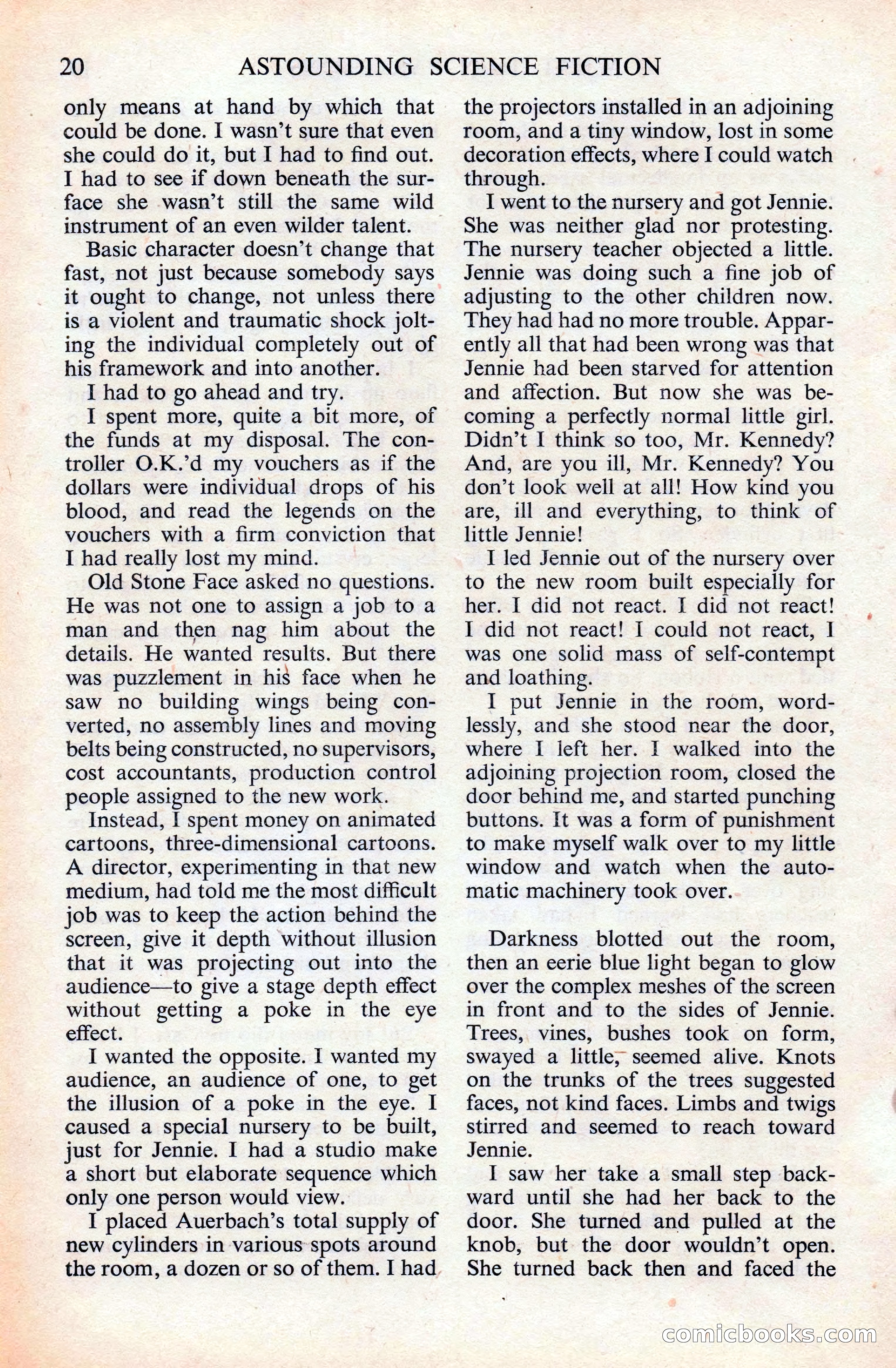
A restored page from Pulp Fiction, 1954. Page through the whole issue in the reader above.
📄 Transcribed text from this page (OCR, searchable)
Machine-transcribed from the original scan — historical spelling and the odd misread are preserved.
20 only means at hand by which that could be done. I wasn’t sure that even she could do it, but I had to find out. I had to see if down beneath the sur- face she wasn’t still the same wild instrument of an even wilder talent. Basic character doesn’t change that fast, not just because somebody says it ought to change, not unless there is a violent and traumatic shock jolt- ing the individual completely out of his framework and into another. I had to go ahead and try. I spent more, quite a bit more, of the funds at my disposal. The con- troller O.K.’d my vouchers as if the dollars were individual drops of his blood, and read the legends on the vouchers with a firm conviction that I had really lost my mind. Old Stone Face asked no questions. He was not one to assign a job to a man and then nag him about the details. He wanted results. But there was puzzlement in his face when he saw no building wings being con- verted, no assembly lines and moving belts being constructed, no supervisors, cost accountants, production control people assigned to the new work. Instead, I spent money on animated cartoons, three-dimensional cartoons. A director, experimenting in that new medium, had told me the most difficult job was to keep the action behind the screen, give it depth without illusion that it was projecting out into the audience—to give a stage depth effect without getting a poke in the eye effect. I wanted the opposite. I wanted my audience, an audience of one, to get the illusion of a poke in the eye. I caused a special nursery to be built, just for Jennie. I had a studio make a short but elaborate sequence which only one person would view. I placed Auerbach’s total supply of new cylinders in various spots around the room, a dozen or so of them. I had ASTOUNDING SCIENCE FICTION the projectors installed in an adjoining room, and a tiny window, lost in some decoration effects, where I could watch through. I went to the nursery and got Jennie. She was neither glad nor protesting. The nursery teacher objected a little. Jennie was doing such a fine job of adjusting to the other children now. They had had no more trouble. Appar- ently all that had been wrong was that Jennie had been starved for attention and affection. But now she was be- coming a perfectly normal little girl. Didn’t I think so too, Mr. Kennedy? And, are you ill, Mr. Kennedy? You don’t look well at all! How kind you are, ill and everything, to think of little Jennie! I led Jennie out of the nursery over to the new room built especially for her. I did not react. I did not react! I did not react! I could not react, I was one solid mass of self-contempt and loathing. I put Jennie in the room, word- lessly, and she stood near the door, where I left her. I walked into the adjoining projection room, closed the door behind me, and started punching buttons. It was a form of punishment to make myself walk over to my little window and watch when the auto- matic machinery took over. Darkness blotted out the room, then an eerie blue light began to glow over the complex meshes of the screen in front and to the sides of Jennie. Trees, vines, bushes took on form, swayed a little, seemed alive. Knots on the trunks of the trees suggested faces, not kind faces. Limbs and twigs stirred and seemed to reach toward Jennie. I saw her take a small step back- ward until she had her back to the door. She turned and pulled at the knob, but the door wouldn’t open. She turned back then and faced the conniclooolkks.€c© inn