
Pulp Fiction, 1954 · page 21 of 132
Astounding Science Fiction, British Edition — page 21: what you’re looking at
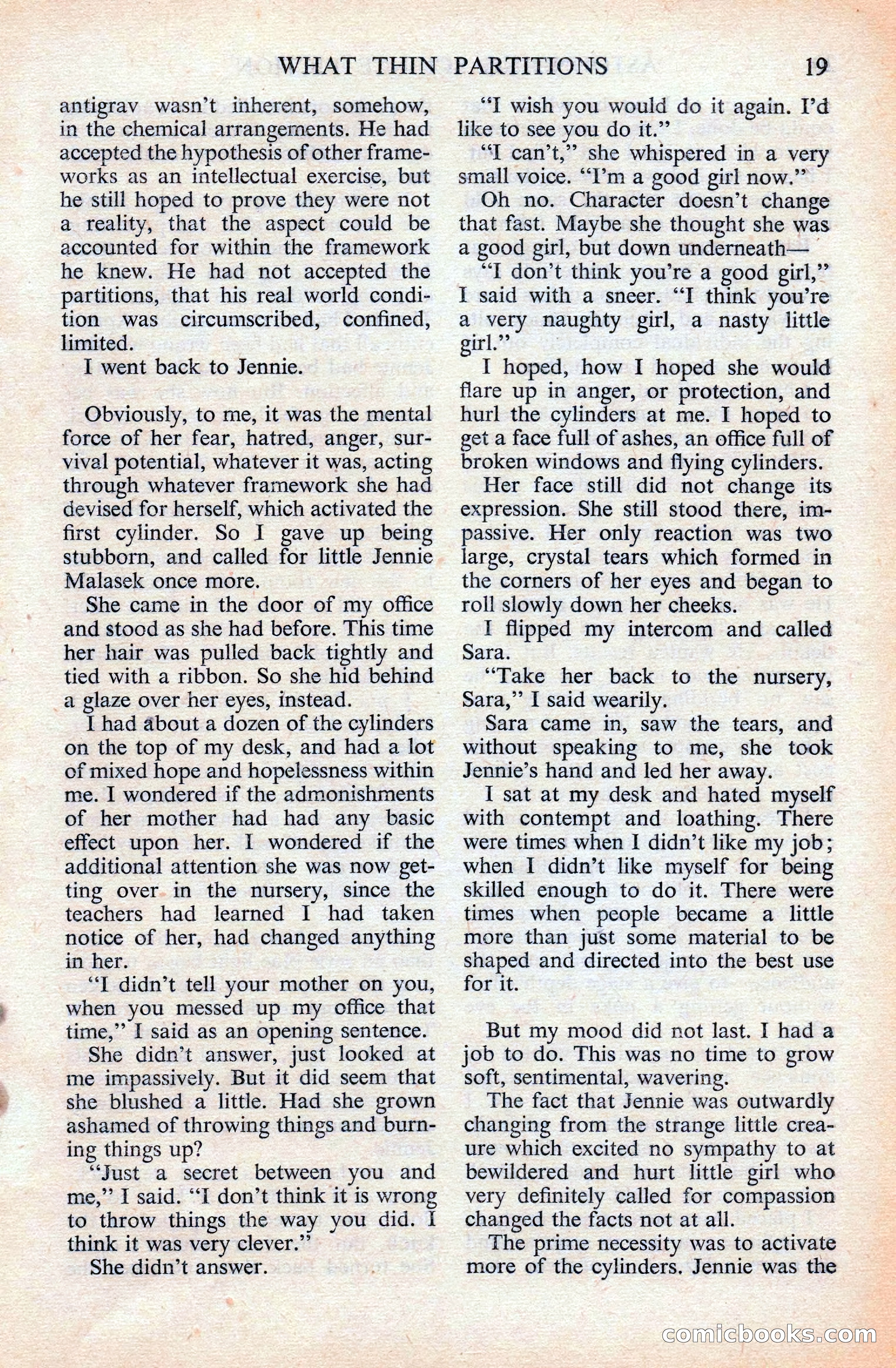
A restored page from Pulp Fiction, 1954. Page through the whole issue in the reader above.
📄 Transcribed text from this page (OCR, searchable)
Machine-transcribed from the original scan — historical spelling and the odd misread are preserved.
WHAT THIN antigrav wasn’t inherent, somehow, in the chemical arrangements. He had accepted the hypothesis of other frame- works as an intellectual exercise, but he still hoped to prove they were not a reality, that the aspect could be accounted for within the framework he knew. He had not accepted the partitions, that his real world condi- tion was circumscribed, confined, limited. I went back to Jennie. Obviously, to me, it was the mental force of her fear, hatred, anger, sur- vival potential, whatever it was, acting through whatever framework she had devised for herself, which activated the first cylinder. So I gave up being stubborn, and called for little Jennie Malasek once more. She came in the door of my office and stood as she had before. This time her hair was pulled back tightly and tied with a ribbon. So she hid behind a glaze over her eyes, instead. I had about a dozen of the cylinders on the top of my desk, and had a lot of mixed hope and hopelessness within me. I wondered if the admonishments of her mother had had any basic effect upon her. I wondered if the additional attention she was now get- ting over. in the nursery, since the teachers had learned I had taken notice of her, had changed anything in her. “J didn’t tell your mother on you, when you messed up my office that time,” I said as an opening sentence. She didn’t answer, just looked at me impassively. But it did seem that she blushed a little. Had she grown ashamed of throwing things and burn- ing things up? ‘Just a secret between you and me,”’ I said. “I don’t think it is wrong to throw things the way you did. I think it was very clever.”’ She didn’t answer. PARTITIONS 19 “T wish you would do it again. I'd like to see you do it.” “I can’t,” she whispered in a very small voice. “I’m a good girl now.” Oh no. Character doesn’t change that fast. Maybe she thought she was a good girl, but down underneath— “IT don’t think you’re a good girl,” I said with a sneer. “I think you’re a os naughty girl, a nasty little gir a I hoped, how I hoped she would flare up in anger, or protection, and hurl the cylinders at me. I hoped to get a face full of ashes, an office full of broken windows and flying cylinders. Her face still did not change its expression. She still stood there, im- passive. Her only reaction was two large, crystal tears which formed in the corners of her eyes and began to roll slowly down her cheeks. I flipped my intercom and called Sara. “Take her back to the nursery, Sara,” I said wearily. Sara came in, saw the tears, and without speaking to me, she took Jennie’s hand and led her away. I sat at my desk and hated myself with contempt and loathing. There were times when I didn’t like my job; when I didn’t like myself for being skilled enough to do it. There were times when people became a little more than just some material to be shaped and directed into the best use for it. But my mood did not last. I had a job to do. This was no time to grow soft, sentimental, wavering. The fact that Jennie was outwardly changing from the strange little crea- ure which excited no sympathy to at bewildered and hurt little girl who very definitely called for compassion changed the facts not at ail. The prime necessity was to activate more of the cylinders. Jennie was the Connie ooolkks.e@ im