
Pulp Fiction, 1954 · page 15 of 132
Astounding Science Fiction, British Edition — page 15: what you’re looking at
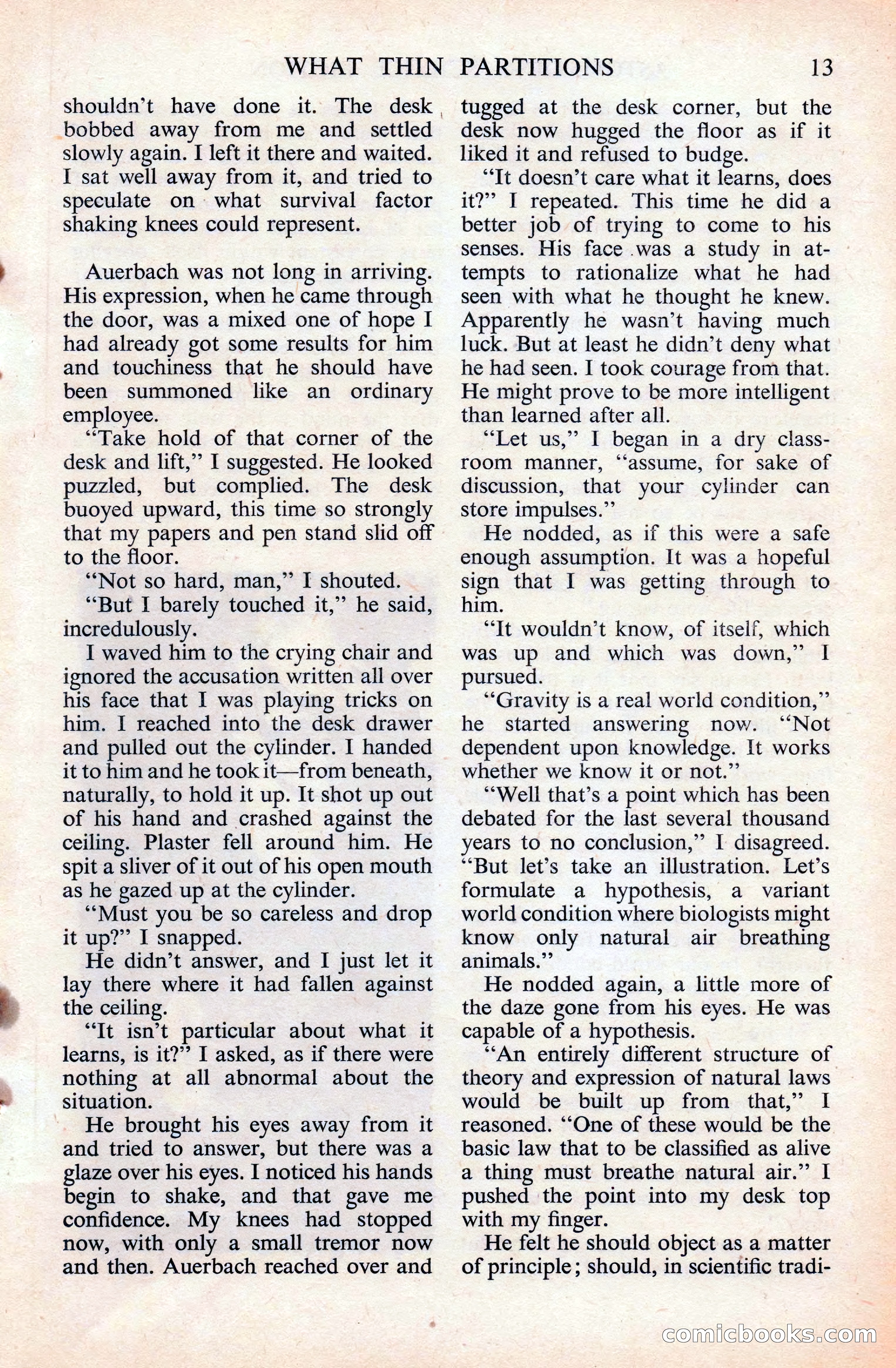
A restored page from Pulp Fiction, 1954. Page through the whole issue in the reader above.
📄 Transcribed text from this page (OCR, searchable)
Machine-transcribed from the original scan — historical spelling and the odd misread are preserved.
WHAT THIN shouldn’t have done it. The desk bobbed away from me and settled slowly again. I left it there and waited. I sat well away from it, and tried to speculate on = what survival factor shaking knees could represent. Auerbach was not long in arriving. His expression, when he came through the door, was a mixed one of hope I had already got some results for him and touchiness that he should have been summoned like an ordinary employee. “Take hold of that corner of the desk and lift,” I suggested. He looked puzzled, but complied. The desk buoyed upward, this time so strongly that my papers and pen stand slid off to the floor. ‘“‘Not so hard, man,”’ I shouted. “But I barely touched it,” he said, incredulously. I waved him to the crying chair and ignored the accusation written all over his face that I was playing tricks on him. I reached into the desk drawer and pulled out the cylinder. I handed it to him and he took it—from beneath, naturally, to hold it up. It shot up out of his hand and crashed against the ceiling. Plaster fell around him. He spit a sliver of it out of his open mouth as he gazed up at the cylinder. “Must you be so careless and drop it up?” I snapped. He didn’t answer, and I just let it lay there where it had fallen against the ceiling. “It isn’t particular about what it learns, is it?’ I asked, as if there were nothing at all abnormal about the situation. He brought his eyes away from it and tried to answer, but there was a glaze over his eyes. I noticed his hands begin to shake, and that gave me confidence. My knees had stopped now, with only a small tremor now and then. Auerbach reached over and PARTITIONS 13 tugged at the desk corner, but the desk now hugged the floor as if it liked it and refused to budge. “It doesn’t care what it learns, does it?” I repeated. This time he did a better job of trying to come to his senses. His face .was a study in at- tempts to rationalize what he had seen with what he thought he knew. Apparently he wasn’t having much luck. But at least he didn’t deny what he had seen. I took courage from that. He might prove to be more intelligent than learned after all. “Let us,” I began in a dry class- room manner, ‘‘assume, for sake of discussion, that your cylinder can store impulses.”’ He nodded, as if this were a safe enough assumption. It was a hopeful sign that I was getting through to him. “It wouldn’t know, of itself, which was up and which was down,” I pursued. “Gravity is a real world condition,” he started answering now. “Not dependent upon knowledge. It works whether we know it or not.” “Well that’s a point which has been debated for the last several thousand years to no conclusion,” I disagreed. “But let’s take an illustration. Let’s formulate a hypothesis, a variant world condition where biologists might know only natural air breathing animals.” He nodded again, a little more of the daze gone from his eyes. He was capable of a hypothesis. “An entirely different structure of theory and expression of natural laws would be built up from that,” I reasoned. ‘‘One of these would be the basic law that to be classified as alive a thing must breathe natural air.” I pushed the point into my desk top with my finger. He felt he should object as a matter of principle; should, in scientific tradi- Cconnicloooks.c© iim