
Pulp Fiction, 1954 · page 14 of 132
Astounding Science Fiction, British Edition — page 14: what you’re looking at
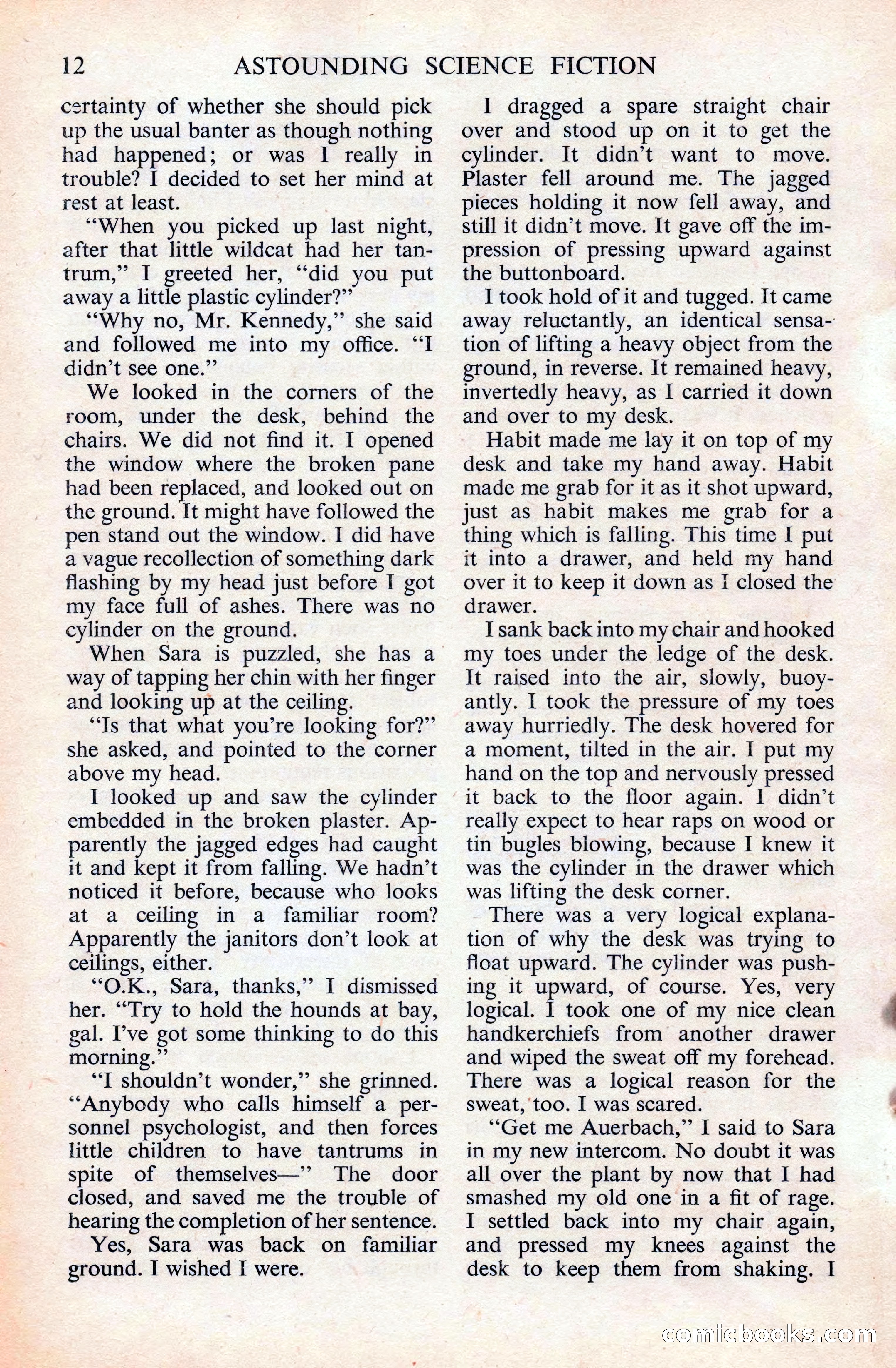
A restored page from Pulp Fiction, 1954. Page through the whole issue in the reader above.
📄 Transcribed text from this page (OCR, searchable)
Machine-transcribed from the original scan — historical spelling and the odd misread are preserved.
12 certainty of whether she should pick up the usual banter as though nothing had happened; or was I really in trouble? I decided to set her mind at rest at least. “When you picked up last night, after that little wildcat had her tan- trum,” I greeted her, “‘did you put away a little plastic cylinder?” “Why no, Mr. Kennedy,” she said and followed me into my office. “I didn’t see one.”’ We looked in the corners of the room, under the desk, behind the chairs. We did not find it. I opened the window where the broken pane had been replaced, and looked out on the ground. It might have followed the pen stand out the window. I did have a vague recollection of something dark flashing by my head just before I got my face full of ashes. There was no cylinder on the ground. When Sara is puzzled, she has a way of tapping her chin with her finger and looking up at the ceiling. ‘Is that what you’re looking for?” she asked, and pointed to the corner above my head. I looked up and saw the cylinder embedded in the broken plaster. Ap- parently the jagged edges had caught it and kept it from falling. We hadn’t noticed it before, because who looks at a ceiling in a familiar room? Apparently the janitors don’t look at ceilings, either. “O.K., Sara, thanks,’ I dismissed her. “Try to hold the hounds at bay, gal. I’ve got some thinking to do this morning.” “IT shouldn’t wonder,” she grinned. *“Anybody who calls himself a per- sonnel psychologist, and then forces little children to have tantrums in spite of themselves—’ The door closed, and saved me the trouble of hearing the completion of her sentence. Yes, Sara was back on familiar ground. I wished I were. ASTOUNDING SCIENCE FICTION I dragged a spare straight chair over and stood up on it to get the cylinder. It didn’t want to move. Plaster fell around me. The jagged pieces holding it now fell away, and still it didn’t move. It gave off the im- pression of pressing upward against the buttonboard. : I took hold of it and tugged. It came away reluctantly, an identical sensa- tion of lifting a heavy object from the ground, in reverse. It remained heavy, invertedly heavy, as I carried it down and over to my desk. Habit made me lay it on top of my desk and take my hand away. Habit made me grab for it as it shot upward, just as habit makes me grab for a thing which is falling. This time I put it into a drawer, and held my hand over it to keep it down as i closed the drawer. I sank back into my chair and hooked my toes under the ledge of the desk. It raised into the air, slowly, buoy- antly. I took the pressure of my toes away hurriedly. The desk hovered for a moment, tilted in the air. I put my hand on the top and nervously pressed it back to the floor again. I didn’t really expect to hear raps on wood or tin bugles blowing, because I knew it was the cylinder in the drawer which was lifting the desk corner. There was a very logical explana- tion of why the desk was trying to float upward. The cylinder was push- ing it upward, of course. Yes, very logical. I took one of my nice clean handkerchiefs from another drawer and wiped the sweat off my forehead. There was a logical reason for the sweat, too. I was scared. ““Get me Auerbach,”’ I said to Sara in my new intercom. No doubt it was all over the plant by now that I had smashed my old one in a fit of rage. I settled back into my chair again, and pressed my knees against the desk to keep them from shaking. I comiicloooks.c© iin