
Pulp Fiction, 1954 · page 129 of 132
Astounding Science Fiction, British Edition — page 129: what you’re looking at
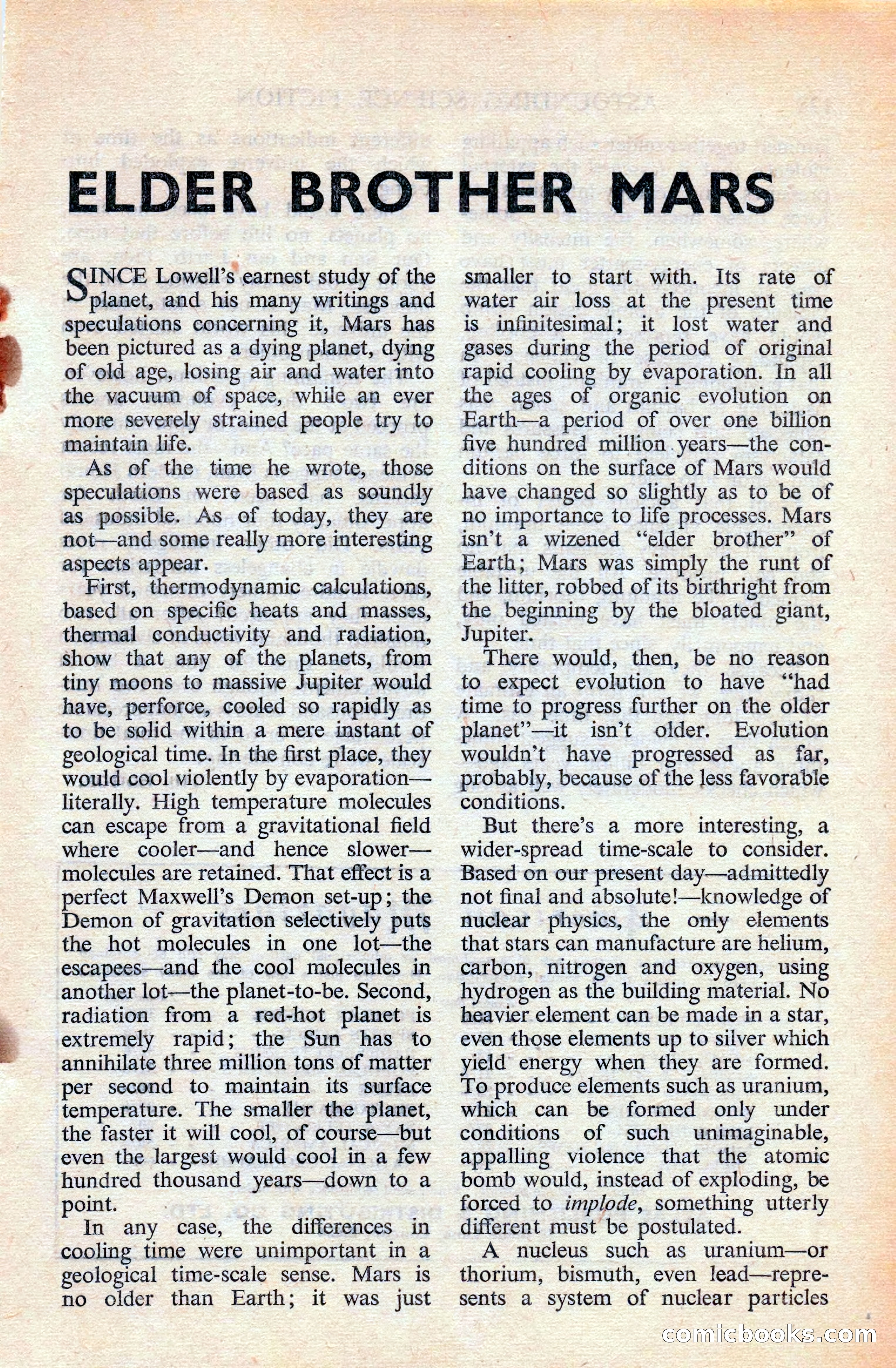
A restored page from Pulp Fiction, 1954. Page through the whole issue in the reader above.
📄 Transcribed text from this page (OCR, searchable)
Machine-transcribed from the original scan — historical spelling and the odd misread are preserved.
ELDER BROTHER MARS INCE Lowell’s earnest study of the planet, and his many writings and speculations concerning it, Mars has been pictured as a dying planet, dying of old age, losing air and water into the vacuum of space, while an ever more severely strained people try to maintain life. As of the time he wrote, those speculations were based as soundly as possible. As of today, they are not—and some really more interesting aspects appear. First, thermodynamic calculations, based on specific heats and masses, thermal conductivity and radiation, show that any of the planets, from tiny moons to massive Jupiter would have, perforce, cooled so rapidly as to be solid within a mere instant of geological time. In the first place, they would cool violently by evaporation— literally. High temperature molecules can escape from a gravitational field where cooler—and hence slower— molecules are retained. That effect is a perfect Maxwell’s Demon set-up; the Demon of gravitation selectively puts the hot molecules in one lot—the escapees—and the cool molecules in another lot—the planet-to-be. Second, radiation from a red-hot planet is extremely rapid; the Sun has to annihilate three million tons of matter per second to maintain its surface temperature. The smaller the planet, the faster it will cool, of course—but even the largest would cool in a few hundred thousand years—down to a point. . In any case, the differences in cooling time were unimportant in a geological time-scale sense. Mars is no older than Earth; it was just smaller to start with. Its rate of water air loss at the present time is infinitesimal; it lost water and gases during the period of original rapid cooling by evaporation. In all the ages of organic evolution on Earth—a period of over one billion five hundred million. years—the con- ditions on the surface of Mars would have changed so slightly as to be of no importance to life processes. Mars isn’t a wizened “elder brother’ of Earth; Mars was simply the runt of the litter, robbed of its birthright from the beginning by the bloated giant, Jupiter. There would, then, be no reason to expect evolution to have “had time to progress further on the older planet’—it isn’t older. Evolution wouldn’t have progressed as far, probably, because of the less favorable conditions. But there’s a more interesting, a wider-spread time-scale to consider. Based on our present day—admittedly not final and absolute!—knowledge of nuclear physics, the only elements that stars can manufacture are helium, carbon, nitrogen and oxygen, using hydrogen as the building material. No heavier element can be made in a star, even those elements up to silver which yield’ energy when they are formed. To produce elements such as uranium, which can be formed only under conditions of such unimaginable, appalling violence that the atomic bomb would, instead of exploding, be forced to implode, something utterly different must be postulated. A nucleus such as uranium—or thorium, bismuth, even lead—trepre- sents a system of nuclear particles Cconniclooolkks.c© im