
Pulp Fiction, 1954 · page 128 of 132
Astounding Science Fiction, British Edition — page 128: what you’re looking at
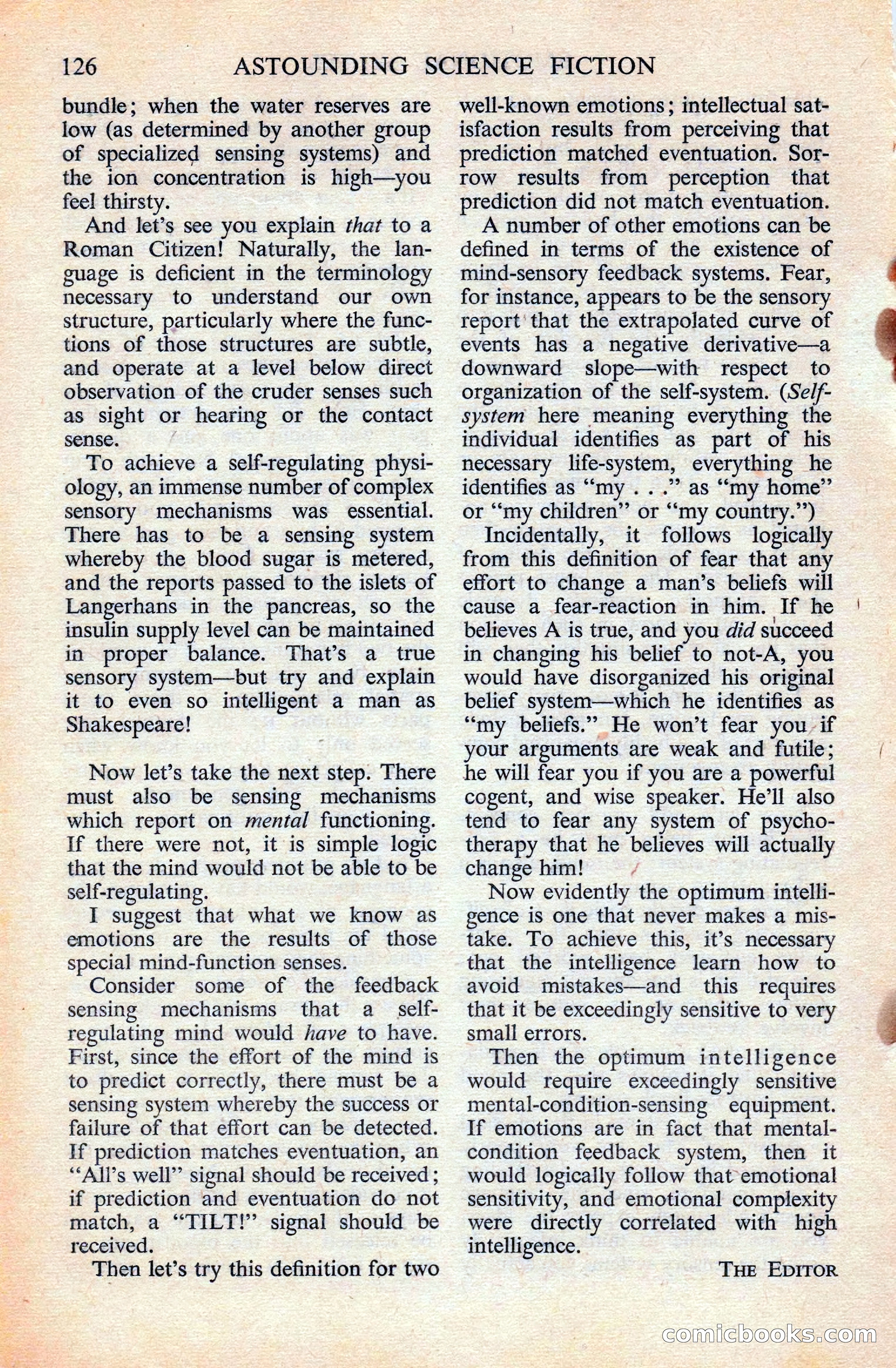
A restored page from Pulp Fiction, 1954. Page through the whole issue in the reader above.
📄 Transcribed text from this page (OCR, searchable)
Machine-transcribed from the original scan — historical spelling and the odd misread are preserved.
126 bundle; when the water reserves are low (as determined by another group of specialized sensing systems) and the ion concentration is high—you feel thirsty. And let’s see you explain that to a Roman Citizen! Naturally, the lan- guage is deficient in the terminology necessary to understand our own structure, particularly where the func- tions of those structures are subtle, and operate at a level below direct observation of the cruder senses such as sight or hearing or the contact sense. : To achieve a self-regulating physi- ology, an immense number of complex sensory mechanisms was essential. There has to be a sensing system whereby the blood sugar is metered, and the reports passed to the islets of Langerhans in the pancreas, so the insulin supply level can be maintained in proper balance. That’s a true sensory system—but try and explain it to even so intelligent a man as Shakespeare! Now let’s take the next step. There must also be sensing mechanisms which report on mental functioning. If there were not, it is simple logic that the mind would not be able to be self-regulating. I suggest that what we know as emotions are the results of those special mind-function senses. Consider some of the feedback sensing mechanisms that a _ self- regulating mind would have to have. First, since the effort of the mind is to predict correctly, there must be a sensing system whereby the success or failure of that effort can be detected. If prediction matches eventuation, an ‘“All’s well” signal should be received ; if prediction and eventuation do not match, a “TILT!” signal should be received. Then let’s try this definition for two ASTOUNDING SCIENCE FICTION well-known emotions; intellectual sat- isfaction results from perceiving that prediction matched eventuation. Sor- row results from perception that prediction did not match eventuation. A number of other emotions can be defined in terms of the existence of mind-sensory feedback systems. Fear, for instance, appears to be the sensory report’ that the extrapolated curve of events has a negative derivative—a downward slope—with respect to organization of the self-system. (Self- system here meaning everything the individual identifies as part of his necessary life-system, everything he identifies as “my .. .” as “my home” or “my children” or ‘‘my country.’’) Incidentally, it follows logically from this definition of fear that any effort to change a man’s beliefs will cause a fear-reaction in him. If he believes A is true, and you did succeed in changing his belief to not-A, you would have disorganized his original belief system—which he identifies as “my beliefs.”” He won’t fear you if your arguments are weak and futile; he will fear you if you are a powerful cogent, and wise speaker. He’ll also tend to fear any system of psycho- therapy that he believes will actually change him! / Now evidently the optimum intelli- gence is one that never makes a mis- take. To achieve this, it’s necessary that the intelligence learn how to avoid mistakes—and this requires that it be exceedingly sensitive to very small errors. Then the optimum intelligence would require exceedingly sensitive mental-condition-sensing equipment. If emotions are in fact that mental- condition feedback system, then it would logically follow that emotional sensitivity, and emotional complexity were directly correlated with high intelligence. THE EDITOR connicloooks.c© iim