
Pulp Fiction, 1954 · page 11 of 132
Astounding Science Fiction, British Edition — page 11: what you’re looking at
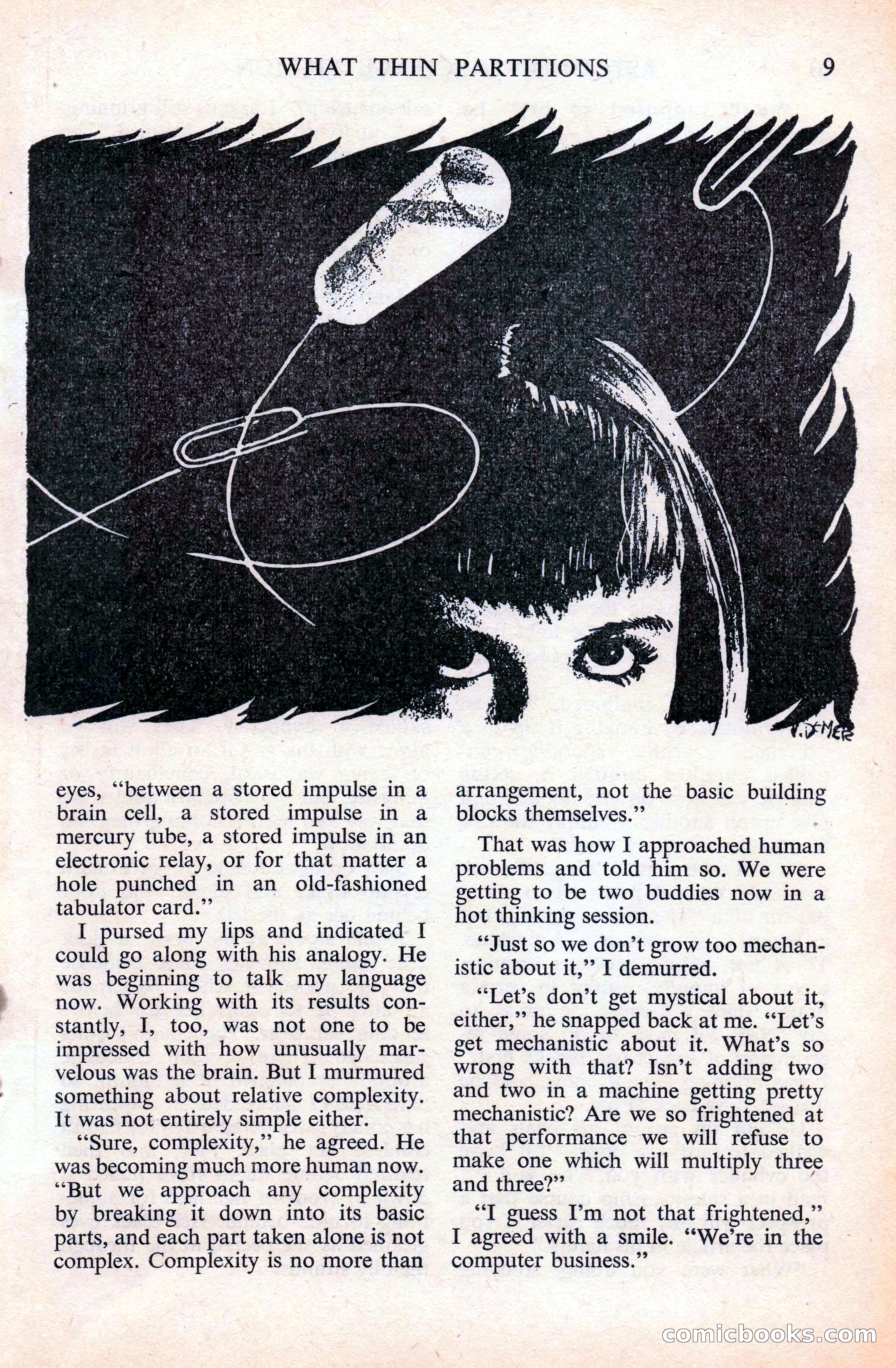
A restored page from Pulp Fiction, 1954. Page through the whole issue in the reader above.
📄 Transcribed text from this page (OCR, searchable)
Machine-transcribed from the original scan — historical spelling and the odd misread are preserved.
WHAT THIN PARTITIONS 9 eyes, “between a stored impulse in a brain cell, a stored impulse in a mercury tube, a stored impulse in an electronic relay, or for that matter a hole punched in an old-fashioned tabulator card.” I pursed my lips and indicated I could go along with his analogy. He was beginning to talk my language now. Working with its results con- stantly, I, too, was not one to be impressed with how unusually mar- velous was the brain. But I murmured something about relative complexity. It was not entirely simple either. “Sure, complexity,” he agreed. He was becoming much more human now. “But we approach any complexity by breaking it down into its basic parts, and each part taken alone is not complex. Complexity is no more than arrangement, not the basic building blocks themselves.”’ That was how I approached human problems and told him so. We were getting to be two buddies now in a hot thinking session. “Just so we don’t grow too mechan- istic about it,’ I demurred. “Let’s don’t get mystical about it, either,” he snapped back at me. “‘Let’s get mechanistic about it. What’s so wrong with that? Isn’t adding two and two in a machine getting pretty mechanistic? Are we so frightened at that performance we will refuse to make one which will multiply three and three?” “I guess I’m not that frightened,” I agreed with a smile. “We're in the computer business.” connicloooks.c© nl