
Pulp Fiction, 1954 · page 10 of 132
Astounding Science Fiction, British Edition — page 10: what you’re looking at
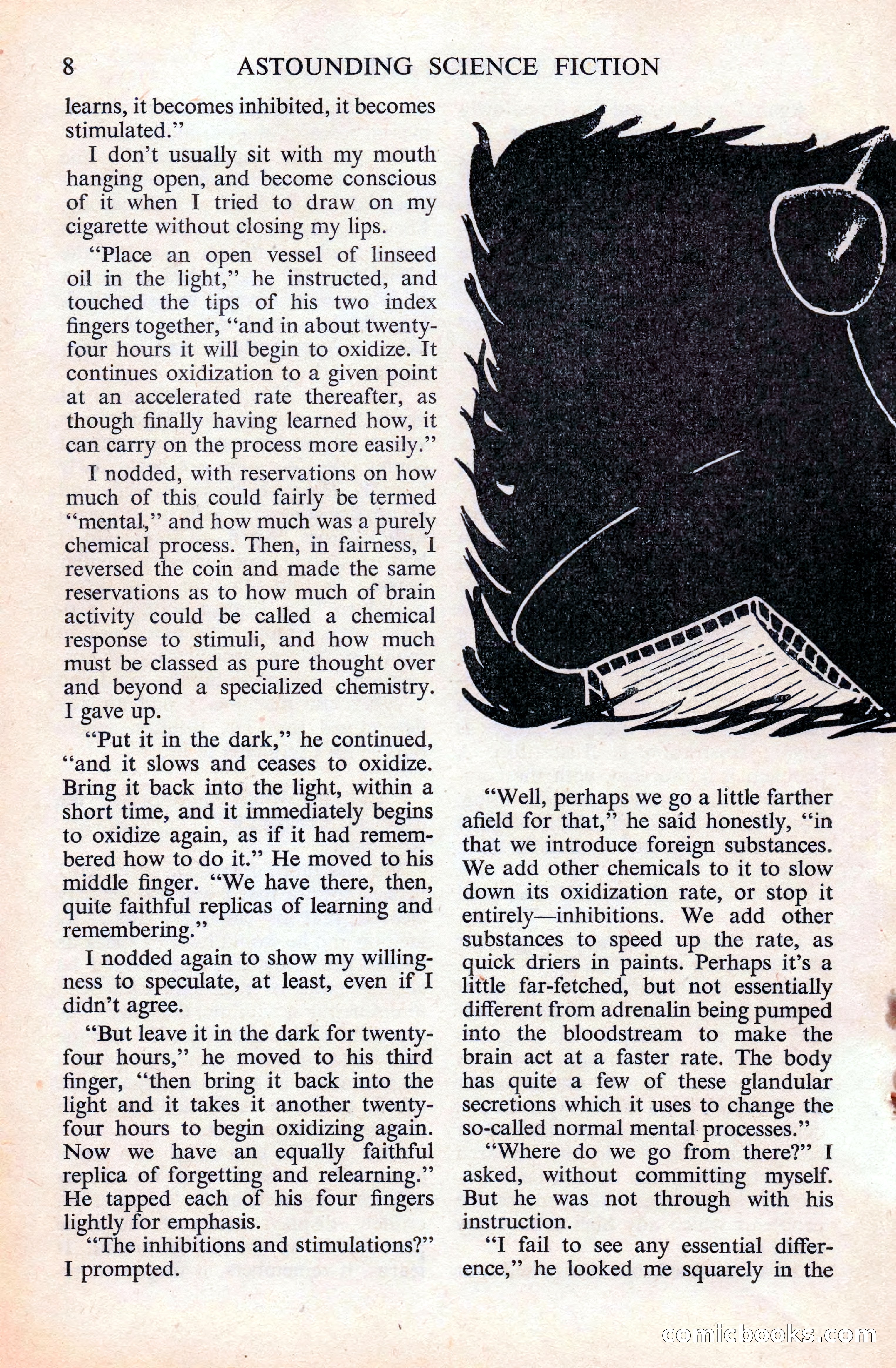
A restored page from Pulp Fiction, 1954. Page through the whole issue in the reader above.
📄 Transcribed text from this page (OCR, searchable)
Machine-transcribed from the original scan — historical spelling and the odd misread are preserved.
8 ASTOUNDING SCIENCE FICTION learns, it becomes inhibited, it becomes stimulated.” I don’t usually sit with my mouth hanging open, and become conscious of it when I tried to draw on my cigarette without closing my lips. “Place an open vessel of linseed oil in the light,” he instructed, and touched the tips of his two index fingers together, ‘‘and in about twenty- four hours it will begin to oxidize. It continues oxidization to a given point at an accelerated rate thereafter, as though finally having learned how, it can carry on the process more easily.”’ I nodded, with reservations on how much of this could fairly be termed “mental,” and how much was a purely chemical process. Then, in fairness, I reversed the coin and made the same reservations as to how much of brain activity could be called a chemical response to stimuli, and how much must be classed as pure thought over and beyond a specialized chemistry. I gave up. ‘Put it in the dark,” he continued, “and it slows and ceases to oxidize. Bring it back into the light, within a . short time, and it immediately begins to oxidize again, as if it had remem- bered how to do it.’’ He moved to his middle finger. ““We have there, then, quite faithful replicas of learning and remembering.” I nodded again to show my willing- ness to speculate, at least, even if I didn’t agree. ‘But leave it in the dark for twenty- four hours,’’ he moved to his third finger, “then bring it back into the light and it takes it another twenty- four hours to begin oxidizing again. Now we have an equally faithful replica of forgetting and relearning.”’ He tapped each of his four fingers lightly for emphasis. “The inhibitions and stimulations?” I prompted. “Well, perhaps we go a little farther afield for that,’ he said honestly, “in that we introduce foreign substances. We add other chemicals to it to slow down its oxidization rate, or stop it entirely—inhibitions. We add other substances to speed up the rate, as quick driers in paints. Perhaps it’s a little far-fetched, but not essentially different from adrenalin being pumped into the bloodstream to make the brain act at a faster rate. The body has quite a few of these glandular secretions which it uses to change the so-called normal mental processes.” ““Where do we go from there?” I asked, without committing myself. But he was not through with his instruction. “I fail to see any essential differ- ence,” he looked me squarely in the conniclbooks.conn