
Pulp Fiction, 1954 · page 105 of 132
Astounding Science Fiction, British Edition — page 105: what you’re looking at
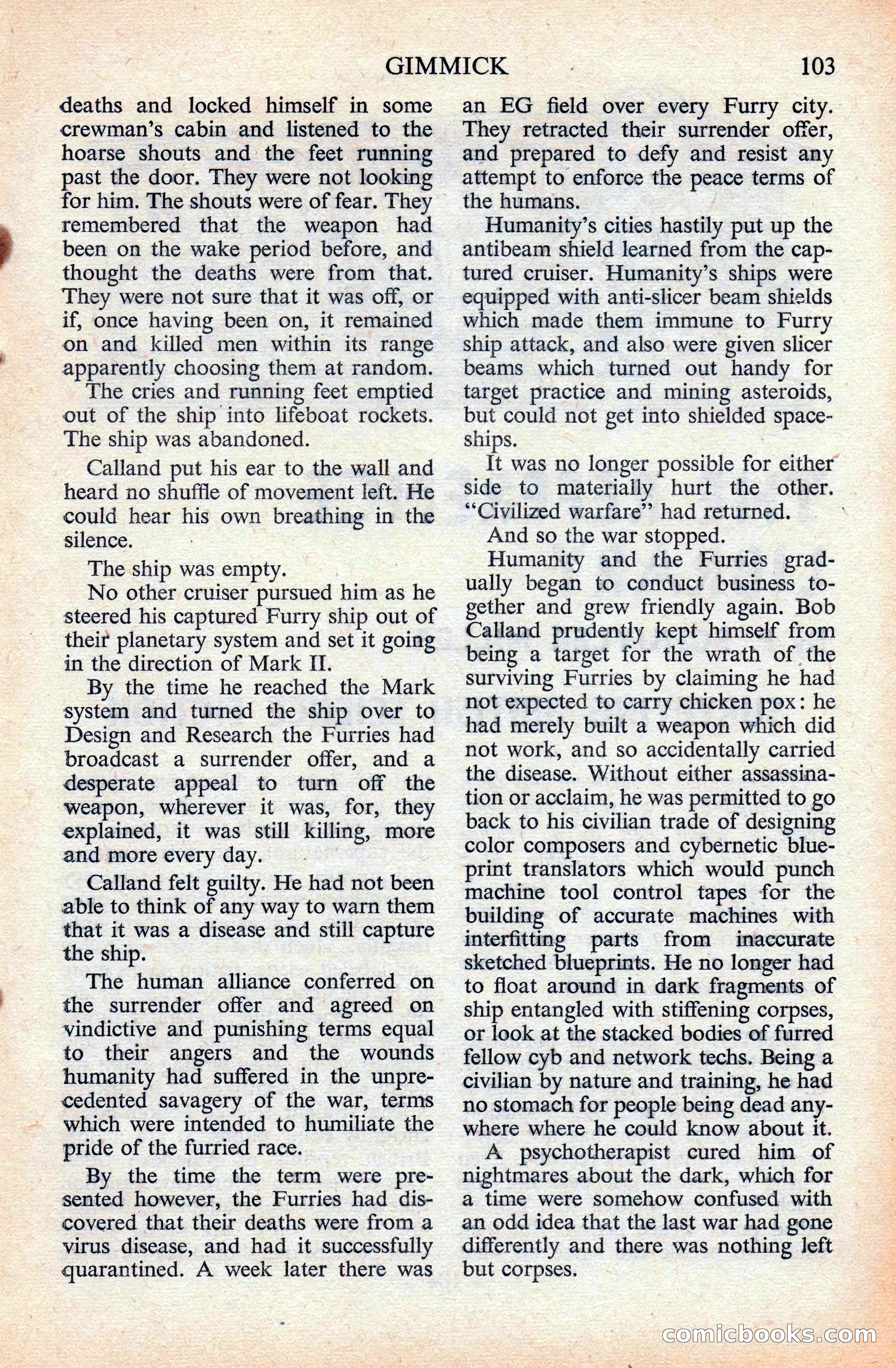
A restored page from Pulp Fiction, 1954. Page through the whole issue in the reader above.
📄 Transcribed text from this page (OCR, searchable)
Machine-transcribed from the original scan — historical spelling and the odd misread are preserved.
GIMMICK / 103 deaths and locked himself in some crewman’s cabin and listened to the hoarse shouts and the feet running past the door. They were not looking for him. The shouts were of fear. They remembered that the weapon had been on the wake period before, and thought the deaths were from that. They were not sure that it was off, or if, once having been on, it remained on and killed men within its range apparently choosing them at random. The cries and running feet emptied out of the ship into lifeboat rockets. The ship was abandoned. Calland put his ear to the wall and heard no shuffle of movement left. He could hear his own breathing in the silence. The ship was empty. No other cruiser pursued him as he steered his captured Furry ship out of their planetary system and set it going in the direction of Mark II. By the time he reached the Mark system and turned the ship over to Design and Research the Furries had broadcast a surrender offer, and a desperate appeal to turn off the weapon, wherever it was, for, they explained, it was still killing, more and more every day. Calland felt guilty. He had not been able to think of any way to warn them that it was a disease and still capture the ship. The human alliance conferred on the surrender offer and agreed on vindictive and punishing terms equal to their angers and the wounds humanity had suffered in the unpre- cedented savagery of the war, terms which were intended to humiliate the pride of the furried race. By the time the term were pre- sented however, the Furries had dis- covered that their deaths were from a virus disease, and had it successfully quarantined. A week later there was an EG field over every Furry city. They retracted their surrender offer, and prepared to defy and resist any attempt to enforce the peace terms of the humans. Humanity’s cities hastily put up the antibeam shield learned from the cap- tured cruiser. Humanity’s ships were equipped with anti-slicer beam shields which made them immune to Furry ship attack, and also were given slicer beams which turned out handy for target practice and mining asteroids, but could not get into shielded space- ships. It was no longer possible for either side to materially hurt the other. “Civilized warfare’ had returned. And so the war stopped. Humanity and the Furries grad- ually began to conduct business to- gether and grew friendly again. Bob Calland prudently kept himself from being a target for the wrath of the surviving Furries by claiming he had not expected to carry chicken pox: he had merely built a weapon which did not work, and so accidentally carried the disease. Without either assassina- tion or acclaim, he was permitted to go back to his civilian trade of designing color composers and cybernetic blue- print translators which would punch machine tool control tapes for the building of accurate machines with interfitting parts from inaccurate sketched blueprints. He no longer had to float around in dark fragments of ship entangled with stiffening corpses, or look at the stacked bodies of furred fellow cyb and network techs. Being a civilian by nature and training, he had no stomach for people being dead any- where where he could know about it. A psychotherapist cured him of nightmares about the dark, which for a time were somehow confused with an odd idea that the last war had gone differently and there was nothing left but corpses. CoOmicdooksico ii